



 Chat with AI
Exam 7: Activity-Based Costing: a Tool to Aid Decision Making

Exam 1: Managerial Accounting and Cost Concepts346 Questions
Exam 2: Job-Order Costing: Calculating Unit Product Costs408 Questions
Exam 3: Job-Order Costing: Cost Flows and External Reporting314 Questions
Exam 4: Process Costing365 Questions
Exam 5: Cost-Volume-Profit Relationships396 Questions
Exam 6: Variable Costing and Segment Reporting: Tools for Management392 Questions
Exam 7: Activity-Based Costing: a Tool to Aid Decision Making382 Questions
Exam 8: Master Budgeting284 Questions
Exam 9: Flexible Budgets and Performance Analysis491 Questions
Exam 10: Standard Costs and Variances469 Questions
Exam 11: Responsibility Accounting Systems335 Questions
Exam 12: Strategic Performance Measurement153 Questions
Exam 13: Differential Analysis: the Key to Decision Making432 Questions
Exam 14: Capital Budgeting Decisions405 Questions
Exam 15: Statement of Cash Flows221 Questions
Exam 16: Financial Statement Analysis327 Questions
Select questions type


Sukhu Corporation's activity-based costing system has three activity cost pools--Fabricating, Setting Up, and Other. The company's overhead costs have already been allocated to these cost pools as follows:
 Costs in the Fabricating cost pool are assigned to products based on machine-hours (MHs) and costs in the Setting Up cost pool are assigned to products based on the number of batches. Costs in the Other cost pool are not assigned to products. The following table shows the machine-hours and number of batches associated with each of the company's two products:
 Required:Calculate activity rates for each activity cost pool using activity-based costing. (Round your answers to 2 decimal places.)
Costs in the Fabricating cost pool are assigned to products based on machine-hours (MHs) and costs in the Setting Up cost pool are assigned to products based on the number of batches. Costs in the Other cost pool are not assigned to products. The following table shows the machine-hours and number of batches associated with each of the company's two products:
Required:Calculate activity rates for each activity cost pool using activity-based costing. (Round your answers to 2 decimal places.) (Essay)
4.9/5  (82)
(82) Mcnamee Corporation's activity-based costing system has three activity cost pools--Fabricating, Setting Up, and Other. Costs in the Fabricating cost pool are assigned to products based on machine-hours (MHs) and costs in the Setting Up cost pool are assigned to products based on the number of batches. Costs in the Other cost pool are not assigned to products. The activity rate for Fabricating is $0.33 per machine-hour; the activity rate for Setting Up is $3.49 per batch. The following table shows the machine-hours and number of batches associated with each of the company's two products:
 Required:Determine the amount of overhead cost that would be assigned to each product using activity-based costing. (Do not round intermediate calculations. Round your final answers to the nearest whole dollar amount.)
 (Essay)
4.7/5 (73)
(73) Time-based activity-based costing does not require extensive interviews with employees to perform stage one allocations.
(True/False)
4.7/5 (88)
(88) Ploof Corporation is conducting a time-driven activity-based costing study in its Customer Service Department. The company has provided the following data to aid in that study: 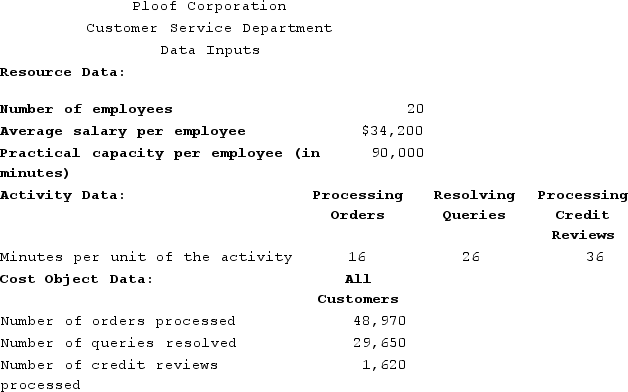 On the Capacity Analysis report in time-driven activity-based costing, the "total minutes used to meet demand" would be closest to:
 (Multiple Choice)
4.9/5 (60)
(60) Imbesi Corporation is conducting a time-driven activity-based costing study in its Customer Service Department. The company has provided the following data to aid in that study: 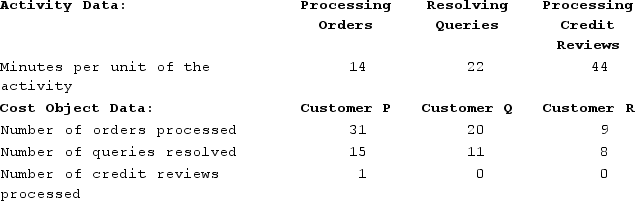 The cost per minute of the resource supplied is $0.36 On the Customer Cost Analysis report in time-driven activity-based costing, the total cost assigned to Customer Q would be closest to:
 (Multiple Choice)
4.7/5 (92)
(92) Mirabile Corporation uses activity-based costing to compute product margins. Overhead costs have already been allocated to the company's three activity cost pools--Processing, Supervising, and Other. The costs in those activity cost pools appear below:  Processing costs are assigned to products using machine-hours (MHs) and Supervising costs are assigned to products using the number of batches. The costs in the Other activity cost pool are not assigned to products. Activity data appear below:
 Finally, sales and direct cost data are combined with Processing and Supervising costs to determine product margins.
 What is the overhead cost assigned to Product M5 under activity-based costing?
Processing costs are assigned to products using machine-hours (MHs) and Supervising costs are assigned to products using the number of batches. The costs in the Other activity cost pool are not assigned to products. Activity data appear below:
Finally, sales and direct cost data are combined with Processing and Supervising costs to determine product margins.
What is the overhead cost assigned to Product M5 under activity-based costing? (Multiple Choice)
4.9/5 (59)
(59) Greife Corporation's activity-based costing system has three activity cost pools--Machining, Setting Up, and Other. The company's overhead costs have already been allocated to these cost pools as follows:
 Costs in the Machining cost pool are assigned to products based on machine-hours (MHs) and costs in the Setting Up cost pool are assigned to products based on the number of batches. Costs in the Other cost pool are not assigned to products. The following table shows the machine-hours and number of batches associated with each of the company's two products:
 Additional data concerning the company's products appears below:
 Required:a. Calculate activity rates for each activity cost pool using activity-based costing.b. Determine the amount of overhead cost that would be assigned to each product using activity-based costing.c. Determine the product margins for each product using activity-based costing.
Costs in the Machining cost pool are assigned to products based on machine-hours (MHs) and costs in the Setting Up cost pool are assigned to products based on the number of batches. Costs in the Other cost pool are not assigned to products. The following table shows the machine-hours and number of batches associated with each of the company's two products:
Additional data concerning the company's products appears below:
Required:a. Calculate activity rates for each activity cost pool using activity-based costing.b. Determine the amount of overhead cost that would be assigned to each product using activity-based costing.c. Determine the product margins for each product using activity-based costing. (Essay)
4.8/5 (80)
(80) Hane Corporation uses the following activity rates from its activity-based costing to assign overhead costs to products:  Data for one of the company's products follow:
 How much overhead cost would be assigned to Product U94W using the activity-based costing system?
Data for one of the company's products follow:
How much overhead cost would be assigned to Product U94W using the activity-based costing system? (Multiple Choice)
4.9/5 (72)
(72) Millner Corporation has provided the following data from its activity-based costing accounting system:  The activity rate for the "designing products" activity cost pool is closest to:
 (Multiple Choice)
4.8/5 (75)
(75) Weissman Corporation manufactures two products: Product E16S and Product P17K. The company is considering implementing an activity-based costing (ABC) system that allocates its manufacturing overhead to four cost pools. The following additional information is available for the company as a whole and for Products E16S and P17K.  Using the ABC system, the percentage of the total overhead cost that is assigned to Product E16S is closest to:
 (Multiple Choice)
4.7/5 (92)
(92) Tomasini Corporation has provided the following data from its activity-based costing accounting system:  Distribution of Resource Consumption across Activity Cost Pools:
 The "Other" activity cost pool consists of the costs of idle capacity and organization-sustaining costs that are not assigned to products.How much supervisory wages and factory supplies cost would NOT be assigned to products using the activity-based costing system?
Distribution of Resource Consumption across Activity Cost Pools:
The "Other" activity cost pool consists of the costs of idle capacity and organization-sustaining costs that are not assigned to products.How much supervisory wages and factory supplies cost would NOT be assigned to products using the activity-based costing system? (Multiple Choice)
4.8/5 (68)
(68) Code Corporation is conducting a time-driven activity-based costing study in its Customer Service Department. The company has provided the following data to aid in that study: 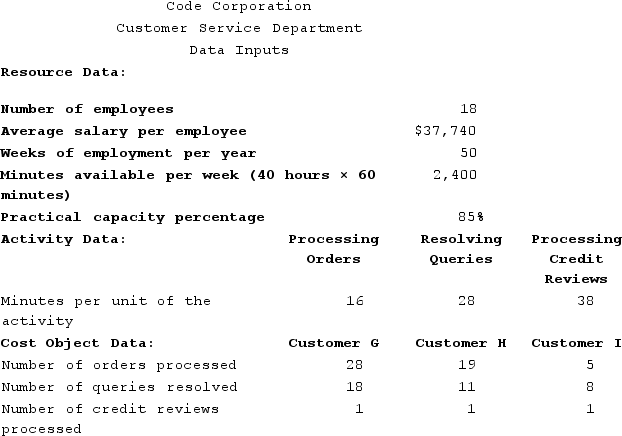 On the Customer Cost Analysis report in time-driven activity-based costing, the Resolving Queries cost assigned to Customer H would be closest to:
 (Multiple Choice)
4.9/5 (79)
(79) Vito Corporation manufactures two products: Product F77I and Product I48D. The company uses a plantwide overhead rate based on direct labor-hours. It is considering implementing an activity-based costing (ABC) system that allocates its manufacturing overhead to four cost pools. The following additional information is available for the company as a whole and for Products F77I and I48D.
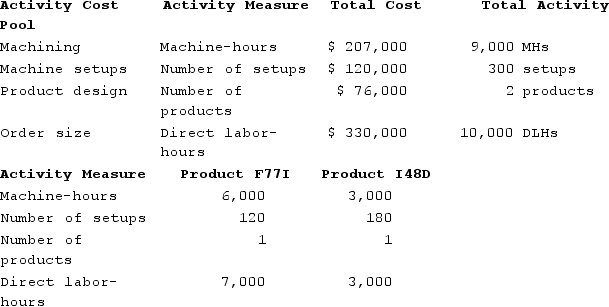 Required:a. What is the company's plantwide overhead rate?b. Using the plantwide overhead rate, how much manufacturing overhead cost would be allocated to Product F77I?c. Using the plantwide overhead rate, what percentage of the total overhead cost is allocated to Product I48D?
 (Essay)
4.9/5 (69)
(69) Schlaefer Corporation is conducting a time-driven activity-based costing study in its Tech Support Department. The company has provided the following data to aid in that study: 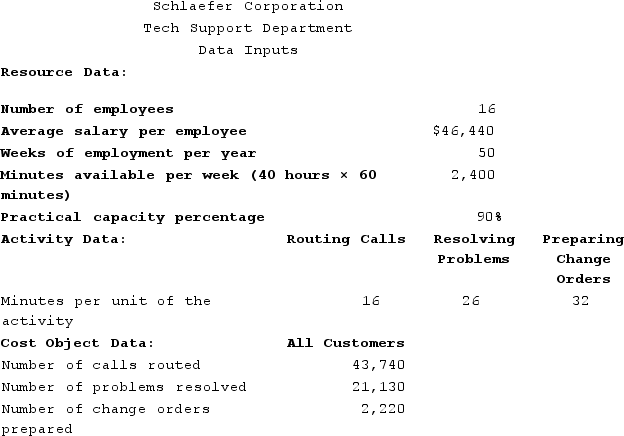 On the Capacity Analysis report in time-driven activity-based costing, the "total minutes used to meet demand" would be closest to:
 (Multiple Choice)
4.9/5 (93)
(93) Meester Corporation has an activity-based costing system with three activity cost pools--Machining, Order Filling, and Other. In the first stage allocations, costs in the two overhead accounts, equipment depreciation and supervisory expense, are allocated to three activity cost pools based on resource consumption. Data used in the first stage allocations follow:  Distribution of Resource Consumption Across Activity Cost Pools:
 Machining costs are assigned to products using machine-hours (MHs) and Order Filling costs are assigned to products using the number of orders. The costs in the Other activity cost pool are not assigned to products. Activity data for the company's two products follow:Activity:
 The activity rate for the Order Filling activity cost pool under activity-based costing is closest to:
Distribution of Resource Consumption Across Activity Cost Pools:
Machining costs are assigned to products using machine-hours (MHs) and Order Filling costs are assigned to products using the number of orders. The costs in the Other activity cost pool are not assigned to products. Activity data for the company's two products follow:Activity:
The activity rate for the Order Filling activity cost pool under activity-based costing is closest to: (Multiple Choice)
5.0/5 (75)
(75) Moorman Corporation has an activity-based costing system with three activity cost pools--Processing, Setting Up, and Other. The company's overhead costs consist of equipment depreciation and indirect labor and are allocated to the cost pools in proportion to the activity cost pools' consumption of resources. Equipment depreciation totals $53,000 and indirect labor totals $3,000. Data concerning the distribution of resource consumption across activity cost pools appear below:
 Required:Assign overhead costs to activity cost pools using activity-based costing.
 (Essay)
4.8/5 (88)
(88) Weimar Corporation is conducting a time-driven activity-based costing study in its Order Fulfillment Department. The company has provided the following data to aid in that study: 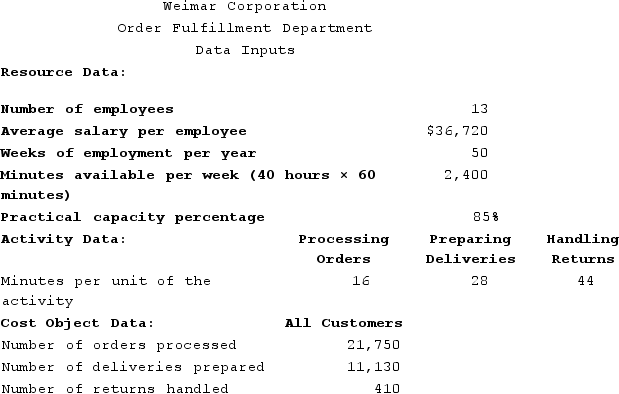 On the Capacity Analysis report in time-driven activity-based costing, the "total minutes used to meet demand" would be closest to:
 (Multiple Choice)
4.8/5 (77)
(77) Spigelmyer Enterprises makes a variety of products that it sells to other businesses. The company's activity-based costing system has four activity cost pools for assigning costs to products and customers. Details concerning thatactivity-based costing system are listed below:
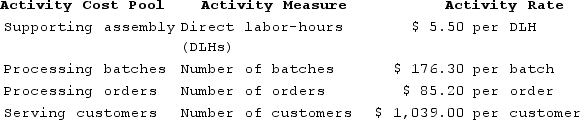 The cost of serving customers, $1,039.00 per customer, is the cost of serving a customer for one year.
Oelschlaeger Corporation buys only one of the company's products which Spigelmyer Enterprises sells for $18.05 per unit. Last year Oelschlaeger Corporation ordered a total of 1,100 units of this product in 2 orders. To fill the orders, 8 batches were required. The direct materials cost is $6.20 per unit and the direct labor cost is $5.70 per unit. Each unit requires 0.30 direct labor-hours.
Required:a. According to theactivity-based costing system, what is the cost of the "Supporting assembly" activity for Oelschlaeger Corporation for the year?b. According to theactivity-based costing system, what is the cost of the "Processing batches" activity for Oelschlaeger Corporation for the year?c. According to theactivity-based costing system, what is the cost of the "Processing orders" activity for Oelschlaeger Corporation for the year?d. According to theactivity-based costing system, what is the cost of the "Servicing customers" activity for Oelschlaeger Corporation for the year?e. What is the customer margin on sales to Oelschlaeger Corporation for the year?
The cost of serving customers, $1,039.00 per customer, is the cost of serving a customer for one year.
Oelschlaeger Corporation buys only one of the company's products which Spigelmyer Enterprises sells for $18.05 per unit. Last year Oelschlaeger Corporation ordered a total of 1,100 units of this product in 2 orders. To fill the orders, 8 batches were required. The direct materials cost is $6.20 per unit and the direct labor cost is $5.70 per unit. Each unit requires 0.30 direct labor-hours.
Required:a. According to theactivity-based costing system, what is the cost of the "Supporting assembly" activity for Oelschlaeger Corporation for the year?b. According to theactivity-based costing system, what is the cost of the "Processing batches" activity for Oelschlaeger Corporation for the year?c. According to theactivity-based costing system, what is the cost of the "Processing orders" activity for Oelschlaeger Corporation for the year?d. According to theactivity-based costing system, what is the cost of the "Servicing customers" activity for Oelschlaeger Corporation for the year?e. What is the customer margin on sales to Oelschlaeger Corporation for the year? (Essay)
4.8/5 (73)
(73) Morine Corporation is conducting a time-driven activity-based costing study in its Customer Service Department. The company has provided the following data to aid in that study: 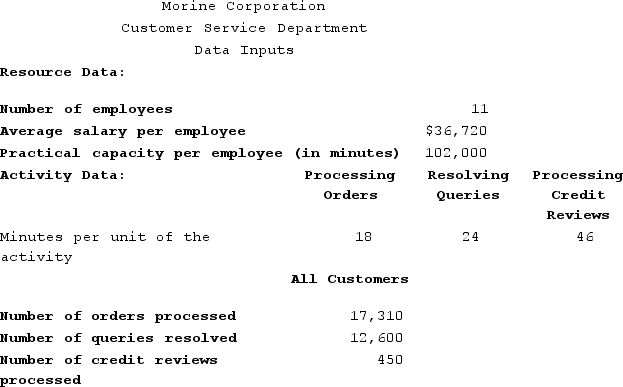 On the Capacity Analysis report in time-driven activity-based costing, the "unused capacity in number of employees" would be closest to:
 (Multiple Choice)
4.8/5 (69)
(69) 
Filters
- Essay(0)
- Multiple Choice(0)
- Short Answer(0)
- True False(0)
- Matching(0)