



 Chat with AI
Exam 16: Supplement A Decision Making

Exam 1: Using Operations to Create Value115 Questions
Exam 2: Process Strategy and Analysis239 Questions
Exam 3: Quality and Performance198 Questions
Exam 4: Capacity Planning120 Questions
Exam 5: Constraint Management136 Questions
Exam 6: Lean Systems166 Questions
Exam 7: Project Management139 Questions
Exam 8: Forecasting150 Questions
Exam 9: Inventory Management205 Questions
Exam 10: Operations Planning and Scheduling149 Questions
Exam 11: Resource Planning124 Questions
Exam 12: Supply Chain Design77 Questions
Exam 13: Supply Chain Logistic Networks114 Questions
Exam 14: Supply Chain Integration120 Questions
Exam 15: Supply Chain Sustainability78 Questions
Exam 16: Supplement A Decision Making107 Questions
Exam 17: Supplement J Operations Scheduling123 Questions
Exam 18: Supplement K Layout39 Questions
Exam 19: Supplement B Waiting Lines111 Questions
Exam 20: Supplement C Special Inventory Models53 Questions
Exam 21: Supplement D Linear Programming87 Questions
Exam 22: Supplement E Simulation54 Questions
Exam 23: Supplement F Financial Analysis55 Questions
Exam 24: Supplement G Acceptance Sampling Plans87 Questions
Exam 25: Supplement H Measuring Output Rates108 Questions
Exam 26: Supplement I Learning Curve Analysis50 Questions
Select questions type


A marketing director must decide among four alternatives for a new marketing campaign. She ascertains that the probability of high demand is 0.45 and the probability of low demand is 0.55. What is the best choice with the payoffs shown in the tree? 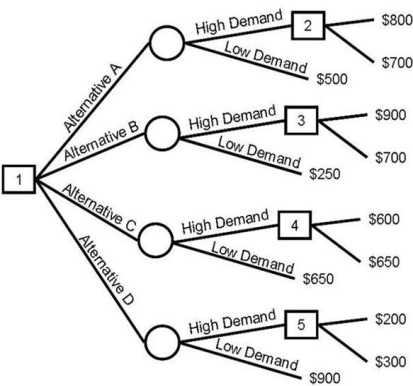
(Multiple Choice)
4.8/5  (66)
(66) The variable cost is the portion of total cost that remains constant regardless of changes in levels of production.
(True/False)
4.8/5 (81)
(81) If the payoff table contains expenses instead of revenues, then the best alternative is the lowest payoff.
(True/False)
4.9/5 (86)
(86) The average probability, P(E), for all branches leaving an event node is 1/n, where n is the number of branches leaving that event node.
(True/False)
4.7/5 (77)
(77) Use the following to answer the questions below.
A company is considering two suppliers for the purchase of a part needed for manufacturing. Particulars are as follows:
 -Refer to the instruction above. For an annual volume of 3,000 units, which supplier should be chosen?
 (Multiple Choice)
5.0/5 (77)
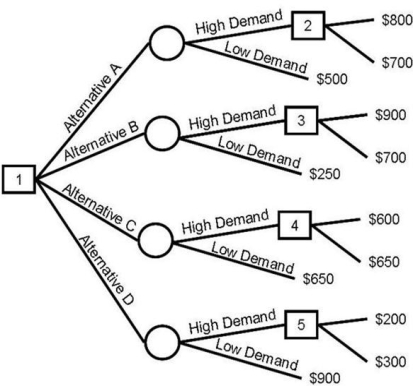
(77) The online courses were already beginning to pay off, Josie thought as she sketched out her first decision tree. All payoffs are in positive dollars and she was confident her estimates were accurate. Clearly, the best choice for her was to choose High Demand.
(True/False)
4.9/5 (70)
(70) A company is screening ideas for new services. Four alternative service ideas are being considered. Management identified four criteria and weighted them as follows: A = 40, B = 30, C = 20, and D = 10. They have also come up with scored values for the five alternatives and the four criteria as shown below. Management has decided that if an alternative has less than a total scored value of 600, it should automatically be rejected. Use the preference matrix technique to determine which idea should be accepted.

(Essay)
4.9/5 (69)
(69) Table A.2
Use the following to answer the questions below.
A company that is introducing a new product has to choose between four different manufacturing methods, referred to as methods A, B, C and D. Depending on the demand for the product, they forecast different levels of expenses for the year (values are in thousands). The company has identified three possible states of nature for economic growth, and named them High, Medium, and Low.
 -Using the information in Table A.2, which alternative is best if further study revealed that the probability of high growth is 0.2, the probability of medium growth is 0.5, and the probability of low growth is 0.3?
 (Multiple Choice)
4.9/5 (74)
(74) Use the following to answer the beekeeping questions below.
A math major turned hipster-beekeeper has determined that his profit is governed by the equation 5x - 40, where x represents the number of hives he sets up for the honey season.
-In the hipster-beekeeper's equation, 5 represents the:
(Multiple Choice)
4.9/5 (72)
(72) An analyst that can't assign probabilities to the events must be engaged in decision-making under ________.
(Short Answer)
4.8/5 (85)
(85) Use the following to answer the questions below.
A company is considering two suppliers for the purchase of a part needed for manufacturing. Particulars are as follows:
-Refer to the instruction above. What does the company save for the year by selecting this low-cost option (for annual requirements of 3,000 units)?
-Refer to the instruction above. What does the company save for the year by selecting this low-cost option (for annual requirements of 3,000 units)? (Multiple Choice)
5.0/5 (73)
(73) Use this scenario to answer the following questions.
A company must decide if it will make or buy an item it needs. The company can make the item for $10 per unit, but must invest $15,000 in tooling to achieve that capability. Alex Rogo has quoted a total price of $12 per unit to supply the quantity required (assume their fixed costs are included in the quoted price).
-Refer to the instruction above. What does the company save for the year by selecting this low-cost option (for annual requirements of 5,000 units)?
(Multiple Choice)
4.7/5 (78)
(78) Given a payoff table in a decision making under risk scenario, what value is derived from applying the following decision rule? Apply all four criteria presented in your book and choose the alternative that is selected more frequently than the others.
(Essay)
4.9/5 (70)
(70) A chance event that has an impact on the outcome of the choice but is not under the manager's control is called a(n) ________.
(Short Answer)
4.7/5 (75)
(75) Pops has a cost function of 3x²-25x + 34,374.74 and a revenue function of 5x². Using Excel (or algebra), determine a break-even point. What is their fixed cost? What is their break-even point in both units and dollar sales?
(Essay)
4.9/5 (77)
(77) Minor Video has opened a new store renting videocassettes. Fixed costs are $60,000, and the variable cost per unit is $1.50. The average sale is $5 per customer. Use the following axes to determine the break-even quantity graphically. Next, refine your solution by solving it algebraically. 
(Multiple Choice)
4.9/5 (74)
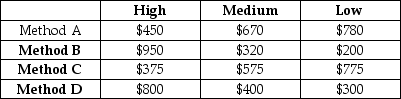
(74) A company that is introducing a new product has to choose between four different manufacturing methods, referred to as methods A, B, C and D. Depending on the demand for the product, they have forecasted different levels of expenses for the year (values are in thousands). The company has identified three possible states of nature for economic growth, and named them High, Medium, and Low. Which alternative is best in accordance with an optimistic outlook? Which alternative is best according to a pessimist?
(Essay)
4.8/5 (75)
(75) Use the following information to answer the questions below.
You currently make a part for old equipment at a cost of $20 / unit. The annual fixed cost for this equipment is $50,000. You have found an outside supplier who will make the part for $15 / unit if you will pay their annual fixed costs of $200,000 / year (see table).
 -Refer to the instruction above. What is the break even quantity between buying and making?
 (Multiple Choice)
4.9/5 (90)
(90) Choosing the alternative that is the best weighted payoff using decision making under uncertainty would be:
(Multiple Choice)
4.7/5 (74)
(74) California Manufacturing, Inc. is now evaluating two new product ideas, and management has decided to apply the preference matrix method. The following table shows five criteria with different weights and individual scores of each product idea. If management has established a threshold of 800, which product(s) should be accepted for further development? 
(Multiple Choice)
4.7/5 (80)
(80) 
Filters
- Essay(0)
- Multiple Choice(0)
- Short Answer(0)
- True False(0)
- Matching(0)