



 Chat with AI
Exam 25: Supplement H Measuring Output Rates

Exam 1: Using Operations to Create Value115 Questions
Exam 2: Process Strategy and Analysis239 Questions
Exam 3: Quality and Performance198 Questions
Exam 4: Capacity Planning120 Questions
Exam 5: Constraint Management136 Questions
Exam 6: Lean Systems166 Questions
Exam 7: Project Management139 Questions
Exam 8: Forecasting150 Questions
Exam 9: Inventory Management205 Questions
Exam 10: Operations Planning and Scheduling149 Questions
Exam 11: Resource Planning124 Questions
Exam 12: Supply Chain Design77 Questions
Exam 13: Supply Chain Logistic Networks114 Questions
Exam 14: Supply Chain Integration120 Questions
Exam 15: Supply Chain Sustainability78 Questions
Exam 16: Supplement A Decision Making107 Questions
Exam 17: Supplement J Operations Scheduling123 Questions
Exam 18: Supplement K Layout39 Questions
Exam 19: Supplement B Waiting Lines111 Questions
Exam 20: Supplement C Special Inventory Models53 Questions
Exam 21: Supplement D Linear Programming87 Questions
Exam 22: Supplement E Simulation54 Questions
Exam 23: Supplement F Financial Analysis55 Questions
Exam 24: Supplement G Acceptance Sampling Plans87 Questions
Exam 25: Supplement H Measuring Output Rates108 Questions
Exam 26: Supplement I Learning Curve Analysis50 Questions
Select questions type


Table H.2
 -Use the information in Table H.2. If the allowance for this task is 20 percent, what is the standard time for the entire task?
 (Multiple Choice)
4.9/5  (80)
(80) A predetermined data approach to time standards can be completed only after actual production begins.
(True/False)
4.9/5 (74)
(74) The key to creating a work standard is defining normal performance.
(True/False)
4.8/5 (88)
(88) An analyst divides each work element into a series of micro-motions common to a variety of tasks when using the ________.
(Short Answer)
4.9/5 (78)
(78) The method used most often for setting time standards for a job is the:
(Multiple Choice)
5.0/5 (67)
(67) At a new watch assembly plant, a job is divided into three work elements. The element times for the first four cycles are recorded by the continuous method and are presented below along with a performance rating factor (RF) for each element.  The standard time for this job, assuming that the allowance is 18 percent, is:
 (Multiple Choice)
4.9/5 (80)
(80) Which one of the following statements about work measurement methods is True?
(Multiple Choice)
4.9/5 (69)
(69) Table H.3
A worker was observed for four cycles in a repetitive task. The observer recorded the following times, in seconds, using the continuous method. The ratings for each element and frequency it is performed are also indicated in the table. The allowance fraction is 20 percent.
 -Use the information in Table H.3. What is the standard time for the complete cycle?
 (Multiple Choice)
4.8/5 (81)
(81) The predetermined data approach does not eliminate the need for time studies.
(True/False)
5.0/5 (87)
(87) When using work sampling, the times of day to collect data samples are selected at random over the length of the study.
(True/False)
4.8/5 (80)
(80) A work sampling method is used to determine the proportion of the time a worker is idle. The following information was gathered on a random basis. 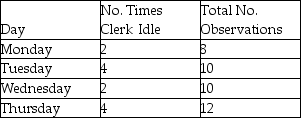 If the manager wants a 95 percent confidence level (z = 1.96) and a degree of precision of + 0.03, how many more observations are needed?
 (Multiple Choice)
4.8/5 (80)
(80) The standard time for a work element is found by multiplying the select time by a performance rating factor.
(True/False)
4.8/5 (80)
(80) A larger sample size is required when the job being studied is shorter in average duration.
(True/False)
4.7/5 (79)
(79) The most commonly used method for setting a time standard is called a(n) ________.
(Short Answer)
4.8/5 (86)
(86) The methods time measurement system is a predetermined data system.
(True/False)
4.8/5 (69)
(69) A time study is the method most often used for setting time standards for a job.
(True/False)
5.0/5 (95)
(95) 
Filters
- Essay(0)
- Multiple Choice(0)
- Short Answer(0)
- True False(0)
- Matching(0)