



 Chat with AI
Exam 6: Accounting for Long-Term Operational Assets

Exam 1: An Introduction to Accounting204 Questions
Exam 2: Accounting for Accruals and Deferrals157 Questions
Exam 3: Accounting for Merchandising Businesses38 Questions
Exam 4: Internal Controls, Accounting for Cash, and Ethics38 Questions
Exam 5: Accounting for Receivables and Inventory Cost Flow57 Questions
Exam 6: Accounting for Long-Term Operational Assets157 Questions
Exam 7: Accounting for Liabilities208 Questions
Exam 8: Proprietorships, Partnerships, and Corporations144 Questions
Exam 9: Financial Statement Analysis172 Questions
Exam 10: An Introduction to Management Accounting155 Questions
Exam 11: Cost Behavior, Operating Leverage, and Profitability Analysis43 Questions
Exam 12: Cost Accumulation, Tracing, and Allocation211 Questions
Exam 13: Relevant Information for Special Decisions137 Questions
Exam 14: Planning for Profit and Cost Control156 Questions
Exam 15: Performance Evaluation162 Questions
Exam 16: Planning for Capital Investments172 Questions
Select questions type


When Company X purchases Company Y, X should record Y's assets at their fair market value at the time of the acquisition.
(True/False)
4.9/5  (78)
(78) Explain how the gain or loss is computed on the sale of a piece of equipment.
(Essay)
4.9/5 (89)
(89) Chubb Company paid cash to purchase equipment on January 1, Year 1. Select the answer that shows how the recognition of depreciation expense in Year 2 would affect the financial statements (+ means increase, − decrease, and NA not affected). 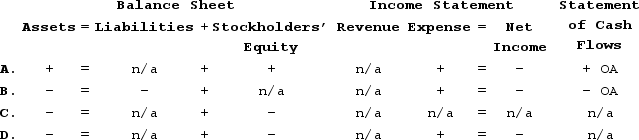
(Multiple Choice)
4.9/5 (80)
(80) On January 1, Year 1, Stewart Corporation purchased equipment for $120,000. A discount of 2% was granted on the equipment; the shipping terms were Free On Board shipping point, and the freight cost was $3,000. Installation and testing costs amounted to $4,000. The equipment had an estimated useful life of 4 years and salvage value of $10,000. At the beginning of Year 3, Stewart revised the expected life of the asset to six years and the salvage value to $12,000. Required:
Compute the depreciation expense using straight-line method for each of the six years.
(Essay)
5.0/5 (73)
(73) On January 1, Year 1, Friedman Company purchased a truck that cost $29,000. The truck had an expected useful life of 8 years and a $7,000 salvage value. The company uses the double-declining balance method. The book value of the truck at the end of Year 1 is: (Do not round intermediate calculations.)
(Multiple Choice)
4.9/5 (74)
(74) A substantial amount spent to improve the quality or extend the life of a long-term asset is called a revenue expenditure.
(True/False)
4.8/5 (82)
(82) On January 1, Year 1, Eller Company purchased an asset that had cost $24,000. The asset had an 8-year useful life and an estimated salvage value of $1,000. Eller depreciates its assets on the straight-line basis. On January 1, Year 5, the company spent $6,000 to improve the quality of the asset. Based on this information, the recognition of depreciation expense in Year 5 would:
(Multiple Choice)
4.9/5 (86)
(86) With an accelerated depreciation method, an asset can be depreciated below its salvage value.
(True/False)
4.8/5 (75)
(75) Indicate how each event affects the horizontal financial statements model. Use the following letters to record your answer in the box shown below. If an event increases one account and decreases another account equally within the same element, record I/D. If an event has no impact on the element, record NA. You do not need to enter amounts.Increase = IDecrease = DNot Affected = NAThe Jenkins Company purchased equipment for $25,000 on January 1, Year 1. The equipment had an estimated useful life of four years and an estimated salvage value of $5,000. At the beginning of Year 3, the equipment was sold for $8,000. Show how the sale affected the financial statements for Year 3, assuming Jenkins uses straight-line depreciation.

(Essay)
4.7/5 (86)
(86) On January 1, Year 1, Stiller Company paid $288,000 to obtain a patent. Stiller expected to use the patent for 5 years before it became technologically obsolete. The remaining legal life of the patent was 8 years. Based on this information, the amount of amortization expense on the December 31, Year 3 income statement and the book value of the patent on the December 31, Year 3, balance sheet, respectively, would be:
(Multiple Choice)
4.9/5 (81)
(81) Which of the following statements is correct regarding accounting treatment of goodwill?
(Multiple Choice)
5.0/5 (86)
(86) Farmer Company purchased equipment on January 1, Year 1 for $82,000. The equipment is estimated to have a 5-year life and a salvage value of $4,000. The company uses the straight-line depreciation method. At the beginning of Year 4, Farmer revised the expected life to eight years. The annual amount of depreciation expense for each of the remaining years would be:
(Multiple Choice)
4.8/5 (89)
(89) On January 1, Year 1, Stiller Company paid $80,000 to obtain a patent. Stiller expected to use the patent for 5 years before it became technologically obsolete. The remaining legal life of the patent was 8 years. Based on this information, the amount of amortization expense on the December 31, Year 3 income statement and the book value of the patent on the December 31, Year 3, balance sheet, respectively, would be:
(Multiple Choice)
4.8/5 (73)
(73) Which of the following is considered an accelerated depreciation method?
(Multiple Choice)
4.9/5 (92)
(92) On January 1, Year 1, Missouri Company purchased a truck that cost $47,000. The truck had an expected useful life of 10 years and a $5,000 salvage value. The amount of depreciation expense recognized in Year 2 assuming that Missouri uses the double declining-balance method is:
(Multiple Choice)
4.8/5 (84)
(84) The purchase of a new delivery truck for cash is an asset use transaction.
(True/False)
5.0/5 (89)
(89) What term is used to describe the situation where there is a permanent decline in the value of an intangible asset?
(Multiple Choice)
4.9/5 (101)
(101) The depreciable cost of a long-term asset is the difference between the amount paid for the asset and its salvage value.
(True/False)
4.8/5 (82)
(82) 
Filters
- Essay(0)
- Multiple Choice(0)
- Short Answer(0)
- True False(0)
- Matching(0)