



 Chat with AI
Exam 5: Audit Evidence

Exam 1: The Demand for Audit and Other Assurance Services72 Questions
Exam 2:The Public Accounting Profession and Audit Quality76 Questions
Exam 3: Professional Ethics and Legal Liability105 Questions
Exam 4: Audit Responsibilities and Objectives79 Questions
Exam 5: Audit Evidence91 Questions
Exam 6: Client Acceptance,Planning,and Materiality73 Questions
Exam 7: Assessing the Risk of Material Misstatement62 Questions
Exam 8: Internal Control and COSO Framework53 Questions
Exam 9: Assessing Control Risk and Designing Test of Controls37 Questions
Exam 10: Develop Risk Response: Audit Strategy and Audit Program75 Questions
Exam 11: Audit Sampling Concepts78 Questions
Exam 12: Audit of the Revenue Cycle138 Questions
Exam 13: Audit of the Acquisition and Payment Cycle78 Questions
Exam 14: Audit of the Inventory and Distribution Cycle75 Questions
Exam 15: Audit of the Human Resources and Payroll Cycle74 Questions
Exam 16: Audit of the Capital Acquisition and Repayment Cycle73 Questions
Exam 17: Audit of Cash Balances68 Questions
Exam 18: Completing the Audit74 Questions
Exam 19: Audit Reports on Financial Statements82 Questions
Exam 20: Other Assurance and Nonassurance Services64 Questions
Select questions type


Those procedures specifically outlined in an audit program are primarily designed to
(Multiple Choice)
4.8/5  (67)
(67) The audit evidence gathering technique of recalculation refers to
(Multiple Choice)
4.8/5 (74)
(74) Audit evidence can come in different forms with different degrees of persuasiveness.Which of the following is the least persuasive type of evidence?
(Multiple Choice)
4.9/5 (81)
(81) Evidence is usually more persuasive for balance sheet accounts when it is obtained
(Multiple Choice)
4.9/5 (87)
(87) Which of the following is the best example of objective evidence?
(Multiple Choice)
4.9/5 (78)
(78) Observation is an important audit technique where the auditor can use sight,hearing,touch,and smell.Observation needs to be used together with other audit techniques because
(Multiple Choice)
4.9/5 (75)
(75) List the various judgments and conclusions that auditors make with the help of evidence gathered in all phases of the audit process.-to accept (or continue with)the client.
-to plan the audit.
-to decide where there could be a risk of material misstatement in the financial statements.
-to develop an appropriate risk response.
-to conclude on the type of audit report to be issued.
(Essay)
4.9/5 (96)
(96) The audit of Simcoe Transports Inc.was completed three months ago,so the PA firm proceeded to the file archive stage in accordance with Canadian Audit Standards.If the audit firm receives additional information related to the audit but the information does not affect the audit conclusions,the information should be
(Multiple Choice)
4.9/5 (83)
(83) Identify the factors that would potentially lead the auditors to obtain more audit evidence after the initial appropriate risk assessment procedures?
(Essay)
4.8/5 (80)
(80) A)Distinguish between internal documentation and external documentation as types of audit evidence.Give two examples of each.Which type is considered more reliable? B)Below are 10 documents typically examined by auditors.Classify each document as either internal or external.
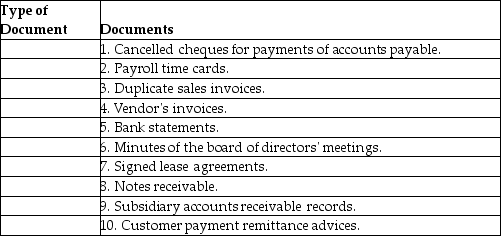
(Essay)
4.8/5 (76)
(76) Most auditors prefer to replace external confirmation with analytical procedures whenever possible because the
(Multiple Choice)
4.7/5 (76)
(76) Renaldo compared shipping reports to sales documents,checking to see that the sales invoice dates matched the shipping dates,and that quantities invoiced matched quantities shipped.On his working paper,he said that he vouched invoices.What else should his working paper include with respect to the audit procedure conducted?
(Multiple Choice)
4.9/5 (75)
(75) List and explain the three times during an audit engagement the auditor performs analytical procedures.
(Essay)
4.9/5 (87)
(87) In determining the quantity and quality of evidence to gather,the auditor will be satisfied when the evidence is
(Multiple Choice)
4.8/5 (78)
(78) A)There are four important purposes of analytical procedures.Identify each of these four purposes and for each purpose give a specific example of an analytical procedure that an auditor might perform.B)Identify each of the five major types of analytical procedures and give an example of each.C)One purpose of performing analytical procedures in the planning phase of an audit is to assess the client's financial condition.Explain how the assessment of a client's financial condition can affect the auditor's decisions concerning evidence accumulation in later phases of the audit.
(Essay)
4.7/5 (78)
(78) An example of a document that the auditor receives from the client,but which was prepared by someone outside the client's organization,is a(n)
(Multiple Choice)
4.9/5 (86)
(86) 
Filters
- Essay(0)
- Multiple Choice(0)
- Short Answer(0)
- True False(0)
- Matching(0)