



 Chat with AI
Exam 2: Parallel Lines

Exam 1: Line and Angle Relationships13 Questions
Exam 2: Parallel Lines13 Questions
Exam 3: Triangles16 Questions
Exam 4: Quadrilaterals14 Questions
Exam 5: Similar Triangles12 Questions
Exam 6: Circles10 Questions
Exam 7: Locus and Concurrence4 Questions
Exam 8: Areas of Polygons and Circles5 Questions
Exam 9: Surfaces and Solids4 Questions
Exam 10: Analytical Geometry8 Questions
Exam 11: Introduction to Trigonometry4 Questions
Exam 12: Geometry Problems: Complementary Angles, Collinear Points, and Similar Triangles916 Questions
Select questions type


Use an indirect proof to complete the following problem.
Given:  (not shown)
Prove:
 and
 cannot both be right angles.
(not shown)
Prove: and cannot both be right angles.
Free
(Essay)
5.0/5  (71)
(71) Correct Answer: Verified
Suppose that  and
 are both be right angles. Then
 and
 .
By the Protractor Postulate,  . Then
 . But this last
statement contradicts the fact that the sum of teh three interior angles of a triangle is exactly 180. Thus, the supposition must be false and it follows that  and
 cannot both be right angles.
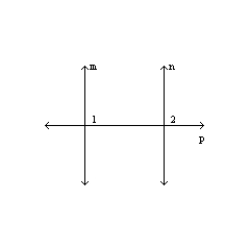 -Supply missing statements and missing reasons for the following proof.
Given:
 and transversal p;
 is a right angle
Prove:
 is a right angle
S1.
 and transversal p R1.
S2.
 R2.
S3. R3. Congruent measures have equal measures.
S4.
 R4.
S5. R5. Substitution Property of Equality
S6. R6. Definition of a right angle
-Supply missing statements and missing reasons for the following proof.
Given: and transversal p; is a right angle
Prove: is a right angle
S1. and transversal p R1.
S2. R2.
S3. R3. Congruent measures have equal measures.
S4. R4.
S5. R5. Substitution Property of Equality
S6. R6. Definition of a right angleFree
(Essay)
4.9/5 (85)
(85) Correct Answer:Verified
VerifiedR1. Given
R2. If 2 parallel lines are cut by a trans, corresponding angles are congruent.
S3.  R4. Given
S5.  S6.
 is a right angle
Use an indirect proof to complete the following problem.
Given:  and
 are supplementary (no drawing)
Prove:
 and
 are not both obtuse angles.
and are supplementary (no drawing)
Prove: and are not both obtuse angles.Free
(Essay)
4.9/5 (79)
(79) Correct Answer:Verified
VerifiedSuppose that  and
 are both obtuse angles. Then
 and
 .
It follows that  . But it is given that
 and
 are supplementary, so that
 .
With a contradiction of the known fact, it follows that the supposition must be false; thus,  and
 are not both obtuse angles.
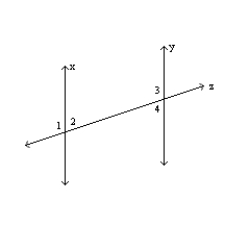 -Supply missing statements and reasons for the foloowing proof.
Given:
 is supplementary to
 Prove:
 S1. R1.
S2.
 is supp. to
 R2. If the ext. sides of 2 adj. angles form a line, the angles are supp.
S3. R3. Angles supp. to the same angle are congruent.
S4. R4.
-Supply missing statements and reasons for the foloowing proof.
Given: is supplementary to Prove: S1. R1.
S2. is supp. to R2. If the ext. sides of 2 adj. angles form a line, the angles are supp.
S3. R3. Angles supp. to the same angle are congruent.
S4. R4. (Essay)
4.9/5 (81)
(81) 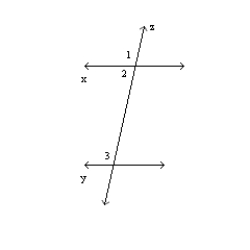 -In the figure, x || y and transversal z. Explain why
 and
 must be supplementary.
-In the figure, x || y and transversal z. Explain why and must be supplementary. (Essay)
4.9/5 (77)
(77) Explain the following statement.
The measure of each interior angle of an equiangular triangle is 60.
(Essay)
4.9/5 (86)
(86) 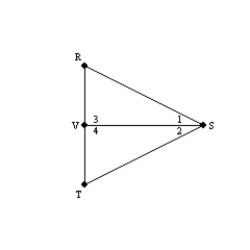 -Supply missing statements and missing reasons for the following proof.
Given:
 so that
 bisects
 ;
also,
 Prove:
 S1.
 so that
 bisects
 R1.
S2. R2.
S3. R3. Given
S4. R4. If 2 angles of one triangle are congruent to
2 angles of a second triangle, then the third angles
of these triangles are also congruent.
-Supply missing statements and missing reasons for the following proof.
Given: so that bisects ;
also, Prove: S1. so that bisects R1.
S2. R2.
S3. R3. Given
S4. R4. If 2 angles of one triangle are congruent to
2 angles of a second triangle, then the third angles
of these triangles are also congruent. (Essay)
4.7/5 (70)
(70) 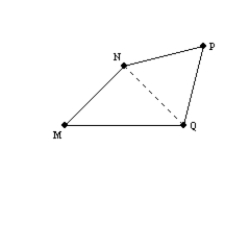 -Using the drawing provided, explain the following statement.
The sum of the interior angles of a quadrilateral is 360.
-Using the drawing provided, explain the following statement.
The sum of the interior angles of a quadrilateral is 360. (Essay)
4.8/5 (83)
(83) 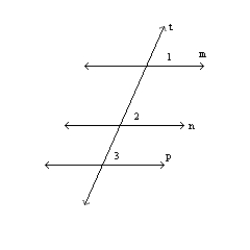 -Supply missing statements in the following proof.
Given:
 and
 Prove:
 S1. R1. Given
S2. R2. If 2 parallel lines are cut by a transversal, corr. angles are congruent.
S3. R3. Given
S4. R4. Same as #2.
S5. R5. Transitive Property of Congruence
S6. R6. If 2 lines are cut by a transversal so that corresponding angles
are congruent, then these lines are parallel.
-Supply missing statements in the following proof.
Given: and Prove: S1. R1. Given
S2. R2. If 2 parallel lines are cut by a transversal, corr. angles are congruent.
S3. R3. Given
S4. R4. Same as #2.
S5. R5. Transitive Property of Congruence
S6. R6. If 2 lines are cut by a transversal so that corresponding angles
are congruent, then these lines are parallel. (Essay)
4.8/5 (69)
(69) 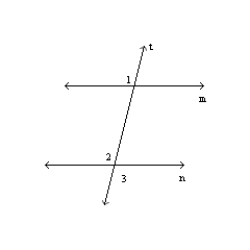 -Supply missing reasons for this proof.
Given: m || n
Prove:
 S1. m || n R1.
S2.
 R2.
S3.
 R3.
S4.
 R4.
-Supply missing reasons for this proof.
Given: m || n
Prove: S1. m || n R1.
S2. R2.
S3. R3.
S4. R4. (Essay)
4.9/5 (76)
(76) 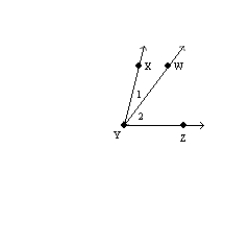 -Use an indirect proof to complete the following problem.
Given:
 is not congruent to
 Prove:
 does not bisect

-Use an indirect proof to complete the following problem.
Given: is not congruent to Prove: does not bisect (Essay)
4.8/5 (74)
(74) 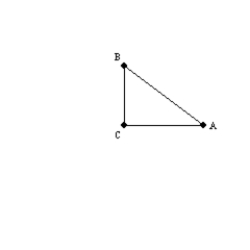 -In the triangle shown,
 is a right angle.Explain why
 and
 are complementary.
-In the triangle shown, is a right angle.Explain why and are complementary. (Essay)
4.7/5 (72)
(72) 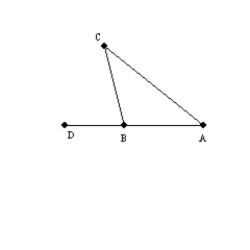 -Supply missing reasons for the following proof.
Given:
 with D-B-A
Prove:
 S1.
 with D-B-A R1.
S2.
 R2.
S3.
 and
 are supp. R3.
S4.
 R4.
S5.
 R5.
S6.
 R6.
-Supply missing reasons for the following proof.
Given: with D-B-A
Prove: S1. with D-B-A R1.
S2. R2.
S3. and are supp. R3.
S4. R4.
S5. R5.
S6. R6. (Essay)
4.8/5 (72)
(72) 
Filters
- Essay(0)
- Multiple Choice(0)
- Short Answer(0)
- True False(0)
- Matching(0)