



 Chat with AI
Exam 16: Working Capital Management

Exam 1: An Overview of Financial Management and the Financial Environment38 Questions
Exam 2: Financial Statements, Cash Flow, and Taxes3 Questions
Exam 3: Analysis of Financial Statements104 Questions
Exam 4: Time Value of Money139 Questions
Exam 5: Bonds, Bond Valuation, and Interest Rates100 Questions
Exam 6: Risks and Rates of Return132 Questions
Exam 7: Stocks and Their Valuation48 Questions
Exam 8: Financial Options and Applications in Corporate Finance22 Questions
Exam 9: The Cost of Capital87 Questions
Exam 10: The Basics of Capital Budgeting98 Questions
Exam 11: Cash Flow Estimation and Risk Analysis66 Questions
Exam 12: Financial Planning and Forecasting Financial Statements46 Questions
Exam 13: Corporate Valuation, Value-Based Management, and Corporate Governance24 Questions
Exam 14: Distributions to Shareholders: Dividends and Repurchases26 Questions
Exam 15: Capital Structure Decisions70 Questions
Exam 16: Working Capital Management129 Questions
Exam 17: Multinational Financial Management39 Questions
Exam 18: Lease Financing20 Questions
Exam 19: Hybrid Financing: Preferred Stock, Warrants, and Convertibles27 Questions
Exam 20: Initial Public Offerings, Investment Banking, and Financial Restructuring22 Questions
Exam 21: Mergers, Lbos, Divestitures, and Holding Companies41 Questions
Exam 22: Bankruptcy, Reorganization, and Liquidation8 Questions
Exam 23: Derivatives and Risk Management14 Questions
Exam 24: Portfolio Theory, Asset Pricing Models, and Behavioral Finance25 Questions
Exam 25: Real Options15 Questions
Exam 26: Analysis of Capital Structure Theory27 Questions
Exam 27: Providing and Obtaining Credit31 Questions
Exam 28: Advanced Issues in Cash Management and Inventory Control20 Questions
Exam 29: Pension Plan Management9 Questions
Exam 30: Financial Management in Not-For-Profit Businesses10 Questions
Select questions type


The risk to the firm of borrowing using short-term credit is usually greater than if it used long-term debt. Added risk stems from (1) the greater variability of interest costs on short-term than long-term debt and (2) the fact that even if its long-term prospects are good, the firm's lenders may not be willing to renew short-term loans if the firm is temporarily unable to repay those loans.
(True/False)
4.8/5  (68)
(68) Cass & Company has the following data. What is the firm's cash conversion cycle? 
(Multiple Choice)
4.7/5 (80)
(80) Short-term marketable securities are held for two separate and distinct purposes: (1) to provide liquidity as a substitute for cash and (2) as a non-operating investment. Marketable securities held while awaiting reinvestment are not available for liquidity purposes.
(True/False)
5.0/5 (70)
(70) Your company has been offered credit terms of 4/30, net 90 days. What will be the nominal annual percentage cost of its non-free trade credit if it pays 120 days after the purchase? (Assume a 365-day year.)
(Multiple Choice)
4.9/5 (90)
(90) If a firm busy on terms of 2/10 net 30, it should pay as early as possible during the discount period.
(True/False)
4.9/5 (81)
(81) If one of your firm's customers is "stretching" its accounts payable, this may be a nuisance but it does not represent a real financial cost to your firm as long as the customer periodically pays off its entire balance.
(True/False)
4.9/5 (78)
(78) Your consulting firm was recently hired to improve the performance of Shin-Soenen Inc, which is highly profitable but has been experiencing cash shortages due to its high growth rate. As one part of your analysis, you want to determine the firm's cash conversion cycle. Using the following information and a 365-day year, what is the firm's present cash conversion cycle?
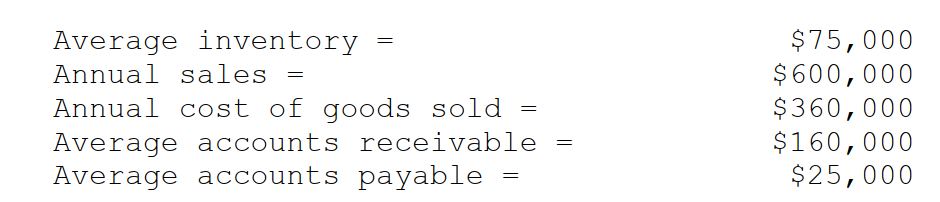
(Multiple Choice)
4.7/5 (73)
(73) If a firm takes actions that reduce its days sales outstanding (DSO), then, other things held constant, this will lengthen its cash conversion cycle (CCC).
(True/False)
4.9/5 (78)
(78) A firm buys on terms of 3/15, net 45. It does not take the discount, and it generally pays after 60 days. What is the nominal annual percentage cost of its non-free trade credit, based on a 365-day year?
(Multiple Choice)
4.8/5 (71)
(71) Zervos Inc. had the following data for 2008 (in millions). The new CFO believes (1) that an improved inventory management system could lower the average inventory by $4,000, (2) that improvements in the credit department could reduce receivables by $2,000, and (3) that the purchasing department could negotiate better credit terms and thereby increase accounts payable by $2,000. Furthermore, she thinks that these changes would not affect either sales or the costs of goods sold. If these changes were made, by how many days would the cash conversion cycle be lowered? 
(Multiple Choice)
4.8/5 (77)
(77) If the yield curve is upward sloping, then short-term debt will be cheaper than long-term debt. Thus, if a firm's CFO expects the yield curve to continue to have an upward slope, this would tend to cause the current ratio to be relatively low, other things held constant.
(True/False)
4.8/5 (82)
(82) The maturity of most bank loans is short term. Bank loans to businesses are frequently made as 90-day notes which are often rolled over, or renewed, rather than repaid when they mature. However, if the borrower's financial situation deteriorates, then the bank may refuse to roll over the loan.
a. True
b. False
(True/False)
4.9/5 (74)
(74) Which of the following is NOT directly reflected in the cash budget of a firm that is in the zero tax bracket?
(Multiple Choice)
4.9/5 (78)
(78) Madura Inc. wants to increase its free cash flow by $180 million during the coming year, which should result in a higher EVA and stock price. The CFO has made these projections for the upcoming year:
EBIT is projected to equal $850 million.
Gross capital expenditures are expected to total to $360 million versus depreciation of $120 million, so its net capital expenditures should total $240 million.
The tax rate is 40%.
There will be no changes in cash or marketable securities, nor will there be any changes in notes payable or accruals.
What increase in net working capital (in millions of dollars) would enable the firm to meet its target increase in FCF?
(Multiple Choice)
4.9/5 (89)
(89) Romano Inc. has the following data. What is the firm's cash conversion cycle? 
(Multiple Choice)
4.8/5 (82)
(82) Short-term financing is riskier than long-term financing since, during periods of tight credit, the firm may not be able to rollover (renew) its debt. This is especially true if the funds are used to finance long-term assets rather than short-term assets.
(True/False)
4.8/5 (77)
(77) Uncertainty about the exact lives of assets prevents precise maturity matching in an ex post (i.e., after the fact) sense even though it is possible to match maturities on an ex ante (expected) basis.
(True/False)
4.8/5 (72)
(72) 
Filters
- Essay(0)
- Multiple Choice(0)
- Short Answer(0)
- True False(0)
- Matching(0)