



 Chat with AI
Exam 3: Analysis of Financial Statements

Exam 1: An Overview of Financial Management and the Financial Environment38 Questions
Exam 2: Financial Statements, Cash Flow, and Taxes3 Questions
Exam 3: Analysis of Financial Statements104 Questions
Exam 4: Time Value of Money139 Questions
Exam 5: Bonds, Bond Valuation, and Interest Rates100 Questions
Exam 6: Risks and Rates of Return132 Questions
Exam 7: Stocks and Their Valuation48 Questions
Exam 8: Financial Options and Applications in Corporate Finance22 Questions
Exam 9: The Cost of Capital87 Questions
Exam 10: The Basics of Capital Budgeting98 Questions
Exam 11: Cash Flow Estimation and Risk Analysis66 Questions
Exam 12: Financial Planning and Forecasting Financial Statements46 Questions
Exam 13: Corporate Valuation, Value-Based Management, and Corporate Governance24 Questions
Exam 14: Distributions to Shareholders: Dividends and Repurchases26 Questions
Exam 15: Capital Structure Decisions70 Questions
Exam 16: Working Capital Management129 Questions
Exam 17: Multinational Financial Management39 Questions
Exam 18: Lease Financing20 Questions
Exam 19: Hybrid Financing: Preferred Stock, Warrants, and Convertibles27 Questions
Exam 20: Initial Public Offerings, Investment Banking, and Financial Restructuring22 Questions
Exam 21: Mergers, Lbos, Divestitures, and Holding Companies41 Questions
Exam 22: Bankruptcy, Reorganization, and Liquidation8 Questions
Exam 23: Derivatives and Risk Management14 Questions
Exam 24: Portfolio Theory, Asset Pricing Models, and Behavioral Finance25 Questions
Exam 25: Real Options15 Questions
Exam 26: Analysis of Capital Structure Theory27 Questions
Exam 27: Providing and Obtaining Credit31 Questions
Exam 28: Advanced Issues in Cash Management and Inventory Control20 Questions
Exam 29: Pension Plan Management9 Questions
Exam 30: Financial Management in Not-For-Profit Businesses10 Questions
Select questions type


The inventory turnover and current ratio are related. The combination of a high current ratio and a low inventory turnover ratio, relative to industry norms, suggests that the firm has an above-average inventory level and/or that part of the inventory is obsolete or damaged.
(True/False)
4.8/5  (79)
(79)
The balance sheet and income statement shown below are for Pettijohn Inc. Note that the firm has no amortization charges, it does not lease any assets, none of its debt must be retired during the next 5 years, and the notes payable will be rolled over.
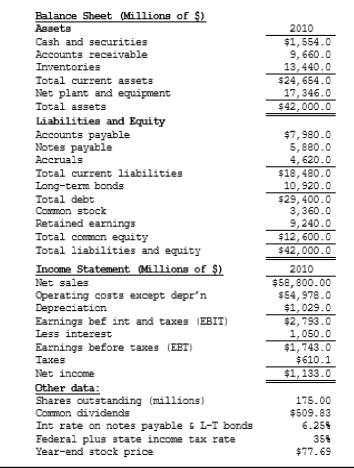 -What is the firm's total assets turnover?
 (Multiple Choice)
4.7/5 (84)
(84) It is appropriate to use the fixed assets turnover ratio to appraise firms' effectiveness in managing their fixed assets if and only if all the firms being compared have the same proportion of fixed assets to total assets.
(True/False)
4.9/5 (72)
(72)
The balance sheet and income statement shown below are for Pettijohn Inc. Note that the firm has no amortization charges, it does not lease any assets, none of its debt must be retired during the next 5 years, and the notes payable will be rolled over.
-What is the firm's days sales outstanding? Assume a 360-day year for this calculation.
-What is the firm's days sales outstanding? Assume a 360-day year for this calculation. (Multiple Choice)
5.0/5 (87)
(87) Ziebart Corp.'s EBITDA last year was $390,000 (= EBIT + depreciation + amortization), its interest charges were $9,500, it had to repay $26,000 of long-term debt, and it had to make a payment of $17,400 under a long- term lease. The firm had no amortization charges. What was the EBITDA coverage ratio?
(Multiple Choice)
4.9/5 (82)
(82) Branch Corp.'s total assets at the end of last year were $315,000 and its net income after taxes was $22,750. What was its return on total assets?
(Multiple Choice)
4.7/5 (67)
(67)
The balance sheet and income statement shown below are for Pettijohn Inc. Note that the firm has no amortization charges, it does not lease any assets, none of its debt must be retired during the next 5 years, and the notes payable will be rolled over.
-What is the firm's EPS?
-What is the firm's EPS? (Multiple Choice)
4.8/5 (80)
(80) Considered alone, which of the following would increase a company's current ratio?
(Multiple Choice)
4.8/5 (87)
(87) Amram Company's current ratio is 1.9. Considered alone, which of the following actions would reduce the company's current ratio?
(Multiple Choice)
4.8/5 (81)
(81) Nikko Corp.'s total common equity at the end of last year was $305,000
And its net income after taxes was $60,000. What was its ROE?
(Multiple Choice)
4.9/5 (82)
(82) Quigley Inc. is considering two financial plans for the coming year. Management expects sales to be $301,770, operating costs to be $266,545, assets to be $200,000, and its tax rate to be 35%. Under Plan A it would use 25% debt and 75% common equity. The interest rate on the debt would be 8.8%, but the TIE ratio would have to be kept at 4.00 or more. Under Plan B the maximum debt that met the TIE constraint would be employed. Assuming that sales, operating costs, assets, the interest rate, and the tax rate would all remain constant, by how much would the ROE change in response to the change in the capital structure?
(Multiple Choice)
4.8/5 (76)
(76) Casey Communications recently issued new common stock and used the proceeds to pay off some of its short-term notes payable. This action had no effect on the company's total assets or operating income. Which of the following effects would occur as a result of this action?
(Multiple Choice)
4.9/5 (61)
(61) Last year Mason Inc. had a total assets turnover of 1.33 and an equity multiplier of 1.75. Its sales were $195,000 and its net income was
$10,549. The CFO believes that the company could have operated more efficiently, lowered its costs, and increased its net income by $5,250 without changing its sales, assets, or capital structure. Had it cut costs and increased its net income in this amount, by how much would the ROE have changed?
(Multiple Choice)
4.9/5 (73)
(73) You observe that a firm's ROE is above the industry average, but its profit margin and debt ratio are both below the industry average. Which of the following statements is CORRECT?
(Multiple Choice)
4.9/5 (89)
(89)
The balance sheet and income statement shown below are for Pettijohn Inc. Note that the firm has no amortization charges, it does not lease any assets, none of its debt must be retired during the next 5 years, and the notes payable will be rolled over.
-What is the firm's quick ratio?
-What is the firm's quick ratio? (Multiple Choice)
4.9/5 (71)
(71)
The balance sheet and income statement shown below are for Pettijohn Inc. Note that the firm has no amortization charges, it does not lease any assets, none of its debt must be retired during the next 5 years, and the notes payable will be rolled over.
-What is the firm's book value per share?
-What is the firm's book value per share? (Multiple Choice)
4.7/5 (69)
(69) 
Filters
- Essay(0)
- Multiple Choice(0)
- Short Answer(0)
- True False(0)
- Matching(0)