



 Chat with AI
Exam 11: A: Trees

Exam 1: The Foundations: Logic and Proofs18 Questions
Exam 1: A: the Foundations: Logic and Proofs201 Questions
Exam 2: Basic Structures: Sets, Functions, Sequences, Sums, Matrices5 Questions
Exam 2: A: Basic Structures: Sets, Functions, Sequences, Sums, Matrices210 Questions
Exam 3: Algorithms8 Questions
Exam 3: A: Algorithms54 Questions
Exam 4: Number Theory and Cryptography10 Questions
Exam 4: A: Number Theory and Cryptography149 Questions
Exam 5: Induction and Recursion10 Questions
Exam 5: A: Induction and Recursion51 Questions
Exam 6: Counting14 Questions
Exam 6: A: Counting155 Questions
Exam 7: Discrete Probability9 Questions
Exam 7: A: Discrete Probability50 Questions
Exam 8: Advanced Counting Techniques16 Questions
Exam 8: A: Advanced Counting Techniques124 Questions
Exam 9: Relations13 Questions
Exam 9: A: Relations72 Questions
Exam 10: Graphs14 Questions
Exam 10: A: Graphs131 Questions
Exam 11: Trees13 Questions
Exam 11: A: Trees94 Questions
Exam 12: Boolean Algebra11 Questions
Exam 12: A: Boolean Algebra67 Questions
Exam 13: Modeling Computation14 Questions
Exam 13: A: Modeling Computation67 Questions
Exam 14: Mathematics Problem Set: Set Theory, Number Theory, Combinatorics, and Boolean Algebra29 Questions
Select questions type


refer to this graph. 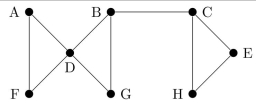 -Using the ordering B, G, J, A, C, I, F, H, D, E, find a spanning tree for this graph by using a breadth-first search.
 (Essay)
4.7/5  (66)
(66) 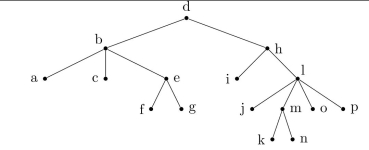 -Find the postorder traversal.
refer to this graph. 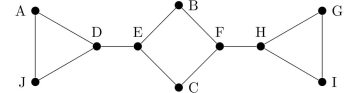 -Using the ordering B, G, J, A, C, I, F, H, D, E, find a spanning tree for this graph by using a depth-first search.
 (Essay)
4.8/5 (85)
(85) (a) Set up a binary tree for the following list, in the given order, using alphabetical ordering: STOP, LET, THERE, TAPE, NONE, YOU, ANT, NINE, OAT, NUT.
(b) Explain step by step how you would search for the word TEST in your tree.
(c) What is the height of the shortest binary search tree that can hold all 10 words?
(d) Write the preorder traversal of the tree.
(e) Write the postorder traversal of the tree.
(f) Write the inorder traversal of the tree.
(Essay)
4.8/5 (78)
(78) fill in the blanks.
-If T is a full binary tree with 101 vertices, its maximum height is ____.
(Short Answer)
4.8/5 (83)
(83) fill in the blanks.
-A full 3-ary tree with 13 internal vertices has ____ vertices.
(Short Answer)
4.8/5 (92)
(92) refer to this graph.
-Using the ordering B, G, J, A, C, I, F, H, D, E, find a spanning tree for this graph by using a depth-first search.
-Using the ordering B, G, J, A, C, I, F, H, D, E, find a spanning tree for this graph by using a depth-first search. (Essay)
4.8/5 (73)
(73) fill in the blanks.
-There are ____ non-isomorphic rooted trees with four vertices.
(Short Answer)
4.9/5 (67)
(67) Use Prim's algorithm to find a minimal spanning tree for this weighted graph. Use alphabetical order to break ties. 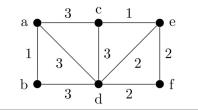
(Essay)
4.8/5 (64)
(64) Find a spanning tree for the graph K3,4 using a depth-first search. (Assume that the vertices are labeled in one set and in the other set, and that alphabetical ordering is used in the search, with numerical ordering on the subscripts used to break ties.)
(Essay)
4.7/5 (83)
(83) refer to this graph.
-Using the ordering C, D, E, F, G, H, I, J, A, B, C, find a spanning tree for this graph by using a depth-first search.
-Using the ordering C, D, E, F, G, H, I, J, A, B, C, find a spanning tree for this graph by using a depth-first search. (Essay)
4.8/5 (90)
(90) Suppose T is a full m-ary tree with i internal vertices. Prove that T has 1 + (m − 1)i leaves.
(Essay)
4.8/5 (91)
(91) fill in the blanks.
-Every full binary tree with 61 vertices has ____ leaves.
(Short Answer)
4.8/5 (84)
(84) Suppose that the universal address set address of a vertex v in an ordered rooted tree is 3.2.5.1.5. Find (a) the level of v.
(b) the minimum number of siblings of v.
(c) the address of the parent of v.
(d) the minimum number of vertices in the tree.
(Short Answer)
4.9/5 (74)
(74) 
Filters
- Essay(0)
- Multiple Choice(0)
- Short Answer(0)
- True False(0)
- Matching(0)