



 Chat with AI
Exam 3: Polynomial and Rational Functions

Exam 1: Functions and Their Graphs276 Questions
Exam 2: Linear and Quadratic Functions210 Questions
Exam 3: Polynomial and Rational Functions96 Questions
Exam 5: Conics63 Questions
Exam 6: Systems of Equations and Inequalities134 Questions
Exam 7: Sequences; Induction; the Binomial Theorem104 Questions
Exam 8: Counting and Probability65 Questions
Select questions type


The equation has a solution r in the interval indicated. Approximate this solution correct to two decimal places.
-x3 - 8x - 3 = 0; -3 ≤ r ≤-2
(Short Answer)
4.9/5  (91)
(91) Use Descartes' Rule of Signs and the Rational Zeros Theorem to find all the real zeros of the polynomial function. Use the
zeros to factor f over the real numbers.
-
(Multiple Choice)
4.8/5 (79)
(79) List the potential rational zeros of the polynomial function. Do not find the zeros.
-
(Multiple Choice)
4.9/5 (75)
(75) List the potential rational zeros of the polynomial function. Do not find the zeros.
-
(Multiple Choice)
4.8/5 (60)
(60) 
Solve the problem.
-The profits (in millions) for a company for 8 years was as follows: Year, x Profits 1993,1 1.1 1994,2 1.7 1995,3 2.0 1996,4 1.4 1997,5 1.3 1998,6 1.5 1999,7 1.8 2000,8 2.1 Find the cubic function of best fit to the data.
(Short Answer)
4.8/5 (84)
(84) Use the Intermediate Value Theorem to determine whether the polynomial function has a zero in the given interval.
-f(x) = -2x4 - 4x2 + 9; [-2, -1]
(Multiple Choice)
5.0/5 (81)
(81) State whether the function is a polynomial function or not. If it is, give its degree. If it is not, tell why not.
-
(Multiple Choice)
4.8/5 (85)
(85) 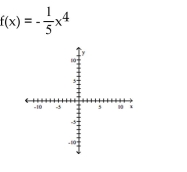
Find the x- and y-intercepts of f.
-f(x) = (x + 6)(x - 2)(x + 2)
(Multiple Choice)
4.9/5 (71)
(71) Use Descartes' Rule of Signs and the Rational Zeros Theorem to find all the real zeros of the polynomial function. Use the
zeros to factor f over the real numbers.
-
(Multiple Choice)
4.9/5 (82)
(82) 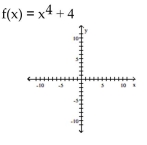
Use Descartes' Rule of Signs and the Rational Zeros Theorem to find all the real zeros of the polynomial function. Use the
zeros to factor f over the real numbers.
-
(Multiple Choice)
4.9/5 (80)
(80) Use Descartes' Rule of Signs and the Rational Zeros Theorem to find all the real zeros of the polynomial function. Use the
zeros to factor f over the real numbers.
-
(Multiple Choice)
4.8/5 (66)
(66) 
Use Descartes' Rule of Signs and the Rational Zeros Theorem to find all the real zeros of the polynomial function. Use the
zeros to factor f over the real numbers.
-
(Multiple Choice)
4.9/5 (75)
(75) List the potential rational zeros of the polynomial function. Do not find the zeros.
-
(Multiple Choice)
4.7/5 (73)
(73) 
Filters
- Essay(0)
- Multiple Choice(0)
- Short Answer(0)
- True False(0)
- Matching(0)