



 Chat with AI
Exam 12: Analysis of Variance

Exam 1: The Where, Why, and How of Data Collection167 Questions
Exam 2: Graphs, Charts and Tablesdescribing Your Data138 Questions
Exam 3: Describing Data Using Numerical Measures138 Questions
Exam 4: Introduction to Probability125 Questions
Exam 5: Discrete Probability Distributions161 Questions
Exam 6: Introduction to Continuous Probability Distributions122 Questions
Exam 7: Introduction to Sampling Distributions136 Questions
Exam 8: Estimating Single Population Parameters174 Questions
Exam 9: Introduction to Hypothesis Testing183 Questions
Exam 10: Estimation and Hypothesis Testing for Two Population Parameters121 Questions
Exam 11: Hypothesis Tests and Estimation for Population Variances69 Questions
Exam 12: Analysis of Variance162 Questions
Exam 13: Goodness-Of-Fit Tests and Contingency Analysis105 Questions
Exam 14: Introduction to Linear Regression and Correlation Analysis139 Questions
Exam 15: Multiple Regression Analysis and Model Building148 Questions
Exam 16: Analyzing and Forecasting Time-Series Data131 Questions
Exam 17: Introduction to Nonparametric Statistics103 Questions
Exam 18: Introducing Business Analytics48 Questions
Exam 19: Introduction to Decision Analysis48 Questions
Exam 20: Introduction to Quality and Statistical Process Control42 Questions
Select questions type


A hotel chain has four hotels in Oregon. The general manager is interested in determining whether the mean length of stay is the same or different for the four hotels. She selects a random sample of n = 20 guests at each hotel and determines the number of nights they stayed. Assuming that she plans to test this using an alpha level equal to 0.05, which of the following is the correct critical value?
(Multiple Choice)
4.9/5  (82)
(82) When the world's largest retailer, Walmart, decided to enter the grocery marketplace in a big way with its "Super Stores," it changed the retail grocery landscape in a major way. The other major chains such as Albertsons have struggled to stay competitive. In addition, regional discounters such as WINCO in the western United States have made it difficult for the traditional grocery chains. Recently, a study was conducted in which a "market basket" of products was selected at random from those items offered in three stores in Boise, Idaho: Walmart, Winco, and Albertsons. At issue was whether the mean prices at the three stores are equal or whether there is a difference in prices. The sample data are in the data file called Food Price Comparisons. Using an alpha level equal to 0.05, test to determine whether the three stores have equal population mean prices. If you conclude that there are differences in the mean prices, perform the appropriate posttest to determine which stores have different means.
(Multiple Choice)
4.7/5 (90)
(90) As a step in establishing its rates, an automobile insurance company is interested in determining whether there is a difference in the mean highway speeds that drivers of different age groups drive. To help answer this question, it has selected a random sample of drivers in three age categories: under 21, 21-50, and over 50. The engineers then recorded the drivers' speeds at a designated point on a highway in the state. The subjects were unaware that their speed was being recorded. The following one-way ANOVA output was generated from the sample data. Based upon this output, it is possible that a Type II statistical error has been committed if the null hypothesis is tested at the alpha equal 0.05 level. ANOVA: Single Factor 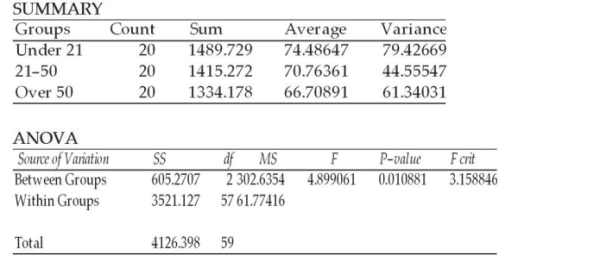
(True/False)
4.8/5 (91)
(91) Recently, a department store chain was interested in determining if there was a difference in the mean number of customers who enter the three stores in Seattle. The analysts set up a study in which the number of people entering the stores was counted depending on whether the day of the week was Saturday, Sunday, or a weekday. The following data were collected: 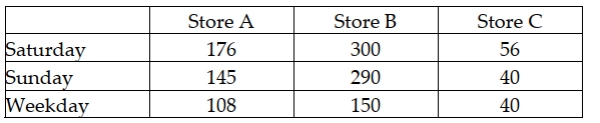 Given this format, what is the null hypothesis for testing whether blocking is effective?
 (Multiple Choice)
5.0/5 (75)
(75) A company has established an experiment with its production process in which three temperature settings are used and five elapsed times are used for each setting. The company then produces one product under each and measures the resulting strength of the product. The managers are mainly interested in determining whether the mean strength is the same at all temperature settings, but they know that controlling for process time is important. The following data were observed from the experiment: 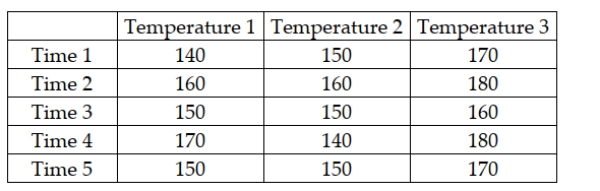 Based on these data and experimental design, for a significance level of 0.05, the managers should conclude that they were justified in blocking on the basis of processing time.
 (True/False)
4.9/5 (75)
(75) A fixed effects analysis of variance differs from a random-effects analysis of variance in the way in which the sums of squares are computed.
(True/False)
4.9/5 (72)
(72) To test for the stopping distances of four brake systems, 10 of the same make and model of car are selected randomly and then are assigned randomly to each of four brake systems. This is a randomized complete block design.
(True/False)
4.9/5 (78)
(78) Frasier and Company manufactures four different products that it ships to customers throughout the United States. Delivery times are not a driving factor in the decision as to which type of carrier to use (rail, plane, or truck) to deliver the product. However, breakage cost is very expensive, and Frasier would like to select a mode of delivery that reduces the amount of product breakage. To help it reach a decision, the managers have decided to examine the dollar amount of breakage incurred by the three alternative modes of transportation under consideration. Because each product's fragility is different, the executives conducting the study wish to control for differences due to type of product. The company randomly assigns each product to each carrier and monitors the dollar breakage that occurs over the course of 100 shipments. The dollar breakage per shipment (to the nearest dollar) is as follows: 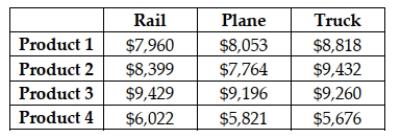 Was Frasier and Company correct in its decision to block for type of product? Conduct the appropriate hypothesis test using a level of significance of 0.01.
 (Multiple Choice)
4.8/5 (76)
(76) In a recent one-way ANOVA test, SSW was equal to 15,900 and the SSB was equal to 3,100. Therefore, SST is equal to 12,800.
(True/False)
5.0/5 (58)
(58) Assume you are conducting a two-way ANOVA and have found a significant interaction between the two factors. Explain what conclusions you can make from the results and what if any further steps should be taken.
(Essay)
4.9/5 (85)
(85) Applebee's International, Inc., is a U.S. company that develops, franchises, and operates the Applebee's Neighborhood Grill and Bar restaurant chain. It is the largest chain of casual dining restaurants in the country, with over 1,500 restaurants across the United States. The headquarters is located in Overland Park, Kansas. The company is interested in determining if mean weekly revenue differs among three restaurants in a particular city. The file entitled Applebees contains revenue data for a sample of weeks for each of the three locations. If you did conclude that there was a difference in the average revenue, use Fisher's LSD approach to determine which restaurant has the lowest mean sales.
(Multiple Choice)
4.7/5 (71)
(71) A golf ball manufacturer has three dimple patterns it is interested in analyzing to see whether one results in longer driving distances. However, it also wishes to control for the material the ball is made from since it believes that the material might affect driving distance. Four materials can be used. The following data represent the results of tests in which each combination of dimple pattern and cover material were used and the length of the ball hit by a robot has been recorded. The test will be conducted using an alpha = 0.05 level. 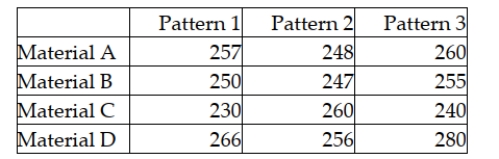 Given these data, what is the value of Fisher's Least Significant Difference critical value?
 (Multiple Choice)
4.9/5 (76)
(76) Six food critics each visited and rated four different restaurants. Each critic visited each restaurant on three separate occasions and recorded a score for each visit. The correct method for analyzing this data is two-factor ANOVA.
(True/False)
4.7/5 (97)
(97) The State Transportation Department is thinking of changing its speed limit signs. It is considering two new options in addition to the existing sign design. At question is whether the three sign designs will produce the same mean speed. To test this, the department has conducted a limited test in which a stretch of roadway was selected. With the original signs up, a random sample of 30 cars was selected and the speeds were measured. Then, on different days, the two new designs were installed, 30 cars each day were sampled, and their speeds were recorded. Suppose that the following summary statistics were computed based on the data:  The appropriate test to conduct to determine if the population means are equal is:
 (Multiple Choice)
4.9/5 (87)
(87) Examine the following two-factor analysis of variance table: 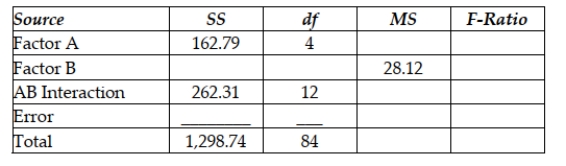 Determine if the levels of factor A have equal means. Use a significance level of 0.05.
 (Multiple Choice)
4.7/5 (82)
(82) The one-way ANOVA test involves assuming that the population variances are equal.
(True/False)
5.0/5 (76)
(76) A study has been conducted to determine whether the mean spending for recreational activities during the month of August differs for residents of three cities. Random samples of 30 people were selected from each city and their spending on recreation was recorded during August. The following output was generated using Excel: ANOVA: Single Factor 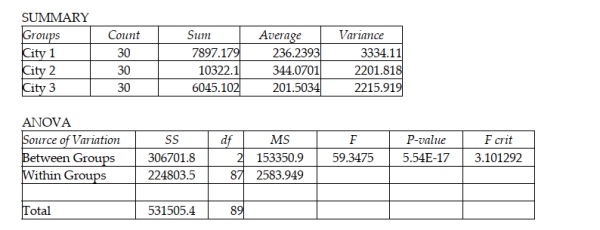 The Excel output shows that the null hypothesis of equal means should be rejected. Given this, perform the appropriate method for determining which population means are different. Conduct the test using an alpha = 0.05 level.
 (Essay)
4.8/5 (68)
(68) In a one-way analysis of variance design, there is a single factor of interest but there may be multiple levels of the factor.
(True/False)
4.8/5 (89)
(89) In order for a one-way analysis of variance to be considered a balanced design, which of the following must hold?
(Multiple Choice)
4.8/5 (81)
(81) The correct null hypothesis to determine whether interaction exists in a two-factor ANOVA is
(Multiple Choice)
4.9/5 (69)
(69) 
Filters
- Essay(0)
- Multiple Choice(0)
- Short Answer(0)
- True False(0)
- Matching(0)