Exam 4: Graphs of the Circular Functions

arrow
  • Select Tags
search iconSearch Question
flashcardsStudy Flashcards
  • Select Tags

Solve the problem. -A weight attached to a spring is pulled down 5 inches below the equilibrium position. Assuming that the period of the system is 13sec\frac { 1 } { 3 } \mathrm { sec } , what is the frequency of the system?

(Multiple Choice)
4.8/5
(101)

Graph the function. - y=csc⁡(x−π2)y = \csc \left( x - \frac { \pi } { 2 } \right)  Graph the function. - y = \csc \left( x - \frac { \pi } { 2 } \right)

(Multiple Choice)
5.0/5
(84)

Use Identities to find the exact value. -A weight attached to a spring is pulled down 4 inches below the equilibrium position. Assuming that the frequency of the system is 5π\frac { 5 } { \pi } cycles per second, determine a trigonometric model that gives the position of the weight at time tt seconds.

(Multiple Choice)
4.9/5
(75)

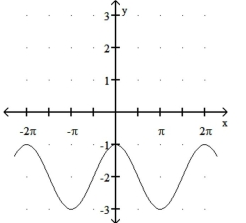
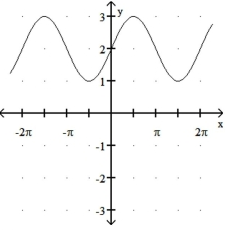
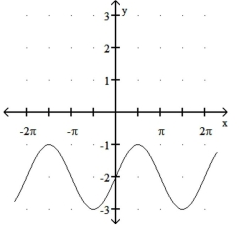
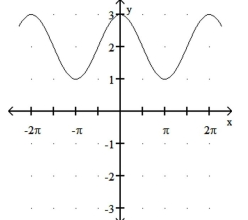
Match the function with its graph. -1) y=2+sin⁡xy = 2 + \sin x 2) y=2+cos⁡xy = 2 + \cos x 3) y=−2+sin⁡xy = - 2 + \sin x 4) y=−2+cos⁡xy = - 2 + \cos x a)  Match the function with its graph. -1)  y = 2 + \sin x  2)  y = 2 + \cos x  3)  y = - 2 + \sin x  4)  y = - 2 + \cos x   a)    b)    c)    d)     b)  Match the function with its graph. -1)  y = 2 + \sin x  2)  y = 2 + \cos x  3)  y = - 2 + \sin x  4)  y = - 2 + \cos x   a)    b)    c)    d)     c)  Match the function with its graph. -1)  y = 2 + \sin x  2)  y = 2 + \cos x  3)  y = - 2 + \sin x  4)  y = - 2 + \cos x   a)    b)    c)    d)     d)  Match the function with its graph. -1)  y = 2 + \sin x  2)  y = 2 + \cos x  3)  y = - 2 + \sin x  4)  y = - 2 + \cos x   a)    b)    c)    d)

(Multiple Choice)
4.9/5
(88)

Find the phase shift of the function. - y=5−3sin⁡(4x+π4)y = 5 - 3 \sin \left( 4 x + \frac { \pi } { 4 } \right)

(Multiple Choice)
5.0/5
(88)

Graph the function. - y=14tan⁡2xy = \frac { 1 } { 4 } \tan 2 x  Graph the function. - y = \frac { 1 } { 4 } \tan 2 x

(Multiple Choice)
4.8/5
(77)

Give the amplitude or period as requested. -Period of y=cos⁡13xy = \cos \frac { 1 } { 3 } x

(Multiple Choice)
4.7/5
(82)

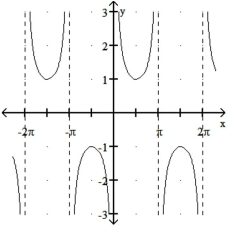
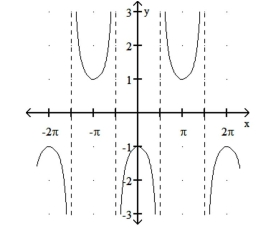
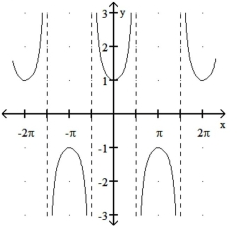
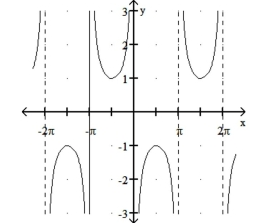
Match the function with its graph. -1) y=sec⁡xy = \sec x 2) y=csc⁡xy = \csc x 3) y=−sec⁡xy = - \sec x 4) y=−csc⁡xy = - \csc x a)  Match the function with its graph. -1)  y = \sec x  2)  y = \csc x  3)  y = - \sec x  4)  y = - \csc x   a)    b)    c)    d)    b)  Match the function with its graph. -1)  y = \sec x  2)  y = \csc x  3)  y = - \sec x  4)  y = - \csc x   a)    b)    c)    d)    c)  Match the function with its graph. -1)  y = \sec x  2)  y = \csc x  3)  y = - \sec x  4)  y = - \csc x   a)    b)    c)    d)    d)  Match the function with its graph. -1)  y = \sec x  2)  y = \csc x  3)  y = - \sec x  4)  y = - \csc x   a)    b)    c)    d)

(Multiple Choice)
4.8/5
(72)

The function graphed is of the form y = a tan bx or y = a cot bx, where b > 0. Determine the equation of the graph. -The function graphed is of the form y = a tan bx or y = a cot bx, where b > 0. Determine the equation of the graph. -
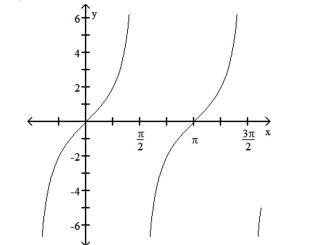
(Multiple Choice)
4.9/5
(86)

Solve the problem. -Ignoring friction, the time, tt (in seconds), required for a block to slide down an inclined plane is given by the formula t=2bgsin⁡θcos⁡θt = \sqrt { \frac { 2 b } { g \sin \theta \cos \theta } } where bb is the length of the base in feet and g=32.2g = 32.2 feet per second is the acceleration of gravity. How long does it take a block to slide down an inclined plane with a base of 12 feet at an angle of 36∘36 ^ { \circ } ? Round your answer to three decimal places.

(Multiple Choice)
4.9/5
(78)

The function graphed is of the form y = cos x + c, y = sin x + c, y = cos(x - d), or y = sin(x - d), where d is the least possible positive value. Determine the equation of the graph. -The function graphed is of the form y = cos x + c, y = sin x + c, y = cos(x - d), or y = sin(x - d), where d is the least possible positive value. Determine the equation of the graph. -
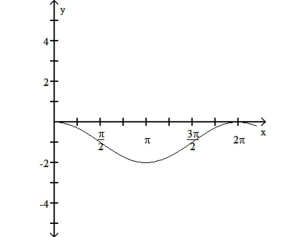
(Multiple Choice)
4.7/5
(93)

Solve the problem. -A generator produces an alternating current according to the equation I = 48 sin 109πt, where t is time in seconds and I is the current in amperes. What is the smallest time t such that I = 24?

(Multiple Choice)
5.0/5
(80)

Graph the function. - y=csc⁡(34x−π4)y=\csc \left(\frac{3}{4} x-\frac{\pi}{4}\right)  Graph the function. - y=\csc \left(\frac{3}{4} x-\frac{\pi}{4}\right)

(Multiple Choice)
4.9/5
(77)

Graph the function. - y=sec⁡(x−π4)y = \sec \left( x - \frac { \pi } { 4 } \right)  Graph the function. - y = \sec \left( x - \frac { \pi } { 4 } \right)

(Multiple Choice)
4.8/5
(83)

Graph the function. - y=13csc⁡(45x+π2)y=\frac{1}{3} \csc \left(\frac{4}{5} x+\frac{\pi}{2}\right)  Graph the function. - y=\frac{1}{3} \csc \left(\frac{4}{5} x+\frac{\pi}{2}\right)

(Multiple Choice)
4.8/5
(79)

Solve the problem. -Determine the length of a pendulum that has a period of 4 seconds.

(Multiple Choice)
4.7/5
(86)

Graph the function. - y=32cot⁡xy = \frac { 3 } { 2 } \cot x  Graph the function. - y = \frac { 3 } { 2 } \cot x

(Multiple Choice)
4.8/5
(65)

Find the specified quantity. -Find the period of y=−5cos⁡(14x+π3)y = - 5 \cos \left( \frac { 1 } { 4 } x + \frac { \pi } { 3 } \right) .

(Multiple Choice)
4.9/5
(79)

Graph the function. - y=34cot⁡(13x−π2)y=\frac{3}{4} \cot \left(\frac{1}{3} x-\frac{\pi}{2}\right)  Graph the function. - y=\frac{3}{4} \cot \left(\frac{1}{3} x-\frac{\pi}{2}\right)

(Multiple Choice)
4.7/5
(82)

Give the amplitude or period as requested. -Amplitude of y=sin⁡5xy = \sin 5 x

(Multiple Choice)
4.9/5
(84)
Showing 81 - 100 of 137
close modal

Filters

  • Essay(0)
  • Multiple Choice(0)
  • Short Answer(0)
  • True False(0)
  • Matching(0)