



 Chat with AI
Exam 17: Electric Potential

Exam 1: Introduction, Measurement, Estimating29 Questions
Exam 2: Describing Motion: Kinematics in One Dimension527 Questions
Exam 3: Kinematics in Two Dimensions; Vectors183 Questions
Exam 4: Dynamics: Newtons Laws of Motion146 Questions
Exam 5: Circular Motion; Gravitation105 Questions
Exam 6: Work and Energy153 Questions
Exam 7: Linear Momentum139 Questions
Exam 8: Rotational Motion148 Questions
Exam 9: Static Equilibrium; Elasticity and Fracture83 Questions
Exam 10: Fluids98 Questions
Exam 11: Oscillations and Waves114 Questions
Exam 12: Sound21 Questions
Exam 13: Temperature and Kinetic Theory87 Questions
Exam 14: Heat88 Questions
Exam 15: The Laws of Thermodynamics78 Questions
Exam 16: Electric Charge and Electric Field99 Questions
Exam 17: Electric Potential107 Questions
Exam 18: Electric Currents96 Questions
Exam 19: Dc Circuits384 Questions
Exam 20: Magnetism164 Questions
Exam 21: Electromagnetic Induction and Faradays Law60 Questions
Exam 22: Electromagnetic Waves167 Questions
Exam 23: Light: Geometric Optics144 Questions
Exam 24: The Wave Nature of Light58 Questions
Exam 25: Optical Instruments156 Questions
Exam 26: The Special Theory of Relativity126 Questions
Exam 27: Early Quantum Theory and Models of the Atom192 Questions
Exam 28: Quantum Mechanics of Atoms74 Questions
Exam 29: Molecules and Solids26 Questions
Exam 30: Nuclear Physics and Radioactivity153 Questions
Exam 31: Nuclear Energy; Effects and Uses of Radiation36 Questions
Exam 32: Elementary Particles19 Questions
Exam 33: Astrophysics and Cosmology25 Questions
Select questions type


A point charge of and a second charge are initially very far apart. If it takes of work to bring them to a final configuration in which the charge is at the point , and the second charge is at the point , find the magnitude of the charge
(Multiple Choice)
4.8/5  (73)
(73) If a ion that is initially at rest accelerates through a potential difference of without friction, how much kinetic energy will it gain?
(Multiple Choice)
4.8/5 (77)
(77) An air-filled capacitor has a potential difference between the plates of . If the charge on each of the plates of the capacitor has magnitude , what is the electrical energy stored by this capacitor?
(Multiple Choice)
4.8/5 (78)
(78) A 4.0-g bead carries a charge of . The bead is accelerated from rest through a potential difference , and afterward the bead is moving at . What is the magnitude of the potential difference ?
(Multiple Choice)
5.0/5 (84)
(84) Two charges lie on the -axis, one at the origin and the other at . What is the potential (relative to infinity) due to these charges at a point at on the -axis? )
(Multiple Choice)
4.9/5 (72)
(72) Two very large parallel metal plates, separated by , are connected across a source of potential. An electron is released from rest at a location from the negative plate. When the electron arrives at a distance from the positive plate, how much kinetic energy has the electron gained?
(Multiple Choice)
5.0/5 (89)
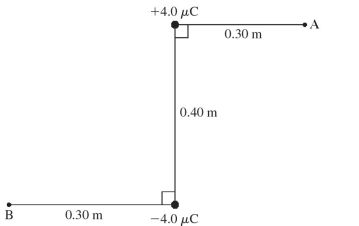
(89) In the figure, and point charges are located as shown. Now an additional point charge is placed at point . What is the electric potential energy of this system of three charges, relative to infinity?
(Multiple Choice)
4.7/5 (83)
(83) A proton is accelerated from rest through a potential difference and gains a speed . If it were accelerated instead through a potential difference of , what speed would it gain?
(Multiple Choice)
4.8/5 (73)
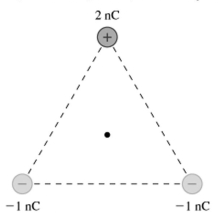
(73) The three point charges shown in the figure form an equilateral triangle with sides long. What is the electric potential (relative to infinity) at the point indicated with the dot, which is equidistant from all three charges? Assume that the numbers in the figure are all accurate to two significant figures.
(Multiple Choice)
5.0/5 (85)
(85) Two parallel circular plates, each with a radius of and carrying equal-magnitude surface charge densities of , are separated by a distance of with only air between them. How much energy is stored in these plates?
(Multiple Choice)
5.0/5 (79)
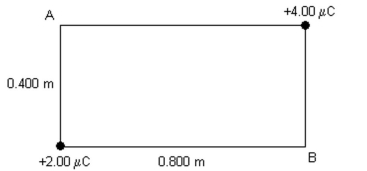
(79) Point charges and are placed at the opposite corners of a rectangle as shown in the figure. If these charges are released and are free to move with no friction, what is the maximum amount of kinetic energy they will gain? . )
(Short Answer)
5.0/5 (100)
(100) A capacitor has a voltage of applied across its plates, and then the voltage source is removed. What is the potential difference across its plates if the space between them is then filled with mica, having a dielectric constant of ?
(Multiple Choice)
4.8/5 (94)
(94) If it takes of energy to move of charge from point to point , what is the magnitude of the potential difference between points and ?
(Multiple Choice)
4.9/5 (79)
(79) Three point charges are placed at the following points in a horizontal plane: is at is at , and is at . Calculate the electrical potential (relative to infinity) at the origin due to these three point charges.
(Short Answer)
4.7/5 (91)
(91) The square plates of a parallel-plate capacitor measure by and are separated by a dielectric that is thickand totally fills the region between the plates. The voltage rating (the maximum safe voltage) of the capacitor is . What is the maximum energy that can be stored in this capacitor without damaging it? )
(Multiple Choice)
4.8/5 (79)
(79) charge is at the point and a charge is at . What work is required to bring a charge from very far away to point ? )
(Multiple Choice)
4.7/5 (70)
(70) A air-filled capacitor is connected across a 100-V potential source (a battery). After the battery fully charges the capacitor, it is left connected and the capacitor is immersed in transformer oil, which has a dielectric constant of 4.5. How much additional charge flows from the battery onto the capacitor during this process?
(Multiple Choice)
4.9/5 (78)
(78) Measurements show that it takes of work to move of charge from one plate to another of a certain air-filled capacitor while the potential difference between these plates is kep constant. What is the potential difference between the plates of this capacitor?
(Multiple Choice)
4.9/5 (91)
(91) A uniform electric field has the strength of . What is the electric energy density of this field?
(Multiple Choice)
4.8/5 (71)
(71) 
Filters
- Essay(0)
- Multiple Choice(0)
- Short Answer(0)
- True False(0)
- Matching(0)