



 Chat with AI
Exam 23: Light: Geometric Optics

Exam 1: Introduction, Measurement, Estimating29 Questions
Exam 2: Describing Motion: Kinematics in One Dimension527 Questions
Exam 3: Kinematics in Two Dimensions; Vectors183 Questions
Exam 4: Dynamics: Newtons Laws of Motion146 Questions
Exam 5: Circular Motion; Gravitation105 Questions
Exam 6: Work and Energy153 Questions
Exam 7: Linear Momentum139 Questions
Exam 8: Rotational Motion148 Questions
Exam 9: Static Equilibrium; Elasticity and Fracture83 Questions
Exam 10: Fluids98 Questions
Exam 11: Oscillations and Waves114 Questions
Exam 12: Sound21 Questions
Exam 13: Temperature and Kinetic Theory87 Questions
Exam 14: Heat88 Questions
Exam 15: The Laws of Thermodynamics78 Questions
Exam 16: Electric Charge and Electric Field99 Questions
Exam 17: Electric Potential107 Questions
Exam 18: Electric Currents96 Questions
Exam 19: Dc Circuits384 Questions
Exam 20: Magnetism164 Questions
Exam 21: Electromagnetic Induction and Faradays Law60 Questions
Exam 22: Electromagnetic Waves167 Questions
Exam 23: Light: Geometric Optics144 Questions
Exam 24: The Wave Nature of Light58 Questions
Exam 25: Optical Instruments156 Questions
Exam 26: The Special Theory of Relativity126 Questions
Exam 27: Early Quantum Theory and Models of the Atom192 Questions
Exam 28: Quantum Mechanics of Atoms74 Questions
Exam 29: Molecules and Solids26 Questions
Exam 30: Nuclear Physics and Radioactivity153 Questions
Exam 31: Nuclear Energy; Effects and Uses of Radiation36 Questions
Exam 32: Elementary Particles19 Questions
Exam 33: Astrophysics and Cosmology25 Questions
Select questions type


Two very flat glass plates, 16 cm long, are in contact at one end and separated by 0.020 mm at the other end. The space between the plates is occupied by oil with index of refraction 1.45. The
Refractive index of the glass plates is 1.55. The plates are illuminated at normal incidence with
Monochromatic light, and fringes are observed. When the monochromatic light has a wavelength
Of 580 nm, how many bright fringes are visible in the pattern?
(Multiple Choice)
4.7/5  (83)
(83) Which of the following changes would increase the separation between the bright fringes in the diffraction pattern formed by a diffraction grating?
(Multiple Choice)
4.8/5 (74)
(74) A single-slit diffraction pattern is formed on a distant screen. Assuming the angles involved are small, by what factor will the width of the central bright spot on the screen change if the
Wavelength of the illuminating light is doubled?
(Multiple Choice)
4.8/5 (73)
(73) What do we mean when we say that two light rays striking a screen are in phase with each other?
(Multiple Choice)
4.8/5 (90)
(90) Monochromatic light is incident on a diffraction grating that is wide and ruled with 50,000 lines. The second-order maximum is seen at . What is the wavelength of the incident light?
(Multiple Choice)
4.8/5 (78)
(78) As shown in the figure, the orientation of the transmission axis for each of three ideal polarizing sheets is labeled relative to the vertical direction. A beam of light, polarized in the vertical direction, is incident on the first polarizer with an intensity of . What is the intensity of the beam after it has passed through the three polarizing sheets when , and ?
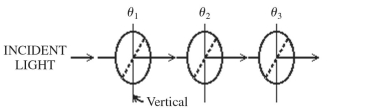
(Multiple Choice)
4.7/5 (85)
(85) In a double-slit experiment, the slit separation is , and two wavelengths, and 900 , illuminate the slits. A screen is placed from the slits. At what distance from the central maximum on the screen will a bright fringe from one pattern first coincide with a bright fringe from the other?
(Multiple Choice)
4.8/5 (89)
(89) Light has wavelength in a vacuum. It passes into glass, which has an index of refraction of 1.5. What is the frequency of the light inside the glass?
(Multiple Choice)
4.7/5 (82)
(82) Light having a frequency in vacuum of enters a liquid of refractive index . What is the frequency of the light in this liquid?
(Multiple Choice)
4.9/5 (90)
(90) A two-slit arrangement with separation between the slits is illuminated with wavelength light. If a viewing screen is located from the slits, find the distance on the screen from the first dark fringe on one side of the central maximum to the second dark fringe on the other side.
(Multiple Choice)
4.7/5 (84)
(84) Light of wavelength is incident on a slit wide and the diffraction pattern is viewed on a screen that is from the slit. What is the width on the screen of the central maximum?
(Multiple Choice)
4.9/5 (93)
(93) Polarized light of intensity S0 passes through an ideal polarizer. If the electric vector of the polarized light is horizontal what, in terms of the initial intensity S0, is the intensity of the light that
Passes through a polarizer if that polarizer is tilted 0.449 rad from the horizontal?
(Multiple Choice)
4.9/5 (83)
(83) A two-slit arrangement with separation between the slits is illuminated with coherent light. If a viewing screen is located from the slits, find the distance from the first dark fringe on one side of the central maximum to the second dark fringe on the other side.
(Multiple Choice)
4.8/5 (85)
(85) A thin uniform film of oil that can be varied in thickness covers a sheet of glass of refractive index 1.52. The refractive index of the oil is 1.64. Light of wavelength 555 nm is shone from air at normal
Incidence on the film. Starting with no oil on the glass, you gradually increase the thickness of the
Oil film until the first interference maximum in the reflected light occurs. What is the thickness of
The oil film at that instant?
(Multiple Choice)
4.8/5 (90)
(90) What is the slit spacing of a diffraction grating necessary so that light will produce a first order principal maximum at away from the centerline?
(Multiple Choice)
4.7/5 (79)
(79) In a two-slit experiment using coherent light, the distance between the slits and the screen is , and the distance between the slits is . If the second order bright fringe is measured to be from the centerline on the screen, what is the wavelength of light?
(Multiple Choice)
4.9/5 (84)
(84) The distance between two slits is . A beam of coherent light of wavelength illuminates these slits, and the distance between the slit and the screen is . What is the distance on the screen between the central bright fringe and the fourth-order bright fringe?
(Multiple Choice)
4.9/5 (86)
(86) Monochromatic light of wavelength is incident normally on a diffraction grating. If the third-order maximum of the diffraction pattern is observed at , what is the total number of maxima can be seen?
(Multiple Choice)
4.7/5 (78)
(78) Unpolarized light of intensity passes through four ideal polarizing sheets. The polarizing angle of each sheet is rotated from the one before it, so that the last sheet is aligned at to the first sheet. What is the intensity of the light emerging from the fourth sheet in terms of ?
(Short Answer)
4.8/5 (78)
(78) 
Filters
- Essay(0)
- Multiple Choice(0)
- Short Answer(0)
- True False(0)
- Matching(0)