



 Chat with AI
Exam 3: Kinematics in Two Dimensions; Vectors

Exam 1: Introduction, Measurement, Estimating29 Questions
Exam 2: Describing Motion: Kinematics in One Dimension527 Questions
Exam 3: Kinematics in Two Dimensions; Vectors183 Questions
Exam 4: Dynamics: Newtons Laws of Motion146 Questions
Exam 5: Circular Motion; Gravitation105 Questions
Exam 6: Work and Energy153 Questions
Exam 7: Linear Momentum139 Questions
Exam 8: Rotational Motion148 Questions
Exam 9: Static Equilibrium; Elasticity and Fracture83 Questions
Exam 10: Fluids98 Questions
Exam 11: Oscillations and Waves114 Questions
Exam 12: Sound21 Questions
Exam 13: Temperature and Kinetic Theory87 Questions
Exam 14: Heat88 Questions
Exam 15: The Laws of Thermodynamics78 Questions
Exam 16: Electric Charge and Electric Field99 Questions
Exam 17: Electric Potential107 Questions
Exam 18: Electric Currents96 Questions
Exam 19: Dc Circuits384 Questions
Exam 20: Magnetism164 Questions
Exam 21: Electromagnetic Induction and Faradays Law60 Questions
Exam 22: Electromagnetic Waves167 Questions
Exam 23: Light: Geometric Optics144 Questions
Exam 24: The Wave Nature of Light58 Questions
Exam 25: Optical Instruments156 Questions
Exam 26: The Special Theory of Relativity126 Questions
Exam 27: Early Quantum Theory and Models of the Atom192 Questions
Exam 28: Quantum Mechanics of Atoms74 Questions
Exam 29: Molecules and Solids26 Questions
Exam 30: Nuclear Physics and Radioactivity153 Questions
Exam 31: Nuclear Energy; Effects and Uses of Radiation36 Questions
Exam 32: Elementary Particles19 Questions
Exam 33: Astrophysics and Cosmology25 Questions
Select questions type


A pickup truck moves at 25 m/s toward the east. Ahmed is standing in the back and
throws a baseball in what to him is the southwest direction at 28 m/s (with respect to the
truck). A person at rest on the ground would see the ball moving how fast in what
direction?
(Short Answer)
4.8/5  (87)
(87) A projectile is thrown upward at 24  ° with the vertical and returns to the horizontal ground
12.5 s later with no air drag.
(a) How fast was it thrown?
(b) How far from its original position did it land?
(c) How high above its original position did it go?
° with the vertical and returns to the horizontal ground
12.5 s later with no air drag.
(a) How fast was it thrown?
(b) How far from its original position did it land?
(c) How high above its original position did it go? (Short Answer)
4.9/5 (83)
(83) The components of vectors  and
 are given as follows:
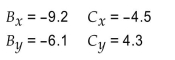 The angle (less than 180°) between vectors
 is closest to
and are given as follows:
The angle (less than 180°) between vectors is closest to (Multiple Choice)
4.7/5 (75)
(75) You walk 33 m to the north, then turn  to your right and walk another 45 m. How far are you from where you originally started?
 (Multiple Choice)
4.7/5 (72)
(72) As shown in the figure, a projectile is fired at time t=0.00 s, from point 0 at the upper edge of a cliff, with initial velocity components of  The projectile rises and then falls into the sea at point P . The time of flight of the projectile is 75.0 s, and air resistance is negligible. At this location,
 What is the horizontal distance D ?
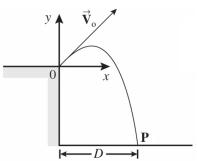
The projectile rises and then falls into the sea at point P . The time of flight of the projectile is 75.0 s, and air resistance is negligible. At this location, What is the horizontal distance D ?
(Multiple Choice)
4.9/5 (84)
(84) A celebrating student throws a water balloon horizontally from a dormitory window that
is 50 m above the ground. It hits the ground at a point 60 m from the building without
appreciable air resistance.
(a) What will be the horizontal component of the velocity of the balloon just before it hits
the ground?
(b) What will be the magnitude of the vertical velocity of the balloon just before it hits the
ground?
(Short Answer)
4.8/5 (70)
(70) A 960-m wide river flows at 16 m/s as shown in the figure. Alice and John have a race in
identical boats which each travel 20 m/s in still water. Alice leaves point A and steers so
that she goes straight to point B directly across and then back to A. John leaves point A
and steers up to point C (960 m upstream) and then returns to A.
(a) Which person arrives back at point A first?
(b) How much sooner than the loser does the winner arrive back at point A? 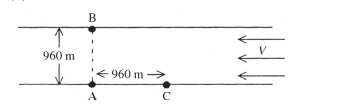
(Essay)
5.0/5 (72)
(72) The figure shows a 100-kg block being released from rest from a height of 1.0 m. It then takes 0.53 s for it to reach the floor. What is the mass m of the block on the left? There is no friction or mass in
The pulley, and the connecting rope is very light.

(Multiple Choice)
4.7/5 (87)
(87) A hobbyist launches a projectile from ground level on a horizontal plain. It reaches a maximum height of 72.3 m and lands 111 m from the launch point, with no appreciable air resistance. What
Was the angle of launch if g = 9.80 m/s²?
(Multiple Choice)
4.9/5 (80)
(80) Vector  has a magnitude of 6.0 m and points
 south of east. Vector
 has a magnitude of 4.0 m and points
 west of south. The resultant vector
 is given by
has a magnitude of 6.0 m and points south of east. Vector has a magnitude of 4.0 m and points west of south. The resultant vector is given by (Multiple Choice)
4.9/5 (68)
(68) The magnitude of a vector can never be less than the magnitude of any of its components.
(True/False)
4.8/5 (84)
(84) Consider two vectors  shown in the figure. The difference
 is best illustrated by
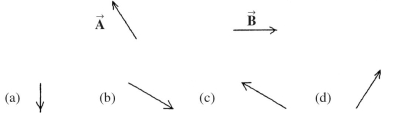
shown in the figure. The difference is best illustrated by
(Multiple Choice)
4.9/5 (87)
(87) Three vectors,  , have the components shown in the table. What angle does the resultant of these three vectors make with the

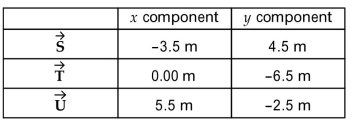
, have the components shown in the table. What angle does the resultant of these three vectors make with the
(Multiple Choice)
4.8/5 (77)
(77) If a vector  has components
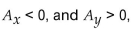 then the angle that this vector makes with the positive x -axis must be in the range
has components then the angle that this vector makes with the positive x -axis must be in the range (Multiple Choice)
4.8/5 (92)
(92) Vector  has a magnitude of 4.0 m and points
 south of east. Vector
 has a magnitude of 2.0 m and points
 north of west. The resultant vector
 is given by
has a magnitude of 4.0 m and points south of east. Vector has a magnitude of 2.0 m and points north of west. The resultant vector is given by (Multiple Choice)
5.0/5 (77)
(77) A hockey puck slides off the edge of a horizontal platform with an initial velocity of 28.0 m/shorizontally in a city where the acceleration due to gravity is 9.81 m/s². The puck experiences
No significant air resistance as it falls. The height of the platform above the ground is 2.00 m. What
Is the angle below the horizontal of the velocity of the puck just before it hits the ground?
(Multiple Choice)
4.9/5 (92)
(92) A boy jumps with a velocity of magnitude 20.0 m/s at an angle of  above the horizontal. What is the horizontal component of the boy's velocity?
 (Multiple Choice)
4.8/5 (82)
(82) An object slides on a level floor. It slows and comes to a stop with a constant acceleration of magnitude 2.4 m/s². What is the coefficient of kinetic friction between the object and the floor?
(Multiple Choice)
4.8/5 (79)
(79) The sum of two vectors of fixed magnitudes has the greatest magnitude when the angle between these two vectors is
(Multiple Choice)
4.9/5 (84)
(84) Mary and Debra stand on a snow-covered roof. They both throw snowballs with the same initial speed, but in different directions. Mary throws her snowball downward, at 30° below the
Horizontal; Debra throws her snowball upward, at  bove the horizontal. Which of the
Following statements are true about just as the snowballs reach the ground below? (There could be
More than one correct choice.)
bove the horizontal. Which of the
Following statements are true about just as the snowballs reach the ground below? (There could be
More than one correct choice.) (Multiple Choice)
4.8/5 (74)
(74) 
Filters
- Essay(0)
- Multiple Choice(0)
- Short Answer(0)
- True False(0)
- Matching(0)