



 Chat with AI
Exam 5: Circular Motion; Gravitation

Exam 1: Introduction, Measurement, Estimating29 Questions
Exam 2: Describing Motion: Kinematics in One Dimension527 Questions
Exam 3: Kinematics in Two Dimensions; Vectors183 Questions
Exam 4: Dynamics: Newtons Laws of Motion146 Questions
Exam 5: Circular Motion; Gravitation105 Questions
Exam 6: Work and Energy153 Questions
Exam 7: Linear Momentum139 Questions
Exam 8: Rotational Motion148 Questions
Exam 9: Static Equilibrium; Elasticity and Fracture83 Questions
Exam 10: Fluids98 Questions
Exam 11: Oscillations and Waves114 Questions
Exam 12: Sound21 Questions
Exam 13: Temperature and Kinetic Theory87 Questions
Exam 14: Heat88 Questions
Exam 15: The Laws of Thermodynamics78 Questions
Exam 16: Electric Charge and Electric Field99 Questions
Exam 17: Electric Potential107 Questions
Exam 18: Electric Currents96 Questions
Exam 19: Dc Circuits384 Questions
Exam 20: Magnetism164 Questions
Exam 21: Electromagnetic Induction and Faradays Law60 Questions
Exam 22: Electromagnetic Waves167 Questions
Exam 23: Light: Geometric Optics144 Questions
Exam 24: The Wave Nature of Light58 Questions
Exam 25: Optical Instruments156 Questions
Exam 26: The Special Theory of Relativity126 Questions
Exam 27: Early Quantum Theory and Models of the Atom192 Questions
Exam 28: Quantum Mechanics of Atoms74 Questions
Exam 29: Molecules and Solids26 Questions
Exam 30: Nuclear Physics and Radioactivity153 Questions
Exam 31: Nuclear Energy; Effects and Uses of Radiation36 Questions
Exam 32: Elementary Particles19 Questions
Exam 33: Astrophysics and Cosmology25 Questions
Select questions type


A small 175-g ball on the end of a light string is revolving uniformly on a frictionless
surface in a horizontal circle of diameter 1.0 m. The ball makes 2.0 revolutions every 1.0 s.
(a) What are the magnitude and direction of the acceleration of the ball?
(b) Find the tension in the string.
(Short Answer)
4.7/5  (81)
(81) The International Space Station is orbiting at an altitude of about 370 km above the earth's surface. The mass of the earth is the radius of the earth is and Assume a circular orbit.
(a) What is the period of the International Space Station's orbit?
(b) What is the speed of the International Space Station in its orbit?
(Short Answer)
4.8/5 (83)
(83) If Earth had twice its present mass but it orbited at the same distance from the sun as it does now, its orbital period would be
(Multiple Choice)
4.8/5 (85)
(85) The reason an astronaut in an earth satellite feels weightless is that
(Multiple Choice)
4.9/5 (80)
(80) A highway curve of radius 80 m is banked at Suppose that an ice storm hits, and the curve is effectively frictionless. What is the speed with which to take the curve without tending to slide either up or down the surface of the road?
(Multiple Choice)
5.0/5 (79)
(79) An astronaut drops a marble on the surface of the airless Planet Z-49 and observes that it takes 1.02 s for the marble to fall 2.00 m starting from rest. She also knows that the radius of Z-49 is 3.39 From this information, what will she determine for the mass of Z-49?
(Multiple Choice)
4.8/5 (81)
(81) A 20-g bead is attached to a light 120-cm-long string as shown in the figure. This bead moves in a horizontal circle with a constant speed of 1.5 m/s. What is the tension in the string if the angle θ is
Measured to be 25°?
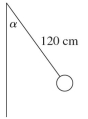
(Multiple Choice)
4.8/5 (88)
(88) Find the orbital speed of an ice cube in the rings of Saturn. The mass of Saturn is and use an orbital radius of
(Multiple Choice)
4.9/5 (79)
(79) A satellite of mass M takes time T to orbit a planet. If the satellite had twice as much mass, the time for it to orbit the planet at the same altitude would be
(Multiple Choice)
5.0/5 (79)
(79) If you swing a bucket of water fast enough in a vertical circle, at the highest point the water does
not spill out. This happens because an outward force balances the pull of gravity on the water.
(True/False)
4.9/5 (89)
(89) In order to simulate weightlessness for astronauts in training, they are flown in a vertical circle. If the passengers are to experience weightlessness, how fast should an airplane be moving at the top
Of a vertical circle with a radius of 2.5 km?
(Multiple Choice)
5.0/5 (77)
(77) A satellite encircles Mars at a distance above its surface equal to 3 times the radius of Mars. If gm is the acceleration due to gravity at the surface of Mars, what is the acceleration due to gravity at the
Location of the satellite?
(Multiple Choice)
4.9/5 (76)
(76) The mass of Pluto is and its radius is
What is the acceleration of a freely-falling object at the surface of Pluto if it has no atmosphere?
(Multiple Choice)
4.8/5 (83)
(83) A curved portion of highway has a radius of curvature of 65 m. As a highway engineer,
you want to bank this curve at the proper angle for a steady speed of 22 m/s.
(a) What banking angle should you specify for this curve?
(b) At the proper banking angle, what normal force and what friction force does the
highway exert on a 750-kg car going around the curve at the proper speed?
(Short Answer)
4.8/5 (85)
(85) Two small objects, with masses m and M, are originally a distance r apart, and the magnitude of the gravitational force on each one is F. The masses are changed to 2m and 2M, and the distance is
Changed to 4r. What is the magnitude of the new gravitational force?
(Multiple Choice)
4.8/5 (76)
(76) Two identical tiny balls of highly compressed matter are 1.50 m apart. When released in an orbiting space station, they accelerate toward each other at
What is the mass of each of them?
(Short Answer)
4.8/5 (91)
(91) Two horizontal curves on a bobsled run are banked at the same angle, but one has twice the radius of the other. The safe speed (for which no friction is needed to stay on the run) for the smaller radius curve is v . What is the safe speed on the larger-radius curve?
(Multiple Choice)
4.8/5 (74)
(74) A highway curve of radius 100 m, banked at an angle of may be negotiated without friction at a speed of
(Multiple Choice)
4.9/5 (79)
(79) Suppose our sun had 4 times its present mass but the earth orbited it at the same distance as it presently does. What would be the length of the year on the earth under those conditions?
(Multiple Choice)
4.8/5 (79)
(79) An object weighs 432 N on the surface of the earth. The earth has radius R . If the object is raised to a height of 3 R above the earth's surface, what is its weight?
(Multiple Choice)
4.9/5 (82)
(82) 
Filters
- Essay(0)
- Multiple Choice(0)
- Short Answer(0)
- True False(0)
- Matching(0)