



 Chat with AI
Exam 3: Polynomial and Rational Functions

Exam 1: Functions and Their Graphs301 Questions
Exam 2: Linear and Quadratic Functions301 Questions
Exam 3: Polynomial and Rational Functions350 Questions
Exam 4: Exponential and Logarithmic Functions518 Questions
Exam 5: Trigonometric Functions366 Questions
Exam 6: Analytic Trigonometry402 Questions
Exam 7: Applications of Trigonometric Functions103 Questions
Exam 8: Polar Coordinates; Vectors270 Questions
Exam 9: Analytic Geometry197 Questions
Exam 10: Systems of Equations and Inequalities235 Questions
Exam 11: Sequences; Induction; the Binomial Theorem238 Questions
Exam 12: Counting and Probability108 Questions
Exam 13: A Preview of Calculus: the Limit, Derivative, and Integral of a Function145 Questions
Exam 14: Review228 Questions
Select questions type


Form a polynomial f(x) with real coefficients having the given degree and zeros.
-Degree: 4; zeros: , and
(Multiple Choice)
4.9/5  (86)
(86) Give the maximum number of zeros the polynomial function may have. Use Descarte's Rule of Signs to determine how
many positive and how many negative zeros it may have.
-
(Multiple Choice)
4.8/5 (86)
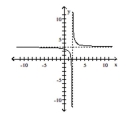
(86) Use the graph to find the oblique asymptote, if any, of the function.
-
(Multiple Choice)
5.0/5 (64)
(64) Find all zeros of the function and write the polynomial as a product of linear factors.
-
(Multiple Choice)
4.8/5 (76)
(76) Form a polynomial whose zeros and degree are given. Use a leading coefficient of 1.
-Zeros: 0, - 7, 6; degree 3 A)
B)
C)
D)
(Multiple Choice)
4.8/5 (76)
(76) Form a polynomial f(x) with real coefficients having the given degree and zeros.
-Degree: 3 ; zeros: and .
(Multiple Choice)
5.0/5 (81)
(81) Solve the problem.
-Decide which of the rational functions might have the given graph. 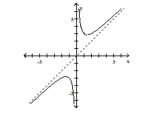 A)
B)
C)
D)
A)
B)
C)
D) (Multiple Choice)
4.9/5 (98)
(98) Solve the problem.
-A closed box with a square base has to have a volume of 16,000 cubic inches. Find a function for the surface area of the box. A)
B)
C)
D)
(Multiple Choice)
4.9/5 (82)
(82) Information is given about a polynomial f(x) whose coefficients are real numbers. Find the remaining zeros of f.
-Degree 5; zeros:
(Multiple Choice)
4.9/5 (84)
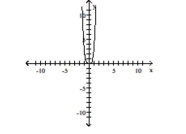
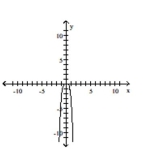
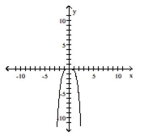
(84) Use transformations of the graph o to graph the function.
-
 A)
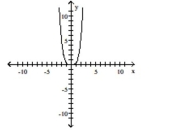 B)
 C)
 D)
A)
B)
C)
D)
(Multiple Choice)
4.9/5 (84)
(84) Use the given zero to find the remaining zeros of the function.
-
(Multiple Choice)
4.8/5 (70)
(70) Use the graph to determine the domain and range of the function.
-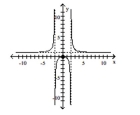 A) domain: or
range:
B) domain: all real numbers
range: all real numbers
C) domain:
range: or
D) domain:
range: or
A) domain: or
range:
B) domain: all real numbers
range: all real numbers
C) domain:
range: or
D) domain:
range: or (Multiple Choice)
4.8/5 (78)
(78) Information is given about a polynomial f(x) whose coefficients are real numbers. Find the remaining zeros of f.
-Degree 5; zeros: , i,
(Multiple Choice)
4.8/5 (71)
(71) Use the Intermediate Value Theorem to determine whether the polynomial function has a zero in the given interval.
-
(Multiple Choice)
4.7/5 (80)
(80) Give the equation of the horizontal asymptote, if any, of the function.
-
(Multiple Choice)
4.7/5 (72)
(72) Give the equation of the oblique asymptote, if any, of the function.
-
(Multiple Choice)
4.9/5 (70)
(70) Solve the problem.
-A ball is thrown vertically upward with an initial velocity of 128 feet per second. The distance in feet of the ball from the ground after t seconds is . For what intervals of time is the ball less than 112 above the
Ground (after it is tossed until it returns to the ground)? A) and
B) and
C) and
D)
(Multiple Choice)
4.9/5 (90)
(90) 
Filters
- Essay(0)
- Multiple Choice(0)
- Short Answer(0)
- True False(0)
- Matching(0)