



 Chat with AI
Exam 9: Analytic Geometry

Exam 1: Functions and Their Graphs301 Questions
Exam 2: Linear and Quadratic Functions301 Questions
Exam 3: Polynomial and Rational Functions350 Questions
Exam 4: Exponential and Logarithmic Functions518 Questions
Exam 5: Trigonometric Functions366 Questions
Exam 6: Analytic Trigonometry402 Questions
Exam 7: Applications of Trigonometric Functions103 Questions
Exam 8: Polar Coordinates; Vectors270 Questions
Exam 9: Analytic Geometry197 Questions
Exam 10: Systems of Equations and Inequalities235 Questions
Exam 11: Sequences; Induction; the Binomial Theorem238 Questions
Exam 12: Counting and Probability108 Questions
Exam 13: A Preview of Calculus: the Limit, Derivative, and Integral of a Function145 Questions
Exam 14: Review228 Questions
Select questions type


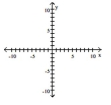 A)
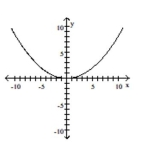 B)
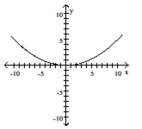 C)
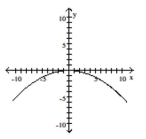 D)
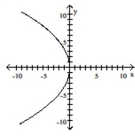

Identify the equation without applying a rotation of axes.
-
(Multiple Choice)
4.9/5  (78)
(78) Find an equation of the parabola described.
-Focus at (5, 0); vertex at (0, 0) A)
B)
C)
D)
(Multiple Choice)
4.9/5 (80)
(80) 
Find the center, transverse axis, vertices, foci, and asymptotes of the hyperbola.
-
(Multiple Choice)
4.8/5 (87)
(87) Find the vertex, focus, and directrix of the parabola with the given equation.
-
(Multiple Choice)
4.9/5 (82)
(82) Find a rectangular equation for the plane curve defined by the parametric equations.
-Ron throws a ball straight up with an initial speed of 70 feet per second from a height of 3 feet. Find parametric equations that describe the motion of the ball as a function of time. How long is the ball in the air? When is the
Ball at its maximum height? What is the maximum height of the ball? A) and
,
25 feet
B) and
,
feet
C) and
,
feet
D) and
,
31 feet
(Multiple Choice)
5.0/5 (90)
(90) Rotate the axes so that the new equation contains no xy-term. Graph the new equation.
-
(Multiple Choice)
4.8/5 (72)
(72) Find an equation for the ellipse described.
-Center at focus at ; vertex at
(Multiple Choice)
4.7/5 (99)
(99) Solve the problem.
-The orbit of a planet around a sun is an ellipse with the sun at one focus. The aphelion of a planet is its greatest distance from the sun, its perihelion is its shortest distance, and its mean distance is the length of the semimajor
Axis of the elliptical orbit. If a planet has a perihelion of 522.2 million miles and a mean distance of 525 million miles, write an equation for the orbit of the planet around the sun. A)
B)
C)
D)
(Multiple Choice)
4.9/5 (74)
(74) Find a rectangular equation for the plane curve defined by the parametric equations.
-A baseball player hit a baseball with an initial speed of 160 feet per second at an angle of 40° to the horizontal.The ball was hit at a height of 4 feet off the ground. Find parametric equations that describe the motion of the ball as a function of time. How long is the ball in the air? When is the ball at its maximum height? What is the
Distance the ball traveled? A) and
,
feet
B) and
,
feet
C) and
,
feet
D) and
,
feet
(Multiple Choice)
4.9/5 (79)
(79) 
Solve the problem.
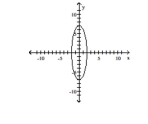
-An arch in the form of a semiellipse is 52 ft wide at the base and has a height of 20 ft. How wide is the arch at a height of 12 ft above the base?
(Multiple Choice)
4.8/5 (79)
(79) Find an equation of the parabola described.
-Focus at vertex at
(Multiple Choice)
4.9/5 (77)
(77) Rotate the axes so that the new equation contains no xy-term. Discuss the new equati
-
(Multiple Choice)
4.9/5 (69)
(69) Find a rectangular equation for the plane curve defined by the parametric equations.
-
(Multiple Choice)
4.8/5 (84)
(84) 

Filters
- Essay(0)
- Multiple Choice(0)
- Short Answer(0)
- True False(0)
- Matching(0)