



 Chat with AI
Exam 20: Decision Making

Exam 1: Defining and Collecting Data200 Questions
Exam 2: Organizing and Visualizing189 Questions
Exam 3: Numerical Descriptive Measures80 Questions
Exam 4: Basic Probability108 Questions
Exam 5: Discrete Probability Distributions81 Questions
Exam 6: Conthe Tinuonormausl Disdis Tributionstribution and Other38 Questions
Exam 7: Sampling Distributions62 Questions
Exam 8: Confidence Interval Estimation139 Questions
Exam 9: Fundamentals of Hypothesis Testing: One-Sample Tests133 Questions
Exam 10: Two-Sample Tests95 Questions
Exam 11: Analysis of Variance73 Questions
Exam 12: Chi-Square and Nonparametric100 Questions
Exam 13: Simple Linear Regression89 Questions
Exam 14: Introduction to Multiple113 Questions
Exam 15: Multiple Regression62 Questions
Exam 16: Time-Series Forecasting61 Questions
Exam 17: Business Analytics102 Questions
Exam 18: A Roadmap for Analyzing Data133 Questions
Exam 19: Statistical Applications in Quality Management86 Questions
Exam 20: Decision Making121 Questions
Select questions type


Blossom's Flowers purchases roses for sale for Valentine's Day.The roses are purchased for $10 a
Dozen and are sold for $20 a dozen.Any roses not sold on Valentine's Day can be sold for $5 per
Dozen.The owner will purchase 1 of 3 amounts of roses for Valentine's Day: 100, 200, or 400 dozen
Roses.Given 0.2, 0.4, and 0.4 are the probabilities for the sale of 100, 200, or 400 dozen roses,
Respectively, then the optimal alternative using EMV for selling roses is to buy dozen
Roses.
(Multiple Choice)
4.8/5  (78)
(78) For a potential investment of $5,000, a portfolio has an EMV of $1,000 and a standard deviation of
$100.The return to risk ratio is
(Multiple Choice)
4.9/5 (96)
(96) SCENARIO 20-1 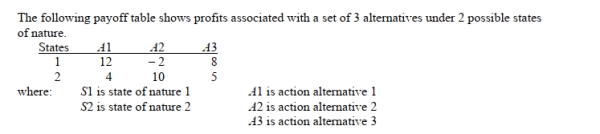 -Referring to Scenario 20-1, if the probability of S1 is 0.5, then the expected monetary value (EMV )
For A1 is
-Referring to Scenario 20-1, if the probability of S1 is 0.5, then the expected monetary value (EMV )
For A1 is (Multiple Choice)
4.9/5 (78)
(78) SCENARIO 20-5 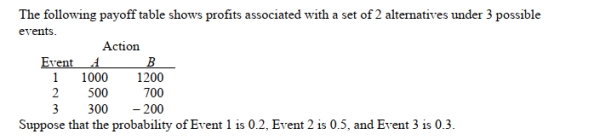 -Referring to Scenario 20-5, what is the EOL for Action B?
 (Essay)
4.8/5 (83)
(83) A tabular presentation that shows the outcome for each decision alternative under the various states of
Nature is called:
(Multiple Choice)
4.9/5 (85)
(85) _________ is a procedure for revising probabilities based upon additional information.
(Multiple Choice)
5.0/5 (77)
(77) SCENARIO 20-1
-Referring to Scenario 20-1, what is the best action using the maximin criterion?
-Referring to Scenario 20-1, what is the best action using the maximin criterion? (Multiple Choice)
5.0/5 (73)
(73) SCENARIO 20-5
-Referring to Scenario 20-5, what is the opportunity loss for Action B with Event 3?
-Referring to Scenario 20-5, what is the opportunity loss for Action B with Event 3? (Essay)
4.8/5 (72)
(72) SCENARIO 20-5
-Referring to Scenario 20-5, what is the optimal action using EMV?
-Referring to Scenario 20-5, what is the optimal action using EMV? (Essay)
4.7/5 (82)
(82) SCENARIO 20-2 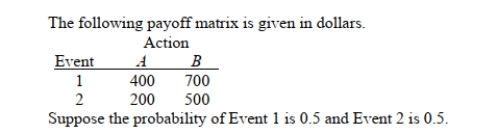 -Referring to Scenario 20-2, the EMV for Action A is
 (Multiple Choice)
4.9/5 (90)
(90) SCENARIO 20-6
A student wanted to find out the optimal strategy to study for a Business Statistics exam.He
constructed the following payoff table based on the mean amount of time he needed to study every
week for the course and the degree of difficulty of the exam.From the information that he gathered
from students who had taken the course, he concluded that there was a 40% probability that the exam
would be easy.  -Referring to Scenario 20-6, how many possible courses of action are there?
 (Essay)
4.8/5 (73)
(73) A medical doctor is involved in a $1 million malpractice suit.He can either settle out of court for
$250,000 or go to court.If he goes to court and loses, he must pay $825,000 plus $175,000 in court
Costs.If he wins in court the plaintiffs pay the court costs.Identify the actions of this decision-making
Problem.
(Multiple Choice)
4.9/5 (76)
(76) SCENARIO 20-6
A student wanted to find out the optimal strategy to study for a Business Statistics exam.He
constructed the following payoff table based on the mean amount of time he needed to study every
week for the course and the degree of difficulty of the exam.From the information that he gathered
from students who had taken the course, he concluded that there was a 40% probability that the exam
would be easy.
-True or False: Referring to Scenario 20-6, the optimal strategy using the coefficient of variation
criterion is to study 8 hours per week on average for the exam.
-True or False: Referring to Scenario 20-6, the optimal strategy using the coefficient of variation
criterion is to study 8 hours per week on average for the exam. (True/False)
4.8/5 (68)
(68) SCENARIO 20-5
-Referring to Scenario 20-5, what is the opportunity loss for Action A with Event 1?
-Referring to Scenario 20-5, what is the opportunity loss for Action A with Event 1? (Essay)
4.8/5 (84)
(84) SCENARIO 20-5
-Referring to Scenario 20-5, what is the optimal action using maximax criterion?
-Referring to Scenario 20-5, what is the optimal action using maximax criterion? (Essay)
4.8/5 (79)
(79) In a local cellular phone area, company A accounts for 60% of the cellular phone market, while
Company B accounts for the remaining 40% of the market.Of the cellular calls made with company
A, 1% of the calls will have some sort of interference, while 2% of the cellular calls with company B
Will have interference.If a cellular call is selected at random, the probability that it will have
Interference is
(Multiple Choice)
4.9/5 (70)
(70) The risk- _______ curve represents the expected monetary value approach.
(Essay)
4.7/5 (81)
(81) SCENARIO 20-6
A student wanted to find out the optimal strategy to study for a Business Statistics exam.He
constructed the following payoff table based on the mean amount of time he needed to study every
week for the course and the degree of difficulty of the exam.From the information that he gathered
from students who had taken the course, he concluded that there was a 40% probability that the exam
would be easy.
-Referring to Scenario 20-6, what is the expected opportunity loss of spending 8 hours per week on
average studying for the exam?
-Referring to Scenario 20-6, what is the expected opportunity loss of spending 8 hours per week on
average studying for the exam? (Essay)
4.7/5 (77)
(77) At Eastern University, 60% of the students are from suburban areas, 30% are from rural areas, and
10% are from urban areas.Of the students from the suburban areas, 60% are nonbusiness majors.Of
The students from the rural areas, 70% are nonbusiness majors.Of the students from the urban areas,
90% are nonbusiness majors.If a randomly selected student is not a business major, the probability
That the student is from the urban area is
(Multiple Choice)
4.8/5 (70)
(70) SCENARIO 20-6
A student wanted to find out the optimal strategy to study for a Business Statistics exam.He
constructed the following payoff table based on the mean amount of time he needed to study every
week for the course and the degree of difficulty of the exam.From the information that he gathered
from students who had taken the course, he concluded that there was a 40% probability that the exam
would be easy.
-True or False: Referring to Scenario 20-6, the optimal strategy using the maximax criterion is to
study 8 hours per week on average for the exam.
-True or False: Referring to Scenario 20-6, the optimal strategy using the maximax criterion is to
study 8 hours per week on average for the exam. (True/False)
4.8/5 (82)
(82) 
Filters
- Essay(0)
- Multiple Choice(0)
- Short Answer(0)
- True False(0)
- Matching(0)