



 Chat with AI
Exam 7: Probability: Living With the Odds

Exam 1: Thinking Critically195 Questions
Exam 2: Approaches to Problem Solving149 Questions
Exam 3: Numbers in the Real World290 Questions
Exam 4: Managing Money262 Questions
Exam 5: Statistical Reasoning230 Questions
Exam 6: Putting Statistics to Work258 Questions
Exam 7: Probability: Living With the Odds261 Questions
Exam 8: Exponential Astonishment103 Questions
Exam 9: Modeling Our World85 Questions
Exam 10: Modeling With Geometry127 Questions
Exam 11: Mathematics and the Arts62 Questions
Select questions type


Provide an appropriate response.
-Which (if any)of the following statements is/are true? A: If two events are dependent, then they must be mutually exclusive : If two events are mutually exclusive, then they must be dependent
(Multiple Choice)
4.9/5  (72)
(72) Find the indicated probability. Round your answer to 6 decimal places when necessary.
-Two 6-sided dice are rolled. What is the probability that the two numbers obtained differ by more than 2?
(Multiple Choice)
4.8/5 (78)
(78) Find the indicated probability.
-The following table show the results of a clinical trial for an allergy drug. Allergy drug Placebo Control (no treatment) Total Improvement 145 85 41 271 No improvement 55 115 59 229 Total 200 200 100 500 What is the probability that a randomly selected person was given the allergy drug and improved? Round your answer to the nearest thousandth when necessary.
(Multiple Choice)
4.7/5 (76)
(76) Find the expected value.
-An insurance policy sells for $750. Based on past data, an average of 1 in 80 policyholders will file a $10,000 claim, an average of 1 in 140 policyholders will file a $20,000 claim, and an average of 1 in
200 policyholders will file a $50,000 claim. What is the expected value to the company per policy
Sold?
(Multiple Choice)
4.7/5 (81)
(81) Write the word or phrase that best completes each statement or answers the question.
-If you flip a fair coin 10 times would you be surprised if the coin comes up the same way
every time? What would be the probability of this?
If 2000 people all flip a fair coin 10 times, on average how many people could be expected
to get the same thing all 10 times?
(Essay)
4.9/5 (80)
(80) Solve the problem. Round your answer to 2 decimal places when necessary.
-At an intersection in Normal, Illinois, there were 156 vehicle accidents with 255,083 vehicles passing through the intersection. Determine the accident rate per 10,000 vehicles.
(Multiple Choice)
4.8/5 (67)
(67) Find the indicated probability. Round your answer to 6 decimal places when necessary.
-A fair die is rolled. What is the probability of rolling an odd number or a number less than 3?
(Multiple Choice)
4.9/5 (61)
(61) Solve the problem.
-If 6 newborn babies are randomly selected, how many different gender sequences are possible?
(Multiple Choice)
4.9/5 (82)
(82) Solve the problem.
-Determine the probability that in a class of 12 students, at least two students have the same birthday. Assume that birth rates are constant throughout the year.
(Hint: First determine the probability that no two students have the same birthday and then apply
The complementation rule.)
(Multiple Choice)
4.9/5 (85)
(85) Find the indicated probability. Round your answer to 6 decimal places when necessary.
-One card is selected from a deck of cards. Find the probability of selecting a red card or a queen.
(Multiple Choice)
4.7/5 (80)
(80) Provide an appropriate response.
-A game involves tossing a fair coin 200 times. For each tail that appears you lose $1. For each head that appears, you win $1.
After 100 tosses, there have been 40 heads and 60 tails. At this point, with 100 tosses to go, what
Can you conclude?
A: You are more likely to lose than to win.
B: You are still equally likely to win or lose because in the long run there should be 50% heads.
C: In the next 100 tosses you are likely to get more heads than tails.
(Multiple Choice)
4.8/5 (72)
(72) Use the relative frequency method to estimate the probability. Round your answer to 2 decimal places when necessary.
-In a poll, respondents were asked whether they were planning to vote in the local election. 315 respondents indicated that they were planning to vote and 217 said that they were not. What is the
Probability that the next respondent questioned will indicate that they are planning to vote?
(Multiple Choice)
4.8/5 (78)
(78) Provide an appropriate response.
-Which of the following statements makes sense? A: When a balanced die is rolled, there are 6 possible outcomes, therefore the probability that I roll a six is 1/6
B: On my test there are four possible outcomes, I could get an , a B, a C, or I could fail. Therefore the probability that I get an is
C: When I flip two coins there are three possible outcomes: 0 tails, 1 tail, or 2 tails. Therefore the probability that I will get 1 tail is
(Multiple Choice)
4.9/5 (79)
(79) Provide an appropriate response.
-The permutation formula can be used to determine which of the following? A: The number of ways of completing a test consisting of 10 true/false questions
B: The number of ways of arranging 8 people in a line
: The number of ways a panel of people could vote if each person votes yes or no
(Multiple Choice)
4.8/5 (87)
(87) Solve the problem.
-License plates are made using 2 letters followed by 3 digits. How many plates can be made if repetition of letters and digits is allowed?
(Multiple Choice)
5.0/5 (84)
(84) Solve the problem. Round your answer to 5 decimal places when necessary.
-The table shows the leading causes of death for one country in a single recent year. Cause of Death Deaths Heart Disease 157,550 Cancer 116,450 AIDS 65,760 Stroke 41,100 Pulmonary Disease 38,497 Accidents 35,620 Diabetes 16,577 Pneumonia 15,344 Kidney Disease 8083 Assume a population of 68.5 million. What is the death rate due to accident in deaths per 100,000 of the population
(Multiple Choice)
4.8/5 (79)
(79) Solve the problem. Round your answer to 2 decimal places when necessary.
-The population of a certain country is about 154 million. The overall death rate is 11.6 deaths per 1000. Approximately how many deaths are there in the country?
(Multiple Choice)
5.0/5 (68)
(68) Solve the problem.
-Suppose there are 6 roads connecting town A to town B and 4 roads connecting town B to town C. In how many ways can a person travel from A to C via B?
(Multiple Choice)
4.8/5 (85)
(85) Find the indicated probability.
-A die is rolled 100 times with the following results. Outcome 1 2 3 4 5 6 Frequency 9 25 24 21 9 12
Compute the empirical probability that the die comes up 2 or 3.
(Multiple Choice)
4.7/5 (90)
(90) Find the indicated probability.
-The following table displays a distribution for a group of retired people by career and age at retirement. 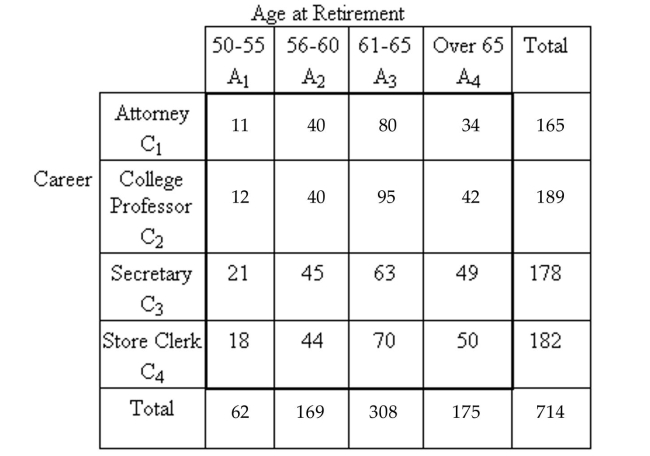 Suppose one of these people is selected at random. Find the probability that the person was a
Secretary or that they retired between ages 56 and 60. Round your answer to the nearest
Thousandth.
Suppose one of these people is selected at random. Find the probability that the person was a
Secretary or that they retired between ages 56 and 60. Round your answer to the nearest
Thousandth. (Multiple Choice)
4.8/5 (71)
(71) 
Filters
- Essay(0)
- Multiple Choice(0)
- Short Answer(0)
- True False(0)
- Matching(0)