



 Chat with AI
Exam 15: Graph Theory

Exam 1: The Art of Problem Solving190 Questions
Exam 2: The Basic Concepts of Set Theory316 Questions
Exam 3: Introduction to Logic315 Questions
Exam 4: Numeration Systems245 Questions
Exam 5: Number Theory171 Questions
Exam 6: The Real Numbers and Their Representations401 Questions
Exam 7: The Basic Concepts of Algebra273 Questions
Exam 8: Graphs, Functions, and Systems of Equations and Inequalities136 Questions
Exam 9: Geometry182 Questions
Exam 10: Counting Methods213 Questions
Exam 11: Probability140 Questions
Exam 12: Statistics152 Questions
Exam 13: Personal Financial Management260 Questions
Exam 14: Trigonometry Formerly234 Questions
Exam 15: Graph Theory110 Questions
Exam 16: Voting and Apportionment99 Questions
Select questions type


James, Carl, Mark, Antonio, Phillip, and Brad are friends at college. Carl, Antonio and
Phillip have calculus together. Brad, Carl, and Mark have the same English composition
class. Draw a graph with vertices representing students and edges representing the relation
"take a common class". How many components does the graph have? Identify a subgraph
that is a complete subgraph with three vertices.
(Essay)
4.9/5  (97)
(97) 
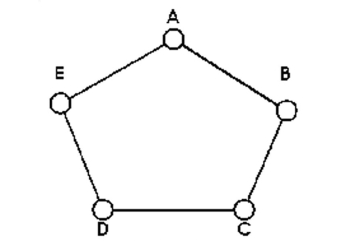
Determine whether the sequence of vertices is an Euler circuit.
-
(Multiple Choice)
4.9/5 (87)
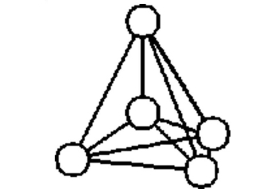
(87) 
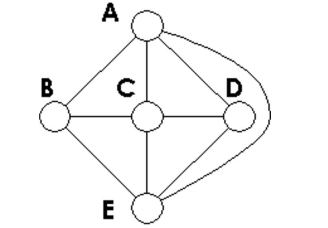
Determine how many vertices and how many edges the graph has.
-
(Multiple Choice)
4.9/5 (69)
(69) 
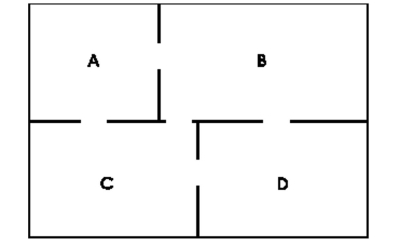
Determine whether the two graphs are isomorphic. If they are, illustrate the isomorphism.
-(a)
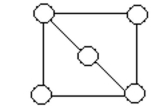 (b)
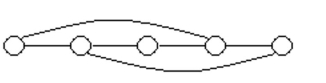
(b)
(Essay)
4.8/5 (91)
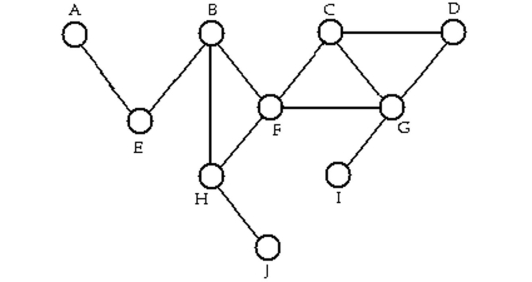
(91) Determine whether the sequence of vertices is i)a walk, ii)a path, iii)a circuit in the given graph.
-
(Multiple Choice)
4.8/5 (80)
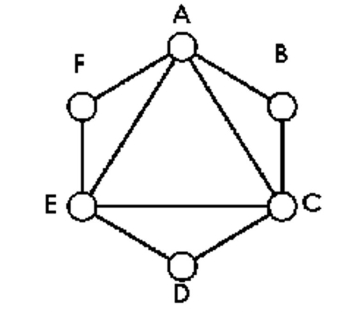
(80) Determine whether the sequence of vertices is an Euler circuit.
-
(Multiple Choice)
4.7/5 (74)
(74) Determine whether the graph is connected or disconnected.
-
(Multiple Choice)
4.9/5 (79)
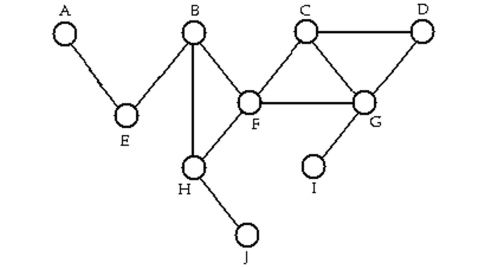
(79) Determine whether the sequence of vertices is i)a walk, ii)a path, iii)a circuit in the given graph.
-
(Multiple Choice)
4.9/5 (81)
(81) 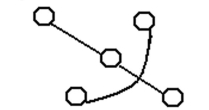
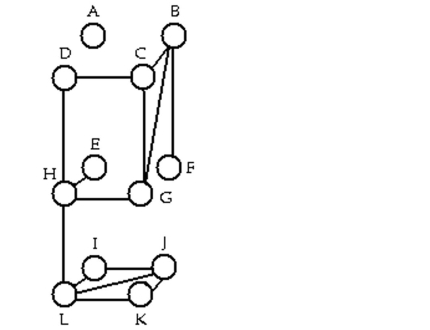
Determine whether the sequence of vertices is i)a walk, ii)a path, iii)a circuit in the given graph.
-
(Multiple Choice)
4.7/5 (80)
(80) 
Seven family members are planning a picnic. They work out the details with a few phone calls. One family member has 5 conversations, two have 3 conversations, and one has only 1 conversation.
How many phone conversations are there?
(Multiple Choice)
4.9/5 (89)
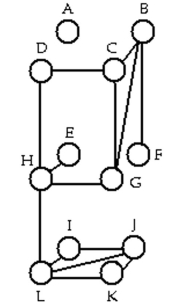
(89) Determine whether the sequence of vertices is i)a walk, ii)a path, iii)a circuit in the given graph.
-
(Multiple Choice)
4.8/5 (76)
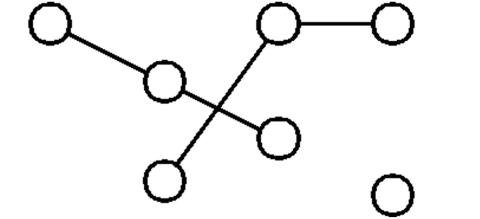
(76) Determine whether the graph is connected or disconnected.
-
(Multiple Choice)
4.8/5 (85)
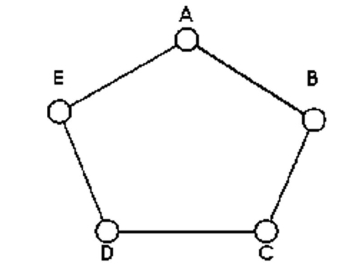
(85) Determine whether the sequence of vertices is an Euler circuit.
-
(Multiple Choice)
4.9/5 (65)
(65) Solve the problem.
-An internet user is participating simultaneously in one-on-one chat sessions with 5 other
people. Draw a graph with vertices representing users and edges representing chat
sessions. How many chat sessions are occurring?
(Essay)
4.9/5 (90)
(90) 
Filters
- Essay(0)
- Multiple Choice(0)
- Short Answer(0)
- True False(0)
- Matching(0)