



 Chat with AI
Exam 11: Introductory Geometry

Exam 1: An Introduction to Problem Solving85 Questions
Exam 2: Introduction to Logic and Sets153 Questions
Exam 3: Numeration Systems and Whole Number Operations194 Questions
Exam 4: Number Theory116 Questions
Exam 5: Integers122 Questions
Exam 6: Rational Numbers and Proportional Reasoning85 Questions
Exam 7: Rational Numbers As Decimals and Percents102 Questions
Exam 8: Real Numbers and Algebraic Thinking151 Questions
Exam 9: Probability129 Questions
Exam 10: Data Analysisstatistics: an Introduction57 Questions
Exam 11: Introductory Geometry115 Questions
Exam 12: Congruence and Similarity With Constructions121 Questions
Exam 13: Congruence and Similarity With Transformations56 Questions
Exam 14: Area, Pythagorean Theorem, and Volume124 Questions
Select questions type


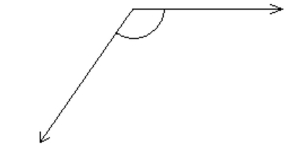
Tell whether the angle is acute, right, obtuse, or straight.
-
(Multiple Choice)
5.0/5  (81)
(81) Convert the given angle measure to a decimal rounded to the nearest hundredth.
-144°31'4''
(Multiple Choice)
4.9/5 (79)
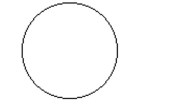
(79) Choose the terminology that best classifies the given figure.
-
(Multiple Choice)
4.9/5 (83)
(83) Complete the sketch so that it has the indicated symmetry.
-Complete the sketch so that it has line symmetry about l. 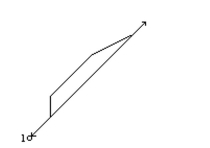
(Essay)
4.7/5 (79)
(79) Complete the sketch so that it has the indicated symmetry.
-Complete the sketch so that it has line symmetry about l. 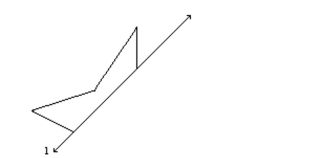
(Essay)
5.0/5 (74)
(74) 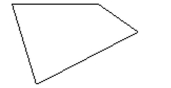
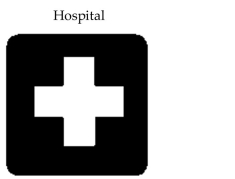
Various signs have symmetries. Determine if the following sign has line symmetry, turn symmetry, and/or point symmetry, if any.
-
(Multiple Choice)
4.8/5 (89)
(89) Refer to this figure to answer the question.
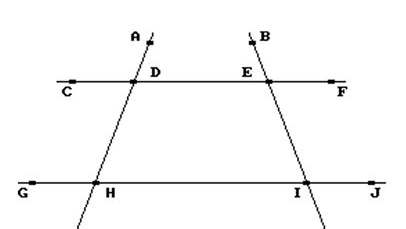 -Are and the same line?
 (Multiple Choice)
4.8/5 (88)
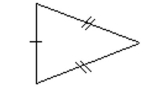
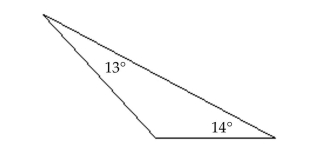
(88) Identify the triangle as scalene, isosceles, or equilateral.
-
(Multiple Choice)
4.7/5 (84)
(84) Find the measure of the dihedral angle indicated.
-The figure shown is a right prism whose bases are regular octagons. Find the measure of the dihedral angle between adjacent lateral faces. 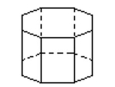
(Multiple Choice)
4.8/5 (91)
(91) Answer the question.
-What is the least and maximum number of lines obtainable with 6 points?
(Multiple Choice)
4.8/5 (75)
(75) Refer to this figure to answer the question.
-What are the endpoints of ?
-What are the endpoints of ? (Multiple Choice)
4.8/5 (76)
(76) 
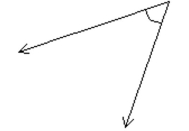
Tell whether the angle is acute, right, obtuse, or straight.
-
(Multiple Choice)
5.0/5 (90)
(90) Convert the given angle measure to degrees, minutes, and seconds.
-160.06°
(Multiple Choice)
4.8/5 (69)
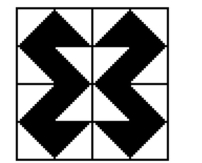
(69) Determine the types of symmetry that the quilt pattern below has (line, turn, point), if any.
-
(Multiple Choice)
4.8/5 (70)
(70) Answer the question.
-How many lines can be drawn through 12 points, no three of which are collinear?
(Multiple Choice)
4.9/5 (87)
(87) Convert the given angle measure to a decimal rounded to the nearest hundredth.
-77°21'55''
(Multiple Choice)
4.8/5 (81)
(81) 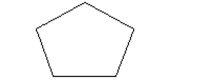
Find the measure of the dihedral angle indicated.
-The figure shown is a right prism whose bases are regular nonagons. Find the measure of the dihedral angle between each lateral face and a base. 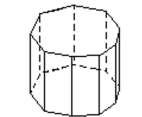
(Multiple Choice)
5.0/5 (83)
(83) 
Filters
- Essay(0)
- Multiple Choice(0)
- Short Answer(0)
- True False(0)
- Matching(0)