



 Chat with AI
Exam 6: Trigonometric Functions

Exam 1: Review of Basic Concepts639 Questions
Exam 2: Equations and Inequalities496 Questions
Exam 3: Graphs and Functions522 Questions
Exam 4: Polynomial and Rational Functions508 Questions
Exam 5: Inverse, Exponential, and Logarithmic Functions472 Questions
Exam 6: Trigonometric Functions297 Questions
Exam 7: The Circular Functions and Their Graphs286 Questions
Exam 8: Trigonometric Identities and Equations492 Questions
Exam 9: Applications of Trigonometry447 Questions
Exam 10: Systems and Matrices507 Questions
Exam 11: Analytic Geometry217 Questions
Exam 12: Further Topics in Algebra348 Questions
Select questions type


Solve the problem.
-A fire is sighted due west of lookout . The bearing of the fire from lookout miles due south of A, is . How far is the fire from B (to the nearest tenth of a mile)?
(Multiple Choice)
4.8/5  (71)
(71) Convert the angle to decimal degrees and round to the nearest hundredth of a degree.
-
(Multiple Choice)
4.8/5 (72)
(72) Solve the right triangle. If two sides are given, give angles in degrees and minutes.
-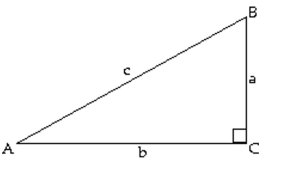 Round side lengths to two decimal places.
 (Multiple Choice)
4.8/5 (56)
(56) Without using a calculator, give the exact trigonometric function value with rational denominator.
-
(Multiple Choice)
4.7/5 (74)
(74) Give an expression that generates all angles coterminal with the given angle. Let n represent any integer.
-
(Multiple Choice)
4.7/5 (66)
(66) Decide whether the statement is possible or impossible for an angle
-
(Multiple Choice)
5.0/5 (84)
(84) Use the fundamental identities to find the value of the trigonometric function.
-Find , given that and is in quadrant IV.
(Multiple Choice)
4.8/5 (69)
(69) 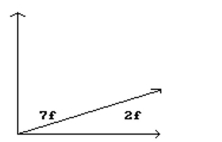
Solve the right triangle. If two sides are given, give angles in degrees and minutes.
-From a boat on the river below a dam, the angle of elevation to the top of the dam is . If the dam is 1421 feet above the level of the river, how far is the boat from the base of the dam (to the nearest foot)?
(Multiple Choice)
4.7/5 (75)
(75) Find the angle of least positive measure coterminal with the given angle.
-
(Multiple Choice)
4.9/5 (76)
(76) Use a calculator to find the function value. Give your answer rounded to seven decimal places, if necessary.
-
(Multiple Choice)
5.0/5 (70)
(70) Suppose that is in standard position and the given point is on the terminal side of . Give the exact value of the
indicated trig function for
- Find
(Multiple Choice)
4.7/5 (71)
(71) Solve the problem for the given information.
-Find the equation of a line passing through the origin so that the sine of the angle between the line in quadrant and the positive -axis is .
(Multiple Choice)
4.9/5 (91)
(91) Use a calculator to find the function value. Give your answer rounded to seven decimal places, if necessary.
-The grade resistance of a car traveling up or down a hill is modeled by the equation , where is the weight of the car and is the angle of the hill's grade for uphill travel, for downhill travel). What is the grade resistance (to the nearest pound) of a car traveling uphill on a grade ?
(Multiple Choice)
4.8/5 (66)
(66) 
Filters
- Essay(0)
- Multiple Choice(0)
- Short Answer(0)
- True False(0)
- Matching(0)