



 Chat with AI
Exam 8: Special Topics in Algebra

Exam 1: Functions, Graphs, and Models; Linear Functions306 Questions
Exam 2: Linear Models, Equations, and Inequalities212 Questions
Exam 3: Quadratic, Piecewise-Defined, and Power Functions261 Questions
Exam 4: Additional Topics With Functions299 Questions
Exam 5: Exponential and Logarithmic Functions304 Questions
Exam 6: Higher-Degree Polynomial and Rational Functions262 Questions
Exam 7: Systems of Equations and Matrices196 Questions
Exam 8: Special Topics in Algebra265 Questions
Select questions type


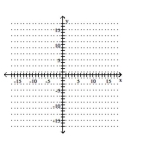
Match the solution of the system of inequalities with the graph.
-
(Multiple Choice)
4.9/5  (73)
(73) 
Find the sum of the first 4 terms of the arithmetic sequence with first term 1 and common difference -2 .
(Multiple Choice)
4.8/5 (78)
(78) 
Write the equation of the circle with the given center and radius.
-center , radius 12
(Multiple Choice)
4.9/5 (65)
(65) 

Find the first five terms of the sequence defined by the given general term.
-
(Multiple Choice)
4.7/5 (83)
(83) Find the center and radius of the circle with the given equation.
-
(Multiple Choice)
4.7/5 (72)
(72) An important calculation in calculus is the evaluation of the expression
-
(Multiple Choice)
4.8/5 (79)
(79) Determine whether the graph of the equation is a circle or an ellipse.
-
(Multiple Choice)
4.7/5 (71)
(71) 
An important calculation in calculus is the evaluation of the expression
-
(Multiple Choice)
4.9/5 (84)
(84) Write the function without radicals by using fractional exponents.
-
(Multiple Choice)
4.9/5 (66)
(66) Write the equation for the shape described.
-The circle with center (19, 17), containing the origin
(Multiple Choice)
4.9/5 (70)
(70) Find the next three terms of the arithmetic sequence.
-Find the 9 th term of the arithmetic sequence with first term 8 and common difference .
(Multiple Choice)
4.9/5 (87)
(87) 
Filters
- Essay(0)
- Multiple Choice(0)
- Short Answer(0)
- True False(0)
- Matching(0)