



 Chat with AI
Exam 12: Pure Monopoly

Exam 1: Limits, Alternatives, and Choices339 Questions
Exam 2: The Market System and the Circular Flow187 Questions
Exam 3: Demand, Supply, and Market Equilibrium296 Questions
Exam 4: Market Failures: Public Goods and Externalities175 Questions
Exam 5: Governments Role and Government Failure258 Questions
Exam 6: Elasticity221 Questions
Exam 7: Utility Maximization186 Questions
Exam 8: Behavioral Economics248 Questions
Exam 9: Businesses and the Costs of Production222 Questions
Exam 10: Pure Competition in the Short Run160 Questions
Exam 11: Pure Competition in the Long Run178 Questions
Exam 12: Pure Monopoly204 Questions
Exam 13: Monopolistic Competition156 Questions
Exam 14: Oligopoly and Strategic Behavior260 Questions
Exam 15: Technology, Rd, and Efficiency228 Questions
Exam 16: The Demand for Resources231 Questions
Exam 17: Wage Determination276 Questions
Exam 18: Rent, Interest, and Profit180 Questions
Exam 19: Natural Resource and Energy Economics280 Questions
Exam 20: Public Finance: Expenditures and Taxes210 Questions
Exam 21: Antitrust Policy and Regulation226 Questions
Exam 22: Agriculture: Economics and Policy190 Questions
Exam 23: Income Inequality, Poverty, and Discrimination265 Questions
Exam 24: Health Care240 Questions
Exam 25: Immigration188 Questions
Exam 26: An Introduction to Macroeconomics199 Questions
Exam 27: Measuring Domestic Output and National Income223 Questions
Exam 28: Economic Growth245 Questions
Exam 29: Business Cycles, Unemployment, and Inflation286 Questions
Exam 30: Basic Macroeconomic Relationships223 Questions
Exam 31: The Aggregate Expenditures Model199 Questions
Exam 32: Aggregate Demand and Aggregate Supply227 Questions
Exam 33: Fiscal Policy, Deficits, and Debt250 Questions
Exam 34: Money, Banking, and Financial Institutions231 Questions
Exam 35: Money Creation177 Questions
Exam 36: Interest Rates and Monetary Policy360 Questions
Exam 37: Financial Economics255 Questions
Exam 38: Extending the Analysis of Aggregate Supply160 Questions
Exam 39: Current Issues in Macro Theory and Policy225 Questions
Exam 40: International Trade205 Questions
Exam 41: The Balance of Payments, Exchange Rates, and Trade Deficits206 Questions
Exam 42: The Economics of Developing Countries245 Questions
Select questions type


For a monopolist, maximum profits will occur when the gap between average revenue (or price) and average cost is biggest.
(True/False)
4.7/5  (70)
(70) A pure monopolist is selling six units at a price of $12.If the marginal revenue of the seventh unit is $5, then the
(Multiple Choice)
4.9/5 (67)
(67) A price discriminating pure monopolist will attempt to charge each buyer (or group of buyers)
(Multiple Choice)
4.9/5 (68)
(68) (Last Word): Alex owns a luxury automobile and regularly purchases high-end fashion items online.Kara drives an old sedan and does most online shopping on eBay and Amazon.Suppose both Alex and Kara search the same online retailer for a nice watch to give on Fathers Day.Based on Big Data and personalized pricing, we would expect
(Multiple Choice)
4.8/5 (71)
(71) If a regulatory commission wants to provide a natural monopoly with a fair return, it should establish a price that is equal to
(Multiple Choice)
4.9/5 (89)
(89) Which phrase would be most characteristic of pure monopoly?
(Multiple Choice)
4.9/5 (88)
(88) 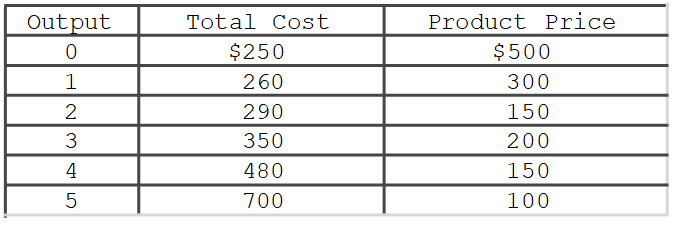 If the profit-maximizing pure monopolist whose information is in the accompanying table is able to price discriminate, charging each customer the price associated with each given level of output, how many units will the firm produce?
 (Multiple Choice)
4.9/5 (89)
(89) Natural monopoly may result where products produce substantial network effects and can be simultaneously consumed by a large number of consumers.
(True/False)
4.8/5 (75)
(75) A monopolist is free to charge whatever price it wishes, to sell a certain level of output.
(True/False)
4.9/5 (79)
(79) When the value of a product to each user, including existing users, increases due to an increase in the total number of users-as in the case of Facebook-we refer to this as
(Multiple Choice)
4.8/5 (70)
(70) If the variable costs of a profit-maximizing pure monopolist decline, the firm should
(Multiple Choice)
4.8/5 (79)
(79) A pure monopolist is producing an output such that ATC = $4, P = $5, MC = $2, and MR = $3.This firm is realizing
(Multiple Choice)
4.9/5 (76)
(76) In a monopoly at equilibrium, price is greater than marginal cost.
(True/False)
4.8/5 (89)
(89) Assume that a monopolist faces a linear demand curve.If the firm is operating at an output level where marginal revenue is positive, the firm
(Multiple Choice)
4.7/5 (69)
(69) 
Filters
- Essay(0)
- Multiple Choice(0)
- Short Answer(0)
- True False(0)
- Matching(0)