



 Chat with AI
Exam 19: Natural Resource and Energy Economics

Exam 1: Limits, Alternatives, and Choices339 Questions
Exam 2: The Market System and the Circular Flow187 Questions
Exam 3: Demand, Supply, and Market Equilibrium296 Questions
Exam 4: Market Failures: Public Goods and Externalities175 Questions
Exam 5: Governments Role and Government Failure258 Questions
Exam 6: Elasticity221 Questions
Exam 7: Utility Maximization186 Questions
Exam 8: Behavioral Economics248 Questions
Exam 9: Businesses and the Costs of Production222 Questions
Exam 10: Pure Competition in the Short Run160 Questions
Exam 11: Pure Competition in the Long Run178 Questions
Exam 12: Pure Monopoly204 Questions
Exam 13: Monopolistic Competition156 Questions
Exam 14: Oligopoly and Strategic Behavior260 Questions
Exam 15: Technology, Rd, and Efficiency228 Questions
Exam 16: The Demand for Resources231 Questions
Exam 17: Wage Determination276 Questions
Exam 18: Rent, Interest, and Profit180 Questions
Exam 19: Natural Resource and Energy Economics280 Questions
Exam 20: Public Finance: Expenditures and Taxes210 Questions
Exam 21: Antitrust Policy and Regulation226 Questions
Exam 22: Agriculture: Economics and Policy190 Questions
Exam 23: Income Inequality, Poverty, and Discrimination265 Questions
Exam 24: Health Care240 Questions
Exam 25: Immigration188 Questions
Exam 26: An Introduction to Macroeconomics199 Questions
Exam 27: Measuring Domestic Output and National Income223 Questions
Exam 28: Economic Growth245 Questions
Exam 29: Business Cycles, Unemployment, and Inflation286 Questions
Exam 30: Basic Macroeconomic Relationships223 Questions
Exam 31: The Aggregate Expenditures Model199 Questions
Exam 32: Aggregate Demand and Aggregate Supply227 Questions
Exam 33: Fiscal Policy, Deficits, and Debt250 Questions
Exam 34: Money, Banking, and Financial Institutions231 Questions
Exam 35: Money Creation177 Questions
Exam 36: Interest Rates and Monetary Policy360 Questions
Exam 37: Financial Economics255 Questions
Exam 38: Extending the Analysis of Aggregate Supply160 Questions
Exam 39: Current Issues in Macro Theory and Policy225 Questions
Exam 40: International Trade205 Questions
Exam 41: The Balance of Payments, Exchange Rates, and Trade Deficits206 Questions
Exam 42: The Economics of Developing Countries245 Questions
Select questions type


If the property rights for forests are clear and enforced, then
(Multiple Choice)
4.9/5  (65)
(65) Alex and Ben are both loggers wanting to harvest timber from the same forest.Alex prefers to harvest and replant at a sustainable rate; Ben wants to harvest as many trees as possible to maximize short-run profit and then move on.They face the same production costs.The forest is more likely to be harvested and replanted at a sustainable rate if
(Multiple Choice)
4.9/5 (89)
(89) Which one of the following statements is true? The fertility rates for major industrialized countries in recent years show that Malthus's theory regarding population is
(Multiple Choice)
4.8/5 (66)
(66) (Consider This) The tragedy of the commons occurs primarily
(Multiple Choice)
4.7/5 (66)
(66) Some nations are increasing the amount of land covered by forests, while others are experiencing rapid deforestation.According to economists, this is largely because
(Multiple Choice)
4.8/5 (73)
(73) The primary focus of natural resource economics is to develop policies for harvesting or extracting natural resources that
(Multiple Choice)
4.8/5 (86)
(86) A fishery collapse happens when a fishery's population grows faster than fish can be harvested.
(True/False)
4.9/5 (83)
(83) In 2014, according to U.S.Energy Information Administration data, which of the following sources of energy contributed the smallest share to U.S.electricity generation?
(Multiple Choice)
4.8/5 (72)
(72) The United States is in imminent danger of running out of energy.
(True/False)
4.9/5 (72)
(72) Which of the following is true about U.S.energy consumption and per capita real GDP since 1990?
(Multiple Choice)
4.8/5 (90)
(90) The key demand-side factors that cause the depletion of finite natural resources are
(Multiple Choice)
4.7/5 (76)
(76) Which of the following is considered a nonrenewable natural resource?
(Multiple Choice)
4.7/5 (85)
(85) 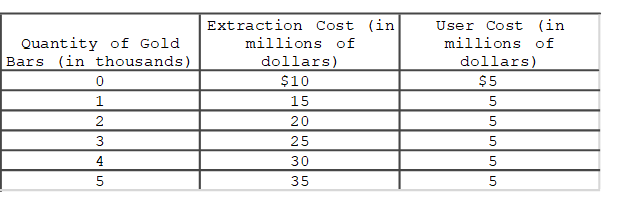 The table shows the quantity of gold bars (Qb) in thousands, the extraction cost for each thousand bars (in millions of dollars), and the user cost of each thousand bars (in millions of dollars) facing the OZ Mining Company this year.Suppose that a new government regulation is going to shut down OZ's mining operation one year from now.If the current price per bar of gold is $25,000, how many bars (in thousands) should OZ extract and sell this year?
 (Multiple Choice)
4.8/5 (73)
(73) 
Filters
- Essay(0)
- Multiple Choice(0)
- Short Answer(0)
- True False(0)
- Matching(0)