



 Chat with AI
Exam 24: Health Care

Exam 1: Limits, Alternatives, and Choices339 Questions
Exam 2: The Market System and the Circular Flow187 Questions
Exam 3: Demand, Supply, and Market Equilibrium296 Questions
Exam 4: Market Failures: Public Goods and Externalities175 Questions
Exam 5: Governments Role and Government Failure258 Questions
Exam 6: Elasticity221 Questions
Exam 7: Utility Maximization186 Questions
Exam 8: Behavioral Economics248 Questions
Exam 9: Businesses and the Costs of Production222 Questions
Exam 10: Pure Competition in the Short Run160 Questions
Exam 11: Pure Competition in the Long Run178 Questions
Exam 12: Pure Monopoly204 Questions
Exam 13: Monopolistic Competition156 Questions
Exam 14: Oligopoly and Strategic Behavior260 Questions
Exam 15: Technology, Rd, and Efficiency228 Questions
Exam 16: The Demand for Resources231 Questions
Exam 17: Wage Determination276 Questions
Exam 18: Rent, Interest, and Profit180 Questions
Exam 19: Natural Resource and Energy Economics280 Questions
Exam 20: Public Finance: Expenditures and Taxes210 Questions
Exam 21: Antitrust Policy and Regulation226 Questions
Exam 22: Agriculture: Economics and Policy190 Questions
Exam 23: Income Inequality, Poverty, and Discrimination265 Questions
Exam 24: Health Care240 Questions
Exam 25: Immigration188 Questions
Exam 26: An Introduction to Macroeconomics199 Questions
Exam 27: Measuring Domestic Output and National Income223 Questions
Exam 28: Economic Growth245 Questions
Exam 29: Business Cycles, Unemployment, and Inflation286 Questions
Exam 30: Basic Macroeconomic Relationships223 Questions
Exam 31: The Aggregate Expenditures Model199 Questions
Exam 32: Aggregate Demand and Aggregate Supply227 Questions
Exam 33: Fiscal Policy, Deficits, and Debt250 Questions
Exam 34: Money, Banking, and Financial Institutions231 Questions
Exam 35: Money Creation177 Questions
Exam 36: Interest Rates and Monetary Policy360 Questions
Exam 37: Financial Economics255 Questions
Exam 38: Extending the Analysis of Aggregate Supply160 Questions
Exam 39: Current Issues in Macro Theory and Policy225 Questions
Exam 40: International Trade205 Questions
Exam 41: The Balance of Payments, Exchange Rates, and Trade Deficits206 Questions
Exam 42: The Economics of Developing Countries245 Questions
Select questions type


The provision of health insurance leads to a deadweight loss due to an overallocation of resources to health care.
(True/False)
4.8/5  (83)
(83) The so-called government tax subsidy for health insurance comes in the form of
(Multiple Choice)
4.9/5 (75)
(75) In 2007, approximately what percentage of people in the United States with private health insurance received it as an employer-provided benefit?
(Multiple Choice)
4.9/5 (84)
(84) Roughly what portion of U.S.total health spending is paid for by private and public insurance?
(Multiple Choice)
4.8/5 (81)
(81) The heavy reliance on private health insurance in the U.S.began during World War II, as a
(Multiple Choice)
4.9/5 (83)
(83) Approximately how many millions of Americans did not have health insurance coverage in 2015?
(Multiple Choice)
4.9/5 (66)
(66) Changes in the average age of the U.S.population over the past decade have decreased the demand for health care.
(True/False)
4.9/5 (72)
(72) A health care organization that contracts with employers to provide health insurance to their workers, and hires doctors and other groups to provide health care for the workers who are insured is a
(Multiple Choice)
4.8/5 (81)
(81) (Consider This) PPACA requirements for health insurance rates created incentives for
(Multiple Choice)
4.8/5 (72)
(72) 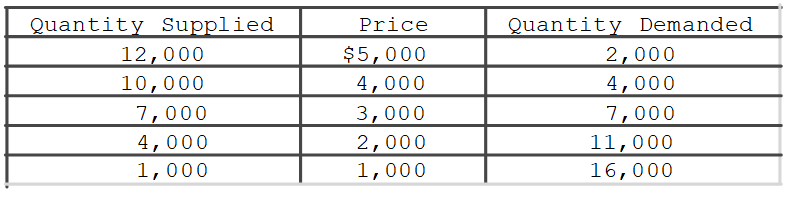 The table shows the hypothetical demand and supply schedule for health care.Assume that health insurance pays two-thirds of the cost of health care.For the consumer, the price and quantity of health care consumed would then be
 (Multiple Choice)
4.8/5 (57)
(57) Singapore's health care system is identified by critics of the PPACA as one good alternative system to study and emulate.Singapore does not have which of the following characteristics?
(Multiple Choice)
4.8/5 (89)
(89) The Patient Protection and Affordable Care Act prohibits insurance companies from denying coverage to anyone on the basis of a preexisting medical condition.
(True/False)
4.9/5 (91)
(91) Since 1960, health care costs in the United States have risen absolutely but remained constant as a percentage of gross domestic product.
(True/False)
4.8/5 (73)
(73) Studies in industrially advanced nations indicate that a 3 percent increase in incomes will generate a
(Multiple Choice)
4.7/5 (84)
(84) Health maintenance organizations (HMOs) are like health clubs that operate facilities where people can exercise and get physical training.
(True/False)
4.9/5 (87)
(87) 
Filters
- Essay(0)
- Multiple Choice(0)
- Short Answer(0)
- True False(0)
- Matching(0)