



 Chat with AI
Exam 15: Insulin Administration

Exam 1: Whole Numbers15 Questions
Exam 2: Fractions7 Questions
Exam 3: Decimals and Percents13 Questions
Exam 4: Dimensional Analysis8 Questions
Exam 5: Measures and Equivalents15 Questions
Exam 6: Conversions20 Questions
Exam 7: Safety Considerations in Medication Administration20 Questions
Exam 8: Prescriptions and Medication Orders16 Questions
Exam 9: Reading Medication Labels and Syringes41 Questions
Exam 10: Reconstituting Parenteral Medications From a Powder18 Questions
Exam 11: Calculations Using Weight and Body Surface Area41 Questions
Exam 12: Intravenous Delivery Systems and Equipmen17 Questions
Exam 13: Intravenous Calculations32 Questions
Exam 14: Enteral Tube Feedings7 Questions
Exam 15: Insulin Administration18 Questions
Exam 16: Heparin Administration20 Questions
Exam 17: Critical Care Dosage Calculations21 Questions
Exam 18: Lifespan Considerations in Dosage Calculation16 Questions
Select questions type


A nurse is preparing a patient's injection of 43 units NPH insulin. Which of the following syringes is the most appropriate to use for this injection?

Free
(Multiple Choice)
5.0/5  (81)
(81) Correct Answer: Verified
B
The nurse is caring for a patient with diabetes mellitus who has pressed the nurse call complains of feeling weak, dizzy, and sweaty. Upon checking a finger stick glucose, the nurse notes the reading is 56 mg/dL. What should the nurse do first?
Free
(Multiple Choice)
4.9/5 (72)
(72) Correct Answer:Verified
VerifiedD
When mixing NPH insulin with regular insulin, which of the following should the nurse draw up in the syringe first?
Free
(Multiple Choice)
4.7/5 (87)
(87) Correct Answer:Verified
VerifiedA
The nurse is preparing to administer Lantus insulin 36 units. Mark the syringe below at the correct dosage.
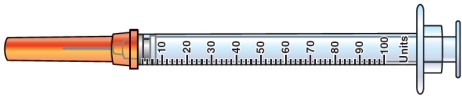
(Short Answer)
4.9/5 (82)
(82) What type of syringe should the nurse choose to administer U-100 insulin?
(Multiple Choice)
4.8/5 (83)
(83) What is the duration of action of long-acting insulins such as insulin glargine (Lantus) and insulin detemir (Levemir)?
(Multiple Choice)
4.9/5 (78)
(78) A nurse suspects that her unconscious patient is experiencing hypoglycemia. The patient has a saline lock in place. Per protocol, what should the nurse do first?
(Multiple Choice)
4.7/5 (76)
(76) A provider orders this sliding scale insulin protocol for a patient:
Administer insulin aspart (Humalog), subcut, before each meal,
Based on the following blood glucose (BG) levels:
BG level less than 110 mg/dL 0 units
BG level between 111 and 150 mg/dL 2 units
BG level between 151 and 170 mg/dL 4 units
BG level between 171 and 199 mg/dL 6 units
BG level over 200 mg/dL Call provider.
The patient's blood glucose just before breakfast is 132 mg/dL. How many units of insulin aspart (Humalog) will the nurse administer?
(Multiple Choice)
5.0/5 (71)
(71) The nurse is caring for a patient with diabetes when the laboratory calls with a blood glucose value of 329 mg/dL for the client. Which term describes this finding?
(Multiple Choice)
4.8/5 (81)
(81) Place the steps of mixing NPH and regular insulin in the correct order.
(Multiple Choice)
4.9/5 (76)
(76) Which term describes insulin that is derived from outside the human body?
(Multiple Choice)
5.0/5 (78)
(78) The nurse has received an order to mix regular insulin 9 units with NPH insulin 15 units. Mark the syringe pictured with the final amount of insulin that the nurse will correctly administer.
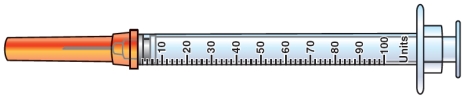
(Short Answer)
4.9/5 (81)
(81) The nurse is admitting a client with type 1 diabetes mellitus to the medical-surgical unit. From the list of healthcare provider orders below, which ones should the nurse question? Select all that apply.
(Multiple Choice)
4.9/5 (81)
(81) 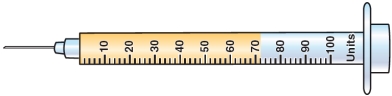
How often should the catheter site for an insulin pump be changed?
(Multiple Choice)
4.8/5 (63)
(63) The nurse has just administered glucagon 1 mg intramuscularly to a patient with a finger stick glucose of 32 mg/dL. The patient is unconscious and does not have IV access. What should the nurse do next?
(Multiple Choice)
4.9/5 (78)
(78) 
Filters
- Essay(0)
- Multiple Choice(0)
- Short Answer(0)
- True False(0)
- Matching(0)