



 Chat with AI
Exam 19: The World of International Finance

Exam 1: Introduction: What Is Economics?118 Questions
Exam 2: The Key Principles of Economics144 Questions
Exam 3: Exchange and Markets111 Questions
Exam 4: Demand, Supply, and Market Equilibrium172 Questions
Exam 5: Measuring a Nation's Production and Income152 Questions
Exam 6:Unemployment and Inflation155 Questions
Exam 7:The Economy at Full Employment148 Questions
Exam 8: Why Do Economies Grow?167 Questions
Exam 9: Aggregate Demand and Aggregate Supply160 Questions
Exam 10: Fiscal Policy133 Questions
Exam 11: The Income-Expenditure Model193 Questions
Exam 12: Investment and Financial Markets150 Questions
Exam 13: Money and the Banking System170 Questions
Exam 14: The Federal Reserve and Monetary Policy149 Questions
Exam 15: Modern Macroeconomics: From the Short Run to the Long Run152 Questions
Exam 16: The Dynamics of Inflation and Unemployment149 Questions
Exam 17: Macroeconomic Policy Debates147 Questions
Exam 18: International Trade and Public Policy155 Questions
Exam 19: The World of International Finance150 Questions
Select questions type


If the yen to dollar exchange rate is 115, the U.S. price index is 140, and the Japanese price index is 165, what is the U.S. real exchange rate?
(Multiple Choice)
4.9/5  (75)
(75) Suppose the United States is experiencing a balance of payments deficit. To prevent the exchange rate from depreciating, the U.S. Treasury must
(Multiple Choice)
4.8/5 (79)
(79) 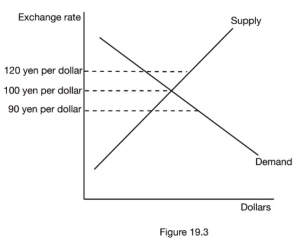 -Refer to Figure 19.3. At the exchange rate of 120 yen per dollar, the United States is experiencing a
 (Multiple Choice)
4.9/5 (69)
(69) In the first quarter of 2009, the United States trade deficit fell to its lowest level in a decade. This means that
(Multiple Choice)
4.9/5 (93)
(93) A(n)________ in U.S. prices will cause a decrease in the demand for U.S. dollars and a(n)________ in the (per dollar)exchange rate.
(Multiple Choice)
4.8/5 (91)
(91) Under a fixed exchange rate system, if the inflation rate in the United States is 5 percent a year and the inflation rate in Australia is 0 percent a year, then the U.S. real exchange rate will
(Multiple Choice)
5.0/5 (66)
(66) Recall the Application about the factors which allow the United States to continue to run large current account trade deficits with the rest of the world to answer the following question(s). The 2006 Economic Report of the President addressed the issue of whether the United States can continue to run large current account deficits. The report stated that the current account deficits would eventually be reduced and highlighted a number of factors that suggested the deficits could continue for a long period of time.
-According to this Application, if the United States is running a current account deficit, then the United States
(Multiple Choice)
4.8/5 (89)
(89) What will happen to the exchange rate between the euro and the U.S. dollar if U.S. interest rates increase?
(Essay)
4.8/5 (79)
(79) Historically, the key role in assisting countries that ran into financial difficulties was played by
(Multiple Choice)
4.9/5 (70)
(70) If, for the United States, exports are $450, imports are $320, net income from foreign investments is -$60, and net transfers from abroad is -$50, then the U.S. current account has a
(Multiple Choice)
4.9/5 (86)
(86) Figure 19.1
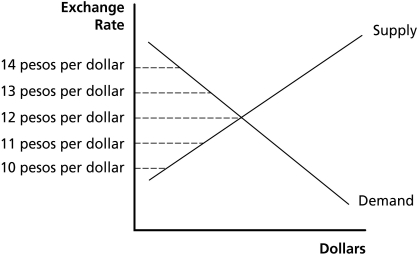 -Referring to Figure 19.1, if the exchange rate is currently 14 pesos per dollar, then we expect the dollar to ________ and the peso to ________.
 (Multiple Choice)
5.0/5 (81)
(81) Since 1982, the United States has run a current account surplus every year.
(True/False)
4.8/5 (81)
(81) An exchange rate system in which governments try to keep currency values from fluctuating against one another is a fixed exchange rate system.
(True/False)
4.9/5 (75)
(75) As the dollar depreciates relative to the Russian ruble, U.S. goods become cheaper for Russians to purchase. Therefore, in the foreign exchange market, the
(Multiple Choice)
4.8/5 (74)
(74) In a fixed exchange rate system, an increase in the exchange rate at which a currency is pegged is called a(n)
(Multiple Choice)
4.9/5 (88)
(88) According to the theory of purchasing power parity, the exchange rate between two countries reflects
(Multiple Choice)
4.9/5 (77)
(77) Recall the Application about how the collapse of the housing boom and the worldwide recession of 2007 led to problems for some countries in the Euro-zone to answer the following question(s). When the euro was launched in 1999, the vision of its founders was to use the monetary union to further unify Europe economically and politically. They envisioned a large economic market, comparable to the United States with integrated goods and financial markets. They believed that by moving to a single currency with agreements on a number of fiscal rules that they could achieve economic stability and growth.
-Recall the Application. The European nations that adopted the euro as a common currency no longer have their own central banks and are therefore no longer able to conduct their own independent
(Multiple Choice)
4.8/5 (67)
(67) The rate at which one currency can be traded for another is called the
(Multiple Choice)
4.9/5 (72)
(72) Explain what is meant by a revaluation of a currency. Under what circumstances would a country devalue its currency?
(Essay)
4.7/5 (83)
(83) 
Filters
- Essay(0)
- Multiple Choice(0)
- Short Answer(0)
- True False(0)
- Matching(0)