



 Chat with AI
Exam 13: Money and the Banking System

Exam 1: Introduction: What Is Economics?118 Questions
Exam 2: The Key Principles of Economics144 Questions
Exam 3: Exchange and Markets111 Questions
Exam 4: Demand, Supply, and Market Equilibrium172 Questions
Exam 5: Measuring a Nation's Production and Income152 Questions
Exam 6:Unemployment and Inflation155 Questions
Exam 7:The Economy at Full Employment148 Questions
Exam 8: Why Do Economies Grow?167 Questions
Exam 9: Aggregate Demand and Aggregate Supply160 Questions
Exam 10: Fiscal Policy133 Questions
Exam 11: The Income-Expenditure Model193 Questions
Exam 12: Investment and Financial Markets150 Questions
Exam 13: Money and the Banking System170 Questions
Exam 14: The Federal Reserve and Monetary Policy149 Questions
Exam 15: Modern Macroeconomics: From the Short Run to the Long Run152 Questions
Exam 16: The Dynamics of Inflation and Unemployment149 Questions
Exam 17: Macroeconomic Policy Debates147 Questions
Exam 18: International Trade and Public Policy155 Questions
Exam 19: The World of International Finance150 Questions
Select questions type


According to the U.S. Secret Service, approximately $2.6 billion of U.S. paper currency in circulation is counterfeit. Undetected counterfeit U.S. currency being held by the public both at home and abroad will impact the level of
(Multiple Choice)
4.9/5  (83)
(83) Suppose George withdraws $60,000 from his bank. If the reserve ratio is 25 percent, then this transaction will lead to a decrease of ________ in checking account balances.
(Multiple Choice)
4.7/5 (88)
(88) If the reserve ratio is 0.3 and a deposit of $1,000 is made to the bank, the bank can lend out $700.
(True/False)
4.9/5 (85)
(85) Given the following information about AAA bank:
Bank Deposits $200,000
Loans 100,000
Required Reserves 40,000
Excess Reserves 60,000
What is the reserve ratio?
(Multiple Choice)
4.8/5 (72)
(72) When checks are exchanged between banks, the Fed oversees the banks to ensure the appropriate funds have been transferred. This is known as
(Multiple Choice)
5.0/5 (90)
(90) Studies by economists have tended to show that countries with more independent central banks have
(Multiple Choice)
4.8/5 (70)
(70) Assuming all excess reserves are loaned out, if the reserve ratio is 1 percent, the money multiplier will be equal to
(Multiple Choice)
4.7/5 (81)
(81) Assuming all excess reserves are loaned out, if the reserve ratio is 3.33 percent, the money multiplier will be equal to
(Multiple Choice)
4.8/5 (76)
(76) Assuming all excess reserves are loaned out, currency holdings by the public are zero, and a reserve ratio of 2 percent, an initial deposit of $500 will lead to a total increase in deposits of
(Multiple Choice)
4.8/5 (77)
(77) As inflation rates increase, money becomes less useful as a
(Multiple Choice)
4.8/5 (68)
(68) Table 13.1
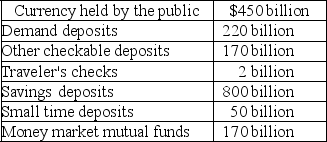 -According to the information in Table 13.1, M2 is equal to
 (Multiple Choice)
4.9/5 (76)
(76) Fiat money refers to a monetary system in which gold backs up paper money.
(True/False)
4.9/5 (71)
(71) There are ________ Federal Reserve Banks located in different parts of the United States.
(Multiple Choice)
4.9/5 (84)
(84) Suppose a bank has $600,000 in deposits, a reserve ratio of 20 percent, and bank reserves of $240,000. This bank can make new loans in the amount of
(Multiple Choice)
4.8/5 (95)
(95) According to the U.S. Secret Service, approximately $2.6 billion of U.S. paper currency in circulation is counterfeit. As long as counterfeit U.S. currency remains undetected and in circulation, an increase in the U.S. inflation rate would essentially
(Multiple Choice)
4.8/5 (87)
(87) Suppose a bank has $8 million in deposits and a reserve ratio of 20 percent. Its required reserves are
(Multiple Choice)
4.9/5 (97)
(97) Assuming all excess reserves are loaned out, currency holdings by the public are zero, and a reserve ratio of 20 percent, an initial deposit of $850 will lead to total deposits of
(Multiple Choice)
4.8/5 (74)
(74) Recall the Application about how the Fed kept the U.S. financial system in operation following the attacks of September 11, 2001, to answer the following question(s). To help prevent financial firms from defaulting on their debts, the Fed took several steps to provide additional funds to the financial system, including allowing banks to borrow more, increasing the difference between the credits and debits it extended while serving as a clearinghouse for checks, purchasing government securities, and providing dollars to foreign central banks. Together, these actions increased the credit extended by the Fed by over $90 billion.
-According to this Application, following the attacks of September 11, 2001, the Fed effectively put an additional $20 billion into the banking system by increasing the difference between the credits and debits it extended while serving as a clearinghouse for checks. The difference between the credits and debits extended by the Federal Reserve is called the
(Multiple Choice)
4.9/5 (90)
(90) 
Filters
- Essay(0)
- Multiple Choice(0)
- Short Answer(0)
- True False(0)
- Matching(0)