



 Chat with AI
Exam 20: Time Response of Reactive Circuits

Exam 1: Quantities and Units40 Questions
Exam 2: Voltage, Current, and Resistance51 Questions
Exam 3: Ohms Law44 Questions
Exam 4: Energy and Power49 Questions
Exam 5: Series Circuits44 Questions
Exam 6: Parallel Circuits40 Questions
Exam 7: Series-Parallel Circuits46 Questions
Exam 8: Circuit Theorems and Conversions35 Questions
Exam 9: Branch, Loop, and Node Analyses39 Questions
Exam 10: Magnetism and Electromagnetism41 Questions
Exam 11: Introduction to Alternating Current and Voltage58 Questions
Exam 12: Capacitors81 Questions
Exam 13: Inductors72 Questions
Exam 14: Transformers40 Questions
Exam 15: Rc Circuits68 Questions
Exam 16: Rl Circuits47 Questions
Exam 17: Rlc Circuits and Resonance50 Questions
Exam 18: Passive Filters41 Questions
Exam 19: Circuit Theorems in Ac Analysis33 Questions
Exam 20: Time Response of Reactive Circuits41 Questions
Exam 21: Three-Phase Systems in Power Applications34 Questions
Select questions type


 Figure 20-1
-What is the steady state output of the differentiator circuit in Figure 20-1?
Figure 20-1
-What is the steady state output of the differentiator circuit in Figure 20-1?
Free
(Multiple Choice)
4.8/5  (88)
(88) Correct Answer: Verified
D
The average value of a waveform is its:
Free
(Multiple Choice)
4.8/5 (74)
(74) Correct Answer:Verified
VerifiedB
The output of an RC integrator approaches the shape of the input pulse when:
Free
(Multiple Choice)
4.7/5 (80)
(80) Correct Answer:Verified
VerifiedA
What is the highest frequency contained in a pulse that has rise and fall times of 17 ns?
(Multiple Choice)
4.9/5 (79)
(79) An RL integrator can act as a _ filter and an RC differentiator can act as a filter.
(Multiple Choice)
4.8/5 (90)
(90) The shape of a repetitive-pulse affects the determination of the pulse repetition frequency.
(True/False)
4.8/5 (79)
(79) A mathematical operation that determines the rate of change of a curve is called .
(Multiple Choice)
4.7/5 (68)
(68) With repetitive pulses, the amount of capacitor charge or discharge in an RC integrator depends upon:
(Multiple Choice)
4.9/5 (61)
(61) If the resistor voltage in a differentiating circuit is down to + 2.4 V at the end of a 14 V input pulse, to what negative value will the resistor voltage go in response to the falling edge of the input?
(Multiple Choice)
4.8/5 (80)
(80)  Figure 20-2
-See Figure 20-2. Assume that the capacitor is initially charged to 3 V before the switch is closed. What is the current that flows after an elapsed time of 20 ms?
Figure 20-2
-See Figure 20-2. Assume that the capacitor is initially charged to 3 V before the switch is closed. What is the current that flows after an elapsed time of 20 ms? (Multiple Choice)
4.8/5 (85)
(85) In a repetitive-pulse RC integrator circuit, what would the steady-state voltage equal at the end of the fifth pulse? Assume a VIN of 20 V.
(Multiple Choice)
4.9/5 (84)
(84) The voltage across a capacitor in an RC integrator circuit cannot change exponentially, it can change only instantaneously.
(True/False)
4.9/5 (76)
(76) In an R-L differentiating circuit, the output voltage is taken across the resistor.
(True/False)
4.9/5 (81)
(81) A mathematical operation for finding the area under the curve of a graph is called .
(Multiple Choice)
4.9/5 (76)
(76) What is the capacitor voltage in an RC integrator when the pulse width is equal to or greater than five time constants?
(Multiple Choice)
4.9/5 (79)
(79) 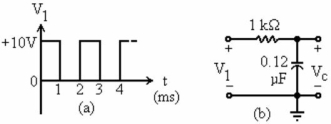 Figure 20-3
-See Figure 20-3. If the square wave pulse width is decreased to 1.0 µs, how will the VC waveform change?
Figure 20-3
-See Figure 20-3. If the square wave pulse width is decreased to 1.0 µs, how will the VC waveform change? (Multiple Choice)
5.0/5 (67)
(67) If a periodic pulse waveform is applied to an RC integrator, the output waveshape depends on the relationship of the circuit time constant and the duty cycle of the input pulses.
(True/False)
4.8/5 (80)
(80) When there is a sudden change in voltage, a capacitor, for an instant, appears as:
(Multiple Choice)
4.8/5 (81)
(81) The fast rising and falling edges of a pulse waveform represent:
(Multiple Choice)
4.7/5 (87)
(87) 
Filters
- Essay(0)
- Multiple Choice(0)
- Short Answer(0)
- True False(0)
- Matching(0)