



 Chat with AI
Exam 3: Evolution, Biodiversity, and Population Ecology

Exam 1: Science and Sustainability: an Introduction to Environmental Science30 Questions
Exam 2: Environmental Systems: Matter, Energy, and Ecosystems38 Questions
Exam 3: Evolution, Biodiversity, and Population Ecology34 Questions
Exam 4: Species Interactions and Community Ecology27 Questions
Exam 5: Economics, Policy, and Sustainable Development29 Questions
Exam 6: Human Population37 Questions
Exam 7: Soil, Agriculture, and the Future of Food32 Questions
Exam 8: Biodiversity and Conservation Biology36 Questions
Exam 9: Forests, Forest Management, and Protected Areas32 Questions
Exam 10: Environmental Health and Toxicology27 Questions
Exam 11: Geology, Minerals, and Mining34 Questions
Exam 12: Fresh Water, Oceans, and Coasts22 Questions
Exam 13: Atmospheric Science, Air Quality, and Pollution Control31 Questions
Exam 14: Global Climate Change34 Questions
Exam 15: Nonrenewable Energy Sources, Their Impacts, and Energy Conservation33 Questions
Exam 16: Renewable Energy Alternatives31 Questions
Exam 17: Managing Our Waste35 Questions
Exam 18: The Urban Environment: Creating Sustainable Cities27 Questions
Exam 19: Sustainable Solutions26 Questions
Exam 20: Answers to Data Analysis Questions34 Questions
Exam 21: How to Interpret Graphs30 Questions
Exam 22: Metric System30 Questions
Exam 23: Periodic Table of the Elements24 Questions
Exam 24: Geologic Time Scale Glossary Credits Index32 Questions
Select questions type


What characteristics do humans share with r -selected species?
(Multiple Choice)
4.9/5  (83)
(83) Which of the following descriptions of a hummingbird best describes its niche?
(Multiple Choice)
4.8/5 (69)
(69) When a population approaches its carrying capacity, its resources .
(Multiple Choice)
4.9/5 (77)
(77) Scientists often depict their understanding of an organism's evolutionary ancestry in diagrams called .
(Multiple Choice)
4.9/5 (68)
(68) Which of the following best illustrates a type I survivorship curve, with higher death rates at older ages?
(Multiple Choice)
4.8/5 (82)
(82) Heavy rains and mudslides cause a river to change course, isolating two groups of lizards from one another. If they remain isolated for a long period of time, .
(Multiple Choice)
4.9/5 (76)
(76) 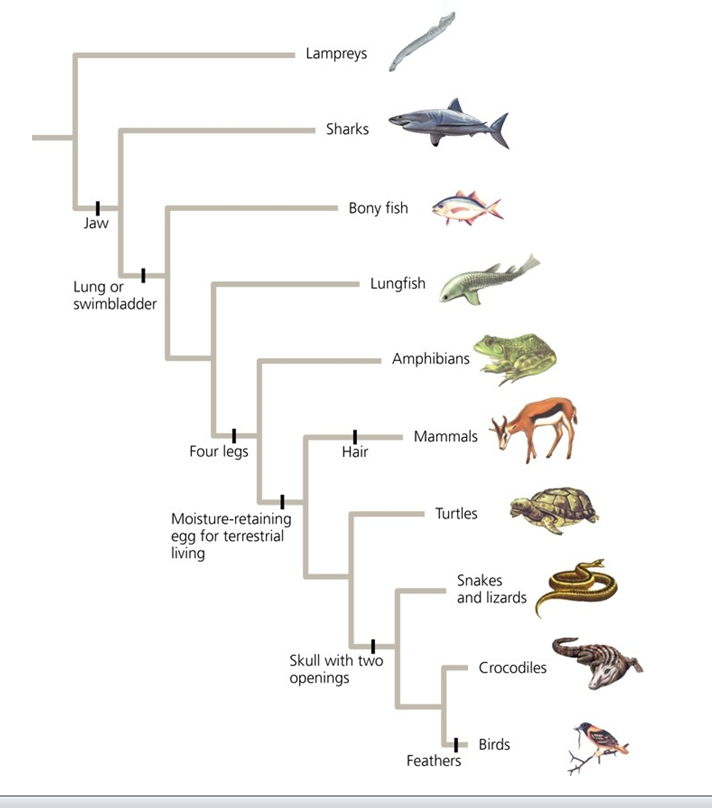 -Organisms that are closely related have a recent common ancestor. Of the following, which choice lists organisms that are most closely related to each other?
 (Multiple Choice)
4.9/5 (72)
(72) The initial population of Kaibab deer in 1906 was about 4000. In an area of about 800,000 acres, this works out to an average density of one deer per 200 acres. What is the density in 1923?
(Multiple Choice)
4.9/5 (78)
(78) Which of the following are the major factors that determine a population's growth rate?
(Multiple Choice)
4.9/5 (84)
(84) Mutation and _ are the key mechanisms that generate and maintain genetic variation among individuals in most populations.
(Multiple Choice)
4.8/5 (75)
(75) 
Filters
- Essay(0)
- Multiple Choice(0)
- Short Answer(0)
- True False(0)
- Matching(0)