



 Chat with AI
Exam 11: Waiting Line Models

Exam 1: Introduction63 Questions
Exam 2: An Introduction to Linear Programming66 Questions
Exam 3: Linear Programming: Sensitivity Analysis and Interpretation of Solution56 Questions
Exam 4: Linear Programming Applications in Marketing, Finance, and Operations Management63 Questions
Exam 5: Advanced Linear Programming Applications46 Questions
Exam 6: Distribution and Network Models70 Questions
Exam 7: Integer Linear Programming61 Questions
Exam 8: Nonlinear Optimization Models51 Questions
Exam 9: Project Scheduling: Pertcpm59 Questions
Exam 10: Inventory Models65 Questions
Exam 11: Waiting Line Models68 Questions
Exam 12: Simulation62 Questions
Exam 13: Decision Analysis97 Questions
Exam 14: Multicriteria Decisions50 Questions
Exam 15: Time Series Analysis and Forecasting63 Questions
Exam 16: Markov Processes49 Questions
Exam 17: Linear Programming: Simplex Method51 Questions
Exam 18: Simplex-Based Sensitivity Analysis and Duality35 Questions
Exam 19: Solution Procedures for Transportation and Assignment Problems44 Questions
Exam 20: Minimal Spanning Tree19 Questions
Exam 21: Dynamic Programming38 Questions
Select questions type


When a waiting system is in steady-state operation, the number of units in the system is not changing.
(True/False)
5.0/5  (88)
(88) The postmaster at the Oak Hill Post Office expects the mean arrival rate of people to her customer counter will soon increase by fifty percent due to a large apartment complex being built. Currently, the mean arrival rate is 15 people per hour. The postmaster can serve an average of 25 people per hour. By what percentage must the postmaster's mean service rate increase when the apartment complex is completed in order that the average time spent at the post office remains at its current value?
(Short Answer)
4.8/5 (93)
(93) With no waiting allowed, operating characteristics Lq and Wq are automatically zero regardless of the number of servers.
(True/False)
4.9/5 (86)
(86) The assumption of exponentially distributed service times indicates that
(Multiple Choice)
4.8/5 (91)
(91) The equations provided in the textbook for computing operating characteristics apply to a waiting line operating
(Multiple Choice)
5.0/5 (82)
(82) Queue discipline refers to the manner in which waiting units are arranged for service.
(True/False)
4.9/5 (61)
(61) Andy Archer, Ph.D., is a training consultant for six mid-sized manufacturing firms. On the average, each of his six clients calls him for consulting assistance once every 25 days. Andy typically spends an average of five days at the client's firm during each consultation.
Assuming that the time between client calls follows an exponential distribution, determine the following:
a.the average number of clients Andy has on backlog
b.the average time a client must wait before Andy arrives to it
c.the proportion of the time Andy is busy
(Essay)
4.9/5 (65)
(65) In a waiting line situation, arrivals occur, on average, every 10 minutes, and 10 units can be received every hour. What are λ and μ?
(Multiple Choice)
4.9/5 (76)
(76) The Arctic Flyers minor league hockey team has one box office clerk. On average, each customer that comes to see a game can be sold a ticket at the rate of 8 per minute. For normal games, customers arrive at the rate of 5 per minute. Assume arrivals follow the Poisson distribution and service times follow the exponential distribution.
a.What is the average number of customers waiting in line?
b.What is the average time a customer spends in the waiting line?
c.What is the average number of customers in the system?
d.What is a customer's average time in the system?
e.What is the probability that someone will be buying tickets when an arrival occurs?The Flyers are playing in the league playoffs and anticipate more fans, estimating that the arrival rate will increase to 12 per minute. Output is supplied for a two-cashier and a three-cashier system. 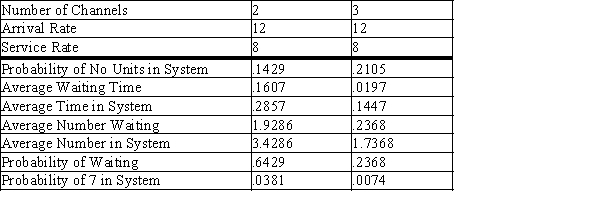 f. The rink has space for six customers to wait indoors to buy tickets. Which system will be better?g. Do you think it is more sensible for them to continue the one cashier system?
 (Essay)
4.8/5 (73)
(73) What queue discipline is assumed by the waiting line models presented in the textbook?
(Multiple Choice)
5.0/5 (87)
(87) Which of the following can NOT be found by the queuing formulas presented in the textbook?
(Multiple Choice)
4.8/5 (77)
(77) Arrivals at a box office in the hour before the show follow the Poisson distribution with λ = 7 per minute. Service times are constant at 7.5 seconds. Find the average length of the waiting line.
(Short Answer)
5.0/5 (73)
(73) For an M/M/1 queuing system, if the service rate, µ, is doubled, the average wait in the system, W, is cut in half.
(True/False)
4.8/5 (84)
(84) Quick Clean Rooter cleans out clogged drains. Due to the competitive nature of the drain cleaning business, if a customer calls Quick Clean and finds the line busy, they immediately try another company and Quick Clean loses the business.
Quick Clean management estimates that on the average, a customer tries to call Quick Clean every three minutes and the average time to take a service order is 200 seconds. The company wishes to hire enough operators so that at most 4% of its potential customers get the busy signal.
a.How many operators should be hired to meet this objective?
b.Given your answer to a), what is the probability that all the operators are idle?
(Essay)
4.8/5 (84)
(84) The total cost for a waiting line does NOT specifically depend on
(Multiple Choice)
4.8/5 (64)
(64) The 8 students in a seminar class must come to the professor's office to turn in a paper and give a 5-minute oral summary. Assume there is a service rate of 10 per hour and adequate time is available for all. The arrival rate for each unit is 5 per hour. What is the probability there is no one in the office or waiting when you come?
(Short Answer)
4.9/5 (72)
(72) In a waiting line situation, arrivals occur at a rate of 2 per minute, and the service times average 18 seconds. Assume the Poisson and exponential distributions.
a.What is λ?
b.What is μ?
c.Find probability of no units in the system.
d.Find average number of units in the system.
e.Find average time in the waiting line.
f. Find average time in the system.
g. Find probability that there is one person waiting.
h. Find probability an arrival will have to wait.
(Essay)
4.7/5 (73)
(73) For an M/M/k system, the average number of customers in the system equals the customer arrival rate times the average time a customer spends waiting in the system.
(True/False)
4.8/5 (83)
(83) 
Filters
- Essay(0)
- Multiple Choice(0)
- Short Answer(0)
- True False(0)
- Matching(0)