



 Chat with AI
Exam 10: Audit Sampling

Exam 1: Introduction to Auditing33 Questions
Exam 2: Audit, Assurance, and Quality Control Standards33 Questions
Exam 3: Reports on Audited Financial Statements and Audited Internal Controlt47 Questions
Exam 4: Professional Ethics and Auditor Responsibilities43 Questions
Exam 5: Legal Liability44 Questions
Exam 6: Preliminary Audit Planning: Understanding the Auditee44 Questions
Exam 7: Assessing Risks and Internal Control45 Questions
Exam 8: Audit Evidence and Assurance34 Questions
Exam 9: Control Assessment and Testing38 Questions
Exam 10: Audit Sampling50 Questions
Exam 11: Revenues, Receivables, and Receipts Process68 Questions
Exam 12: Purchases, Payables, and Payments Processtrue57 Questions
Exam 13: Production and Payroll Process40 Questions
Exam 14: Finance and Investment Process35 Questions
Exam 15: Completing the Audit44 Questions
Exam 16: Other Public Accounting Services and Reports49 Questions
Exam 17: Fraud Awareness Auditing45 Questions
Select questions type


Which of the following is an advantage of statistical sampling?
(Multiple Choice)
4.8/5  (69)
(69) Non-statistical sampling may be better to use than statistical sampling when:
(Multiple Choice)
5.0/5 (80)
(80) In a sample-based audit of an account balance, which of the following combinations properly expresses the relationship between changes in the factors indicated and changes in sample size? 
(Multiple Choice)
4.9/5 (85)
(85) If statistical calculations were not applied then a sampling method would be considered non-statistical even though a random sample was selected.
(True/False)
4.7/5 (84)
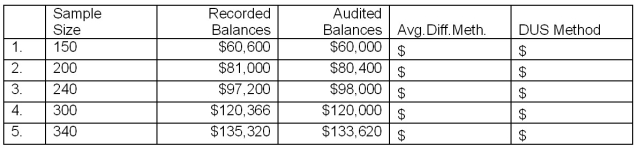
(84) Assume several auditors selected various unrestricted, unstratified random samples from a population of 1,200 customers' accounts receivable with a recorded value of $480,000.The results of their tests are shown in the table below.
Required:
For each of the sample sizes, calculate the projected likely misstatement (PLM) using (1) average difference method, and (2) the Dollar Unit Sample method.Treat each case independently.Round the PLM solutions to the nearest dollar.
Projected Likely Misstatement
Overstatement (Understatement)
(Essay)
4.7/5 (83)
(83) Left and Right PAs audited the accounts receivable of Investo Limited on a sample basis.There were 2,000 customer accounts in the subsidiary ledger with a total recorded value of
$375,000.As part of the audit program, Left and Right selected a sample of 100 accounts having a recorded value of $20,000.They performed the audit procedures and determined that the audited amount of the sample totalled $19,000.
Required:
A) Calculate the projected likely misstatement (PLM) using (1) the average difference method and (2) the ratio method.
B) Evaluate the results of the calculation in part a.- assume that Left and Right set the tolerable misstatement for accounts receivable at $25,000.
(Essay)
4.8/5 (83)
(83) Which of the following audit procedures is not typically used in audit sampling applications?
(Multiple Choice)
4.8/5 (83)
(83) Jack and Jill, two auditors who have separate accounting practices, have independently assessed the risks associated with the accounts receivable of their respective clients.The appropriate audit risk for both is determined to be .02.Both agree that inherent risk should be set at the maximum (1.0) and that no analytical procedures will be performed.Jack evaluates control risk as moderate (.40) while Jill assesses it as relatively low (.20).Using the audit risk model, answer the following questions.
Required:
A) What is the risk of incorrect acceptance for Jack and for Jill?
B) Based on your answer in part a, which auditor will have to collect the most evidence? Explain your reasoning.
C) What effect does differing assessments of control risk have on the sample size of accounts receivable? Explain.
(Essay)
4.8/5 (70)
(70) Which of the following courses of action is an auditor most likely to follow in designing a sampling plan for cash disbursements if the auditor is aware of several unusually large cash disbursements?
(Multiple Choice)
4.7/5 (93)
(93) Auditing a larger sample reduces the probability of determining that the control is working well when in fact it is not.
(True/False)
5.0/5 (78)
(78) An example of non-sampling risk is the selection of a random sample that is not representative of the population.
(True/False)
4.7/5 (68)
(68) In the audit of account balances, the sample size will tend to be smaller when the
(Multiple Choice)
4.8/5 (80)
(80) Green CA audited the inventory of ABC Company on a sample basis.Green audited a sample of 120 items and found a net overstatement of $600.The audited sample had a recorded value of $12,000.The entire inventory contained 2,400 items with a total book value of $280,000.The projected likely overstatement using the average difference method is
(Multiple Choice)
4.8/5 (68)
(68) Non-statistical sampling is audit sampling in which auditors do not use the probability calculations to express the results.
(True/False)
4.9/5 (75)
(75) Using the audit risk model: If audit risk is 0.05, inherent risk is 1.0, control risk is 0.20, and analytical procedures risk is 1.0, the risk of incorrect acceptance is 0.25.
(True/False)
4.9/5 (81)
(81) Green CA audited the inventory of ABC Company on a sample basis.Green audited a sample of 120 items and found a net overstatement of $600.The audited sample had a recorded value of $12,000.The entire inventory contained 2,400 items with a total book value of $280,000.The projected likely overstatement using the dollar unit sampling method is
(Multiple Choice)
4.8/5 (84)
(84) The set of all of the elements that comprise an account balance or a class of transactions is referred to as a
(Multiple Choice)
4.8/5 (76)
(76) When performing the substantive tests on an account balance, the auditor is concerned about two aspects of sampling-based decision errors: 1) the risk of incorrect rejection (RIR) and 2) the risk of incorrect acceptance (RIA).Which of the following is true about RIR and RIA?
(Multiple Choice)
4.8/5 (78)
(78) The sample deviation rate is the best single-point estimate of the actual, but unknown, deviation rate in the population.
(True/False)
4.9/5 (77)
(77) 
Filters
- Essay(0)
- Multiple Choice(0)
- Short Answer(0)
- True False(0)
- Matching(0)