



 Chat with AI
Exam 14: Depreciation

Exam 1: Problem Solving With Math66 Questions
Exam 2: Fractions97 Questions
Exam 3: Decimals126 Questions
Exam 4: Solving for the Unknown105 Questions
Exam 5: Business Statistics76 Questions
Exam 6: Banking and Budgeting70 Questions
Exam 7: Payroll and Income Tax86 Questions
Exam 8: Sales, Excise, and Property Taxes82 Questions
Exam 9: Risk Management105 Questions
Exam 10: Installment Buying and Revolving Charge Credit Cards60 Questions
Exam 11: Discounts: Trade and Cash101 Questions
Exam 12: Markups and Markdowns: Perishables and Breakeven Analysis87 Questions
Exam 13: How to Read, Analyze, and Interpret Financial Reports53 Questions
Exam 14: Depreciation50 Questions
Exam 15: Inventory and Overhead68 Questions
Exam 16: Simple Interest69 Questions
Exam 17: Promissory Notes, Simple Discount Notes, and the Discount Process64 Questions
Exam 18: The Cost of Home Ownership44 Questions
Exam 19: Compound Interest and Present Value64 Questions
Exam 20: Annuities and Sinking Funds40 Questions
Exam 21: Stocks, Bonds, and Mutual Funds65 Questions
Select questions type


Depreciation expense is located on the:

Free
(Multiple Choice)
5.0/5  (78)
(78) Correct Answer: Verified
A
Using the declining-balance method, complete the table as shown (twice the straight-line rate):
Auto: $26,000
Estimated life: 10 years
Residual value: $600 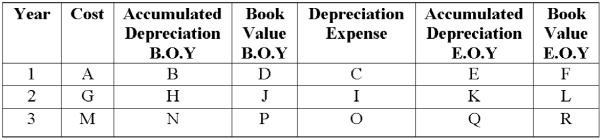
Free
(Short Answer)
4.8/5 (78)
(78) Correct Answer:Verified
Verified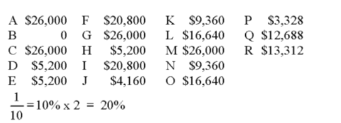
If a car is depreciated in four years, the rate of depreciation using twice the straight-line rate is:
(Multiple Choice)
4.7/5 (90)
(90) A truck costs $8,000 with a residual value of $1,000. The truck is expected to have a useful life of 70,000 miles. Assuming the truck is driven 15,000 miles the first year, the depreciation expense would be:
(Multiple Choice)
4.9/5 (62)
(62) Residual value is not used in calculating the depreciation expense per unit of product, miles driven, etc.
(True/False)
4.7/5 (66)
(66) A truck costs $35,000 with a residual value of $2,000. Its service life is five years. Using the declining-balance method at twice the straight-line rate, the book value at the end of year 2 is:
(Multiple Choice)
4.7/5 (73)
(73) MACRS does not use residual value; thus, assets are depreciated to zero.
(True/False)
4.9/5 (86)
(86) Depreciation expense in the declining-balance method is calculated by the depreciation rate:
(Multiple Choice)
4.7/5 (82)
(82) A new piece of equipment costs $18,000 with a residual value of $600 and an estimated useful life of five years. Assuming twice the straight-line rate, the book value at the end of year 2 using the declining-balance method is:
(Multiple Choice)
4.8/5 (71)
(71) A truck costs $16,000 with a residual value of $1,000. It has an estimated useful life of five years. If the truck was bought on July 3, what would be the book value at the end of year 1 using straight-line rate?
(Multiple Choice)
4.8/5 (83)
(83) A truck costs $9,200 with a residual value of $1,000. It is estimated that the useful life of the truck is four years. The amount of depreciation expense in year 2 using the declining-balance method at twice the straight-line rate is:
(Multiple Choice)
5.0/5 (86)
(86) A depreciation schedule for partial years must cover at least three years.
(True/False)
4.8/5 (71)
(71) In the straight-line method, book value never goes below the residual value.
(True/False)
4.8/5 (75)
(75) Product obsolescence means the asset has been fully depreciated.
(True/False)
4.9/5 (74)
(74) In a straight-line depreciation schedule, the depreciation expense is the same each year.
(True/False)
4.9/5 (72)
(72) Joe Wong, owner of Cookie Palace, is discussing with his accountant which method of depreciation would be best for his new delivery truck. The cost of the truck is $20,000 with an estimated life of four years. The residual value of the truck is $2,500. Prepare a depreciation schedule using the declining-balance method at twice the straight-line rate.
(Short Answer)
4.8/5 (84)
(84) 
Filters
- Essay(0)
- Multiple Choice(0)
- Short Answer(0)
- True False(0)
- Matching(0)