



 Chat with AI
Exam 25: Capital Investment Analysis

Exam 1: Introduction to Accounting and Business235 Questions
Exam 2: Analyzing Transactions238 Questions
Exam 3: The Adjusting Process209 Questions
Exam 4: Completing the Accounting Cycle208 Questions
Exam 5: Accounting Systems201 Questions
Exam 6: Accounting for Merchandising Businesses236 Questions
Exam 7: Inventories208 Questions
Exam 8: Internal Control and Cash190 Questions
Exam 9: Receivables196 Questions
Exam 10: Long-Term Assets: Fixed and Intangible223 Questions
Exam 11: Current Liabilities and Payroll201 Questions
Exam 12: Accounting for Partnerships and Limited Liability Companies205 Questions
Exam 13: Corporations: Organization, Stock Transactions, and Dividends217 Questions
Exam 14: Long-Term Liabilities: Bonds and Notes181 Questions
Exam 15: Investments and Fair Value Accounting171 Questions
Exam 16: Statement of Cash Flows189 Questions
Exam 17: Financial Statement Analysis201 Questions
Exam 18: Introduction to Managerial Accounting247 Questions
Exam 19: Job Order Costing195 Questions
Exam 20: Process Cost Systems198 Questions
Exam 21: Cost-Volume-Profit Analysis225 Questions
Exam 22: Evaluating Variances From Standard Costs174 Questions
Exam 23: Decentralized Operations218 Questions
Exam 24: Differential Analysis, Product Pricing, and Activity-Based Costing177 Questions
Exam 25: Capital Investment Analysis189 Questions
Select questions type


The average rate of return is a measure of profitability computed by dividing the average annual cash inflows from an asset by the average amount invested in the asset.
(True/False)
4.9/5  (63)
(63) For Years 1-5, a proposed expenditure of $500,000 for a fixed asset with a five-year life has expected net income of $40,000, $35,000, $25,000, $25,000, and $25,000, respectively, and net cash flows of $90,000, $85,000, $75,000, $75,000, and $75,000, respectively. The cash payback period is five years.
(True/False)
4.9/5 (62)
(62) All of the following qualitative considerations may impact capital investment analysis except
(Multiple Choice)
4.8/5 (65)
(65) T-Bone Company is contemplating investing in a new piece of manufacturing machinery. The amount to be invested is $150,000. The present value of the future cash flows is $141,000. Should the company invest in this project?
(Multiple Choice)
4.7/5 (84)
(84) A $400,000 capital investment proposal has an estimated life of four years and no residual value. The estimated net cash flows are as follows:YearNet Cash Flow1$200,0002150,000390,000480,000The minimum desired rate of return for net present value analysis is 12%. The present value of $1 at compound interest of 12% for Years 1 through 4 is 0.893, 0.797, 0.712, and 0.636, respectively.Determine the net present value.
(Essay)
4.9/5 (89)
(89) An anticipated purchase of equipment for $520,000, with a useful life of eight years and no residual value, is expected to yield the following annual net income and net cash flow:? Year Net Income Net Cash Flow 1 \ 60,000 \ 120,000 2 50,000 110,000 3 50,000 110,000 4 40,000 100,000 5 40,000 80,000 6 40,000 80,000 7 40,000 60,000 8 40,000 60,000 What is the cash payback period?
(Multiple Choice)
4.9/5 (81)
(81) Which of the following would not be considered a good managerial tool in making a decision for determining a capital investment?
(Multiple Choice)
4.9/5 (78)
(78) The rate of earnings is 6% and the cash to be received in four years is $20,000. The present value amount, using the following partial table of present value of $1 at compound interest, is? Year 6\% 10\% 12\% 1 0.943 0.909 0.893 2 0.890 0.826 0.797 3 0.840 0.751 0.712 4 0.792 0.683 0.636
(Multiple Choice)
4.8/5 (79)
(79) The expected average rate of return for a proposed investment of $4,800,000 in a fixed asset, using straight-line depreciation, with a useful life of 20 years, no residual value, and an expected total net income of $10,560,000 over the 20 years is
(Multiple Choice)
4.7/5 (81)
(81) The anticipated purchase of a fixed asset for $400,000, with a useful life of five years and no residual value, is expected to yield total net income of $300,000 for the five years. The expected average rate of return is 30%.
(True/False)
4.9/5 (86)
(86) Which of the following is not an advantage of the average rate of return method?
(Multiple Choice)
4.7/5 (71)
(71) The primary advantages of the average rate of return method are its ease of computation and the fact that
(Multiple Choice)
4.7/5 (94)
(94) Which of the following is a present value method of analyzing capital investment proposals?
(Multiple Choice)
4.9/5 (82)
(82) What is the present value of $8,000 to be received at the end of six years if the required rate of return is 15%?Below is a table for the present value of $1 at compound interest.  Below is a table for the present value of an annuity of $1 at compound interest.

Below is a table for the present value of an annuity of $1 at compound interest. (Short Answer)
4.9/5 (81)
(81) Methods that ignore present value in capital investment analysis include the internal rate of return method.
(True/False)
4.8/5 (77)
(77) The management of Indiana Corporation is considering the purchase of a new machine costing $400,000. The company's desired rate of return is 10%. The present value factors for $1 at compound interest of 10% for Years 1 through 5 are 0.909, 0.826, 0.751, 0.683, and 0.621, respectively. In addition to the foregoing information, use the following data in determining the acceptability of this investment: 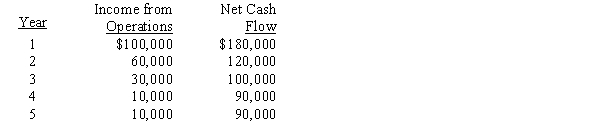 The average rate of return for this investment is
 (Multiple Choice)
4.7/5 (83)
(83) Heidi Company is considering the acquisition of a machine that costs $420,000. The machine is expected to have a useful life of six years, a negligible residual value, an annual net cash flow of $120,000, and annual operating income of $83,721. What is the estimated cash payback period for the machine?
(Multiple Choice)
4.7/5 (77)
(77) Jimmy Co. is considering a 12-year project that is estimated to cost $1,050,000 and has no residual value. Jimmy Co. seeks to earn an average rate of return of 18% on all capital projects. Determine the necessary average annual income
(using straight-line depreciation) that must be achieved on this project for it to be acceptable to Jimmy Co.
(Essay)
4.8/5 (78)
(78) If a proposed expenditure of $80,000 for a fixed asset with a four-year life has an annual expected net cash flow and net income of $32,000 and $12,000, respectively, the cash payback period is four years.
(True/False)
4.8/5 (83)
(83) The formula for calculating the present value factor for an annuity of $1 is
(Multiple Choice)
4.8/5 (92)
(92) 
Filters
- Essay(0)
- Multiple Choice(0)
- Short Answer(0)
- True False(0)
- Matching(0)