



 Chat with AI
Exam 2: Production Possibilities, Opportunity Cost, and Economic Growth

Exam 1: Introducing the Economic Way of Thinking251 Questions
Exam 2: Production Possibilities, Opportunity Cost, and Economic Growth202 Questions
Exam 3: Market Demand and Supply412 Questions
Exam 4: Markets in Action253 Questions
Exam 5: Price Elasticity of Demand and Supply280 Questions
Exam 6: Consumer Choice Theory272 Questions
Exam 7: Production Costs243 Questions
Exam 8: Perfect Competition237 Questions
Exam 9: Monopoly168 Questions
Exam 10: Monopolistic Competition and Oligopoly187 Questions
Exam 11: Labor Markets202 Questions
Exam 12: Income Distribution, Poverty, and Discrimination130 Questions
Exam 13: Antitrust and Regulation203 Questions
Exam 14: Environmental Economics106 Questions
Exam 15: International Trade and Finance241 Questions
Exam 16: Economies in Transition108 Questions
Exam 17: Growth and the117 Questions
Select questions type


Exhibit 2-13 Production possibilities curve 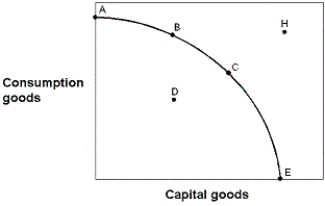 -In Exhibit 2-13, point H is:
 (Multiple Choice)
5.0/5  (71)
(71) If some resources were used inefficiently, the economy would operate outside its production possibilities curve.
(True/False)
4.7/5 (84)
(84) A rightward (an outward) shift of a nation's production possibilities curve could be caused by:
(Multiple Choice)
4.8/5 (77)
(77) Compare two economies A and B that start out with identical production possibilities curves. Economy A chooses an efficient point with 6 consumption goods and 3 capital goods, while economy B also chooses an efficient point, but with 4 consumption goods and 5 capital goods. In the future we can predict:
(Multiple Choice)
4.7/5 (88)
(88) Exhibit 2-12 Production possibilities curve 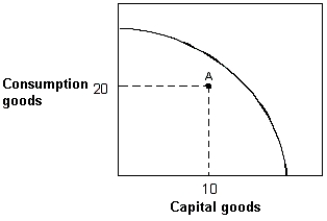 -In Exhibit 2-12, suppose an economy with the given production possibilities curve is currently located at point A in the figure. Which of the following statements is false?
 (Multiple Choice)
4.8/5 (74)
(74) Which of the following is true about the production possibilities curve when a technological progress occurs? The curve:
(Multiple Choice)
4.7/5 (73)
(73) Mikki decides to work five hours the night before her economics exam. She earns an extra $75, but her exam score is 10 points lower than it would have been had she stayed home and studied. Her opportunity cost is the:
(Multiple Choice)
4.8/5 (82)
(82) Exhibit 2-7 Production possibilities curve 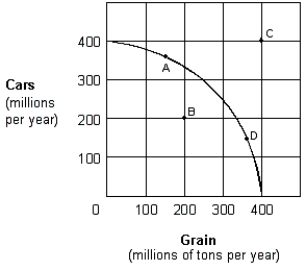 -For the economy shown in Exhibit 2-7, which of the following is true when the economy is at point A?
 (Multiple Choice)
4.9/5 (76)
(76) Which fundamental economic question is most closely related to the issues of income distribution and poverty?
(Multiple Choice)
4.9/5 (79)
(79) Which of the following correctly lists the three fundamental economic questions?
(Multiple Choice)
4.8/5 (87)
(87) Exhibit 2-18 Production possibilities curves 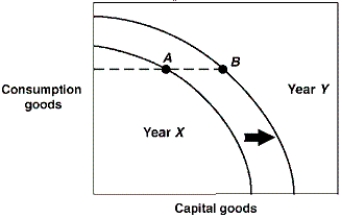 -In Exhibit 2-18, the production possibilities curves for a country are shown for the years Year X and Year Y. Suppose this country was located at point A in Year X and point B in Year Y. This economy:
 (Multiple Choice)
4.7/5 (80)
(80) Exhibit 2-9 Production possibilities curve 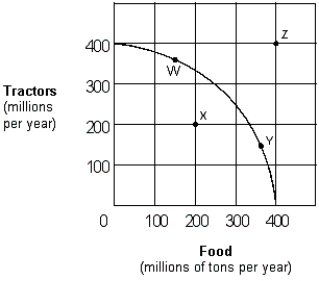 -Movement along this production possibilities curve shown in Exhibit 2-9 indicates:
 (Multiple Choice)
4.9/5 (89)
(89) In economics, investment refers to the process of accumulating:
(Multiple Choice)
4.8/5 (85)
(85) Exhibit 2-6 Production possibilities curve data A B C D E F Capital goods 150 140 120 90 50 0 Consume goods 0 20 40 60 80 100
-In Exhibit 2-6, the concept of increasing opportunity costs is represented by the fact that:
(Multiple Choice)
4.8/5 (81)
(81) Assuming an economy is already experiencing full employment, then it must produce more consumer goods and fewer capital goods if it wishes to experience greater rates of economic growth over time.
(True/False)
4.9/5 (82)
(82) Which of the following would be least likely to cause the production possibilities curve to shift outward?
(Multiple Choice)
4.9/5 (77)
(77) 
Filters
- Essay(0)
- Multiple Choice(0)
- Short Answer(0)
- True False(0)
- Matching(0)