



 Chat with AI
Exam 6: Consumer Choice Theory

Exam 1: Introducing the Economic Way of Thinking251 Questions
Exam 2: Production Possibilities, Opportunity Cost, and Economic Growth202 Questions
Exam 3: Market Demand and Supply412 Questions
Exam 4: Markets in Action253 Questions
Exam 5: Price Elasticity of Demand and Supply280 Questions
Exam 6: Consumer Choice Theory272 Questions
Exam 7: Production Costs243 Questions
Exam 8: Perfect Competition237 Questions
Exam 9: Monopoly168 Questions
Exam 10: Monopolistic Competition and Oligopoly187 Questions
Exam 11: Labor Markets202 Questions
Exam 12: Income Distribution, Poverty, and Discrimination130 Questions
Exam 13: Antitrust and Regulation203 Questions
Exam 14: Environmental Economics106 Questions
Exam 15: International Trade and Finance241 Questions
Exam 16: Economies in Transition108 Questions
Exam 17: Growth and the117 Questions
Select questions type


The slope of the indifference curve for goods X and Y is called the marginal:
(Multiple Choice)
4.9/5  (64)
(64) Assume a consumer purchases a combination of goods X and Y such that MUx / −Px = 20 units of utility per dollar and MUy / Py = 10 units of utility per dollar. To maximize utility, the consumers should buy:
(Multiple Choice)
4.8/5 (86)
(86) Which of the following most directly reflects the law of diminishing marginal utility?
(Multiple Choice)
4.9/5 (78)
(78) JoAnn considers cola and plain sparkling water to be good substitutes. Suppose the price of sugar, a key ingredient used to produce cola, falls. According to the substitution effect, which of the following is most likely to occur?
(Multiple Choice)
4.8/5 (78)
(78) The law of diminishing marginal utility states that total utility increases by smaller and smaller increments as more of a good is consumed.
(True/False)
4.9/5 (77)
(77) Suppose a consumer is spending all of his/her income on two goods, A and B, in a manner where MUa = 15 and MUb = 80, and the Pa = $5 and the Pb = $20. Then the consumer:
(Multiple Choice)
4.8/5 (91)
(91) A utility-maximizing consumer equalizes marginal utilities per dollar spent across all goods.
(True/False)
4.9/5 (77)
(77) If total utility increases from 10 to 15 for the second unit of a good consumed, the marginal utility of the second unit is 25.
(True/False)
4.9/5 (80)
(80) Exhibit 6-8 Bea's total utility of 3-minute telephone calls Quantity of 3-Minute Calls Total Utility of Telephone Calls 0 0 1 15 2 28 3 38 4 45 5 50 6 48
-Refer to Exhibit 6-8. Diminishing returns set in after which telephone call?
(Multiple Choice)
5.0/5 (78)
(78) The MU/P equalization principle means consumers will exhaust their expenditure budget so that, in the end, the MU/P ratio is:
(Multiple Choice)
4.9/5 (83)
(83) A budget line represents all combinations of bundles of two goods that give a consumer equal total utility.
(True/False)
4.8/5 (83)
(83) Assume the price of good X is Px, price of good Y is Py, and B is the budget. The formula for the budget line for these two goods is:
(Multiple Choice)
4.9/5 (71)
(71) Exhibit 6A-3 Consumer equilibrium
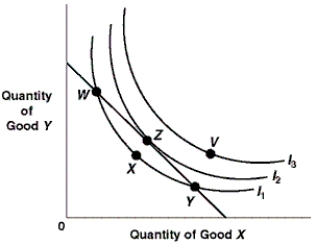 -Given the budget line and indifference curves shown in Exhibit 6A-3, assume the consumer is initially at point Y. To maximize total utility, the consumer should:
 (Multiple Choice)
4.9/5 (84)
(84) The law of diminishing marginal utility states that marginal utility must diminish after the first unit of consumption of every good or service.
(True/False)
4.7/5 (82)
(82) A state of consumer equilibrium for two goods consumed exists when the:
(Multiple Choice)
4.8/5 (75)
(75) If a consumer is spending all of his/her income in a manner where MUa / Pa is greater than MUb / Pb, then the consumer:
(Multiple Choice)
4.7/5 (88)
(88) The amount by which an additional unit of a good or service increases a consumer's total utility is:
(Multiple Choice)
4.8/5 (69)
(69) On Thanksgiving, Jake's mother gives him a huge platter of food. If Jake were to keep eating just to please his mother (even when he really wanted to stop), his marginal utility would be:
(Multiple Choice)
4.9/5 (71)
(71) 
Filters
- Essay(0)
- Multiple Choice(0)
- Short Answer(0)
- True False(0)
- Matching(0)