



 Chat with AI
Exam 11: Labor Markets

Exam 1: Introducing the Economic Way of Thinking251 Questions
Exam 2: Production Possibilities, Opportunity Cost, and Economic Growth202 Questions
Exam 3: Market Demand and Supply412 Questions
Exam 4: Markets in Action253 Questions
Exam 5: Price Elasticity of Demand and Supply280 Questions
Exam 6: Consumer Choice Theory272 Questions
Exam 7: Production Costs243 Questions
Exam 8: Perfect Competition237 Questions
Exam 9: Monopoly168 Questions
Exam 10: Monopolistic Competition and Oligopoly187 Questions
Exam 11: Labor Markets202 Questions
Exam 12: Income Distribution, Poverty, and Discrimination130 Questions
Exam 13: Antitrust and Regulation203 Questions
Exam 14: Environmental Economics106 Questions
Exam 15: International Trade and Finance241 Questions
Exam 16: Economies in Transition108 Questions
Exam 17: Growth and the117 Questions
Select questions type


Exhibit 11-4 Supply and demand curves for food servers  -If the equilibrium wage rate in Exhibit 11-4 increased, the cause could be that:
 (Multiple Choice)
4.8/5  (69)
(69) A union may attempt to obtain stricter certification requirements or longer apprenticeships. These changes would raise workers' wages because they:
(Multiple Choice)
4.7/5 (75)
(75) If the wage rate in a monopsonistic industry is $15, the marginal factor cost will be:
(Multiple Choice)
4.9/5 (70)
(70) To maximize profit, a monopsonist hires workers up to the point at which marginal factor cost (MFC) equals marginal revenue product (MRP).
(True/False)
4.7/5 (78)
(78) In a competitive labor market, the demand for labor X that produces product Y will increase if the demand for product Y increases.
(True/False)
4.7/5 (76)
(76) Which of the following best illustrates the concept of derived demand?
(Multiple Choice)
5.0/5 (84)
(84) Exhibit 11-4 Supply and demand curves for food servers
-In Exhibit 11-4, assume that both input and output markets are perfectly competitive. If one additional server increases the number of meals sold by four per day and each meal sells for $10, each additional food server will be paid:
-In Exhibit 11-4, assume that both input and output markets are perfectly competitive. If one additional server increases the number of meals sold by four per day and each meal sells for $10, each additional food server will be paid: (Multiple Choice)
4.7/5 (78)
(78) Which of the following is characteristic of the marginal revenue product schedule for a resource?
(Multiple Choice)
4.9/5 (68)
(68) Dividing the change in total revenue by the change in labor gives:
(Multiple Choice)
4.8/5 (81)
(81) Currently, union membership in the United States is about:
(Multiple Choice)
4.8/5 (92)
(92) Exhibit 11-8 A labor market 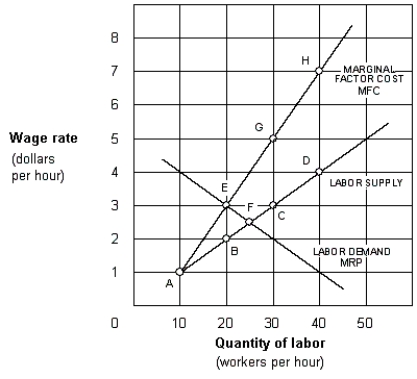 -If the labor market shown in Exhibit 11-8 is competitive, the wage rate and number of workers employed will be determined at point:
 (Multiple Choice)
4.9/5 (97)
(97) Exhibit 11-1
Use the information in the accompanying chart to answer the following question(s). The firm hires labor competitively and sells its product in a competitive price-taker market. Units of Labor (per day) T otal Output (dollars) Product Price 1 15 6 2 30 6 3 40 6 4 48 6 5 54 6 6 59 6 7 62 6
-Refer to Exhibit 11-1. What is the marginal revenue product of the fifth unit of labor?
(Multiple Choice)
4.7/5 (69)
(69) Exhibit 11-11 Labor wage and cost data Labor Wage TWC MFC 10 \ \ 50.00 \ 11 5.80 12 17.80 13 102.70 14 126.00 15 46.50
-In Exhibit 11-11, the marginal factor cost of the 13th employee is equal to:
(Multiple Choice)
4.9/5 (79)
(79) In a competitive labor market a firm will continue to employ workers for as long as an additional worker's marginal revenue product is below the wage rate.
(True/False)
4.9/5 (84)
(84) Exhibit 11-13 A monopsonist's supply and marginal revenue product data Workers Wage Rate MRP 1 \ 8 \ 50 2 9 25 3 10 20 4 11 17 5 12 16 6 13 13
-In Exhibit 11-13, how many workers will the monopsonist hire?
(Multiple Choice)
4.8/5 (81)
(81) Since World War II, the percentage of U.S. workers who are unionized has declined from about 86 percent to its current level of 60 percent.
(True/False)
4.7/5 (87)
(87) In a competitive labor market a firm will continue to employ workers for as long as an additional worker's marginal revenue product exceeds the wage rate.
(True/False)
4.9/5 (75)
(75) 
Filters
- Essay(0)
- Multiple Choice(0)
- Short Answer(0)
- True False(0)
- Matching(0)