



 Chat with AI
Exam 12: Income Distribution, Poverty, and Discrimination

Exam 1: Introducing the Economic Way of Thinking251 Questions
Exam 2: Production Possibilities, Opportunity Cost, and Economic Growth202 Questions
Exam 3: Market Demand and Supply412 Questions
Exam 4: Markets in Action253 Questions
Exam 5: Price Elasticity of Demand and Supply280 Questions
Exam 6: Consumer Choice Theory272 Questions
Exam 7: Production Costs243 Questions
Exam 8: Perfect Competition237 Questions
Exam 9: Monopoly168 Questions
Exam 10: Monopolistic Competition and Oligopoly187 Questions
Exam 11: Labor Markets202 Questions
Exam 12: Income Distribution, Poverty, and Discrimination130 Questions
Exam 13: Antitrust and Regulation203 Questions
Exam 14: Environmental Economics106 Questions
Exam 15: International Trade and Finance241 Questions
Exam 16: Economies in Transition108 Questions
Exam 17: Growth and the117 Questions
Select questions type


After 1929 in the United States, as measured by the Lorenz curve, income inequality:
(Multiple Choice)
4.8/5  (66)
(66) Wage discrimination means workers with equal productivity are paid unequal wages, or workers with unequal productivity are paid equal wages.
(True/False)
4.7/5 (76)
(76) Discrimination lowers the average wage of members of one group of workers in spite of laws that require equal pay for all workers.
(True/False)
4.8/5 (82)
(82) The poorest 20 percent of the U.S. population received approximately ____ of total income.
(Multiple Choice)
4.9/5 (72)
(72) Some people believe that employees should be paid the same wages when their jobs, although different, require similar levels of education, training, experience, and responsibility. This principle is known as:
(Multiple Choice)
4.9/5 (77)
(77) Consider a law that limits women's access to certain "dangerous" occupations like coal mining and military combat service. Such a law would likely reduce women's wages because:
(Multiple Choice)
4.8/5 (79)
(79) According to the statistics, the distribution of money income:
(Multiple Choice)
4.8/5 (78)
(78) Using the Lorenz curve, the degree of income inequality is measured by the:
(Multiple Choice)
4.9/5 (75)
(75) Which of the following might increase the supply curve of labor?
(Multiple Choice)
4.8/5 (76)
(76) If official U.S. poverty statistics included in-kind transfer payments the:
(Multiple Choice)
4.8/5 (76)
(76) Exhibit 12-4 Lorenz curve 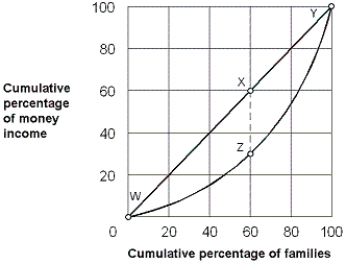 -As shown in Exhibit 12-4, 40 percent of families earned a cumulative share of about ____ percent of income.
 (Multiple Choice)
4.8/5 (90)
(90) Which of the following countries has the most unequal distribution of income?
(Multiple Choice)
4.9/5 (84)
(84) The U.S. Lorenz curve today is closer to the perfect equality line than in 1929.
(True/False)
4.7/5 (72)
(72) Exhibit 12-1 Income distribution for three countries Quintile Country I (\%) Country II (\%) Country III (\%) Poorest 6 8 4 Second 12 12 8 Third 15 15 10 Fourth 27 30 30 Richest 40 35 48
-Exhibit 12-1 shows the percentage of income received by each population quintile. From this chart we can conclude:
(Multiple Choice)
4.8/5 (82)
(82) Exhibit 12-3 Lorenz curve for an economy 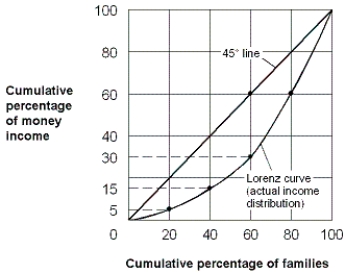 -According to the Lorenz curve shown in Exhibit 12-3, what percentage of total income is earned by the richest 20 percent of families?
 (Multiple Choice)
5.0/5 (79)
(79) Exhibit 12-6 Lorenz curves 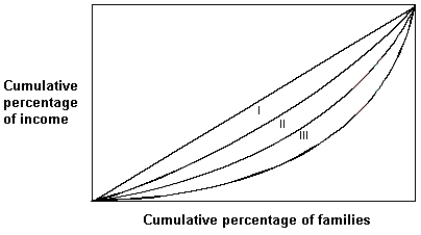 -Exhibit 12-6 shows the Lorenz Curve for three countries, I, II, and III. Of the three countries shown,
 (Multiple Choice)
4.8/5 (94)
(94) 
Filters
- Essay(0)
- Multiple Choice(0)
- Short Answer(0)
- True False(0)
- Matching(0)