



 Chat with AI
Exam 14: Environmental Economics

Exam 1: Introducing the Economic Way of Thinking251 Questions
Exam 2: Production Possibilities, Opportunity Cost, and Economic Growth202 Questions
Exam 3: Market Demand and Supply412 Questions
Exam 4: Markets in Action253 Questions
Exam 5: Price Elasticity of Demand and Supply280 Questions
Exam 6: Consumer Choice Theory272 Questions
Exam 7: Production Costs243 Questions
Exam 8: Perfect Competition237 Questions
Exam 9: Monopoly168 Questions
Exam 10: Monopolistic Competition and Oligopoly187 Questions
Exam 11: Labor Markets202 Questions
Exam 12: Income Distribution, Poverty, and Discrimination130 Questions
Exam 13: Antitrust and Regulation203 Questions
Exam 14: Environmental Economics106 Questions
Exam 15: International Trade and Finance241 Questions
Exam 16: Economies in Transition108 Questions
Exam 17: Growth and the117 Questions
Select questions type


A government passes a new law allowing only 1,000 tons of pollution per day to be generated and simultaneously sells 1,000 transferable rights to emit one ton each of pollution per day. Which of the following is true?
(Multiple Choice)
4.8/5  (77)
(77) When consumption of a good or service produces benefits or costs that are not reflected in the market price for the good, this is known as a(n):
(Multiple Choice)
4.9/5 (80)
(80) Which of the following is the environmental approach found in the Clean Air Act of 1990?
(Multiple Choice)
4.9/5 (82)
(82) If some firms internalize their external costs by being a cleaner and more "environmentally friendly" producers than other firms that do not, then which of the following offers the best and most complete description of this situation?
(Multiple Choice)
4.7/5 (80)
(80) Exhibit 14-1 Private and social cost 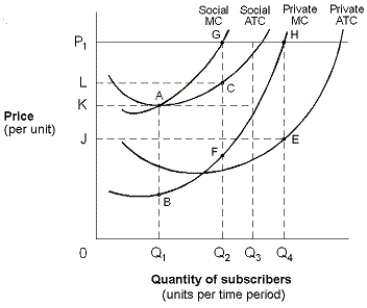 -Use Exhibit 14-1 to answer the following question. To maximize social welfare, the firm should produce at the output rate:
 (Multiple Choice)
4.8/5 (86)
(86) A profit-maximizing firm will base its supply decisions on its marginal:
(Multiple Choice)
4.9/5 (72)
(72) Ronald Coase's analysis of externalities emphasizes the importance of:
(Multiple Choice)
4.8/5 (66)
(66) Command-and-control regulation, as compared to incentive-based regulation, is:
(Multiple Choice)
4.7/5 (84)
(84) Which of the following is the best example of a command-and-control regulation?
(Multiple Choice)
4.8/5 (77)
(77) Economists view pollution as an economic problem that arises because:
(Multiple Choice)
4.7/5 (55)
(55) The social marginal cost curve is higher than the private marginal cost curve.
(True/False)
4.8/5 (77)
(77) Requiring cars in Los Angeles to reduce pollution by the same amount as cars in Topeka is inefficient.
(True/False)
4.9/5 (72)
(72) Exhibit 14-3 Impact of flights on house value
Each time Orville flies over Wilber's house, the noise reduces the value of Wilbur's house. The table shows the profits to Orville of each flight, and the value of Wilbur's house. Number of flights Total profits Marginal profits Value of Wilbur's house 1 \ 10,000 \ 10,000 \ 100,000 2 18,000 8,000 95,000 3 24,000 6,000 90,000 4 28,000 4,000 85,000 5 30,000 2,000 80,000
-As shown in Exhibit 14-3, at the socially efficient number of flights, what will be the market value of Orville's house?
(Multiple Choice)
4.8/5 (81)
(81) Suppose a state discovered chemical compounds in their water. The source of these chemicals is the waste discharges of industrial plants in another state. This is an example of a(n):
(Multiple Choice)
5.0/5 (75)
(75) 
Filters
- Essay(0)
- Multiple Choice(0)
- Short Answer(0)
- True False(0)
- Matching(0)