



 Chat with AI
Exam 17: Growth and the

Exam 1: Introducing the Economic Way of Thinking251 Questions
Exam 2: Production Possibilities, Opportunity Cost, and Economic Growth202 Questions
Exam 3: Market Demand and Supply412 Questions
Exam 4: Markets in Action253 Questions
Exam 5: Price Elasticity of Demand and Supply280 Questions
Exam 6: Consumer Choice Theory272 Questions
Exam 7: Production Costs243 Questions
Exam 8: Perfect Competition237 Questions
Exam 9: Monopoly168 Questions
Exam 10: Monopolistic Competition and Oligopoly187 Questions
Exam 11: Labor Markets202 Questions
Exam 12: Income Distribution, Poverty, and Discrimination130 Questions
Exam 13: Antitrust and Regulation203 Questions
Exam 14: Environmental Economics106 Questions
Exam 15: International Trade and Finance241 Questions
Exam 16: Economies in Transition108 Questions
Exam 17: Growth and the117 Questions
Select questions type


Which of the following is most likely to help the residents of a nation produce more goods and services and achieve higher income levels?
(Multiple Choice)
4.9/5  (87)
(87) In general, GDP per capita is highly correlated with alternative measures of quality of life.
(True/False)
4.9/5 (81)
(81) If a country's real GDP is growing at 5 percent and the population is also growing at 5 percent, its:
(Multiple Choice)
4.8/5 (82)
(82) Which of the following is not a common characteristic of IACs?
(Multiple Choice)
4.8/5 (78)
(78) In order for a country to develop a high per capita GDP, it must have a rich endowment of natural resources, particularly energy and mineral resources.
(True/False)
4.9/5 (97)
(97) According to the text, Singapore is classified as a less developed country (LDC).
(True/False)
4.8/5 (87)
(87) Which of the following is not an example of a country's infrastructure?
(Multiple Choice)
4.9/5 (85)
(85) If an economy's population grows at 3 percent and real GDP grows at 2 percent, then:
(Multiple Choice)
4.9/5 (85)
(85) Exhibit 17-1 Nation of Padia 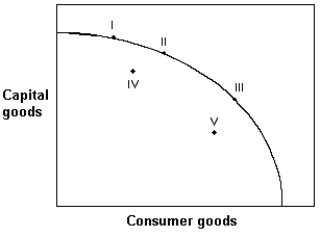 -Exhibit 17-1 shows the production possibility curve of the nation of Padia. Based only on this information, the point which would produce the highest rate of growth would be:
 (Multiple Choice)
4.9/5 (66)
(66) Which of the following does not hinder economic development?
(Multiple Choice)
4.7/5 (81)
(81) If population grows faster than GDP, then per capita GDP must fall.
(True/False)
4.9/5 (71)
(71) Which of the following factors would be most likely to encourage investment and capital formation in a less-developed nation?
(Multiple Choice)
4.8/5 (82)
(82) A country with a high GDP per capita is classified as an industrially advanced country (IAC).
(True/False)
4.9/5 (75)
(75) Which of the following helps low-income countries grow rapidly relative to high-income countries?
(Multiple Choice)
4.7/5 (86)
(86) According to the text, Singapore and Hong Kong are classified as industrially advanced countries (IACs).
(True/False)
4.8/5 (86)
(86) Which of the following represents a problem with using per capita GDP to compare standard of living between less-developed and industrially advanced countries?
(Multiple Choice)
4.9/5 (73)
(73) 
Filters
- Essay(0)
- Multiple Choice(0)
- Short Answer(0)
- True False(0)
- Matching(0)