



 Chat with AI
Exam 23: Planning for Capital Investments

Exam 1: Introduction to Financial Statements183 Questions
Exam 2: A Further Look at Financial Statements201 Questions
Exam 3: The Accounting Information System226 Questions
Exam 4: Merchandising Operations and the Multiple-Step Income Statement221 Questions
Exam 5: Reporting and Analyzing Inventory201 Questions
Exam 6: Fraud, Internal Control, and Cash209 Questions
Exam 7: Reporting and Analyzing Receivables220 Questions
Exam 8: Reporting and Analyzing Long-Lived Assets227 Questions
Exam 9: Reporting and Analyzing Liabilities245 Questions
Exam 10: Reporting and Analyzing Stockholders Equity215 Questions
Exam 11: Statement of Cash Flows170 Questions
Exam 12: Financial Analysis: The Big Picture211 Questions
Exam 13: Managerial Accounting151 Questions
Exam 14: Job Order Costing150 Questions
Exam 15: Process Costing129 Questions
Exam 16: Activity-Based Costing147 Questions
Exam 17: Cost-Volume-Profit156 Questions
Exam 18: Cost-Volume-Profit Analysis: Additional Issues81 Questions
Exam 19: Incremental Analysis166 Questions
Exam 20: Budgetary Planning158 Questions
Exam 21: Budgetary Control and Responsibility Accounting154 Questions
Exam 22: Standard Costs and Balanced Scorecard161 Questions
Exam 23: Planning for Capital Investments156 Questions
Select questions type


When a capital budgeting project generates a positive net present value, this means that the project earns a return higher than the
(Multiple Choice)
4.8/5  (76)
(76) All of the following are involved in the capital budgeting evaluation process except a company's
(Multiple Choice)
4.8/5 (81)
(81) A project that cost $75,000 has a useful life of 5 years and a salvage value of $3,000. The internal rate of return is 12% and the annual rate of return is 18%. The amount of the annual net income was
(Multiple Choice)
4.7/5 (71)
(71) The capital budgeting technique that indicates the profitability of a capital expenditure is the
(Multiple Choice)
4.9/5 (86)
(86) Companies often assume that the risk element in the discount rate is
(Multiple Choice)
4.7/5 (85)
(85) Capital expenditure proposals are initially screened by the
(Multiple Choice)
4.9/5 (75)
(75) A project has an annual rate of return of 15%. The project cost $120,000, has a 5-year useful life, and no salvage value. Straight-line depreciation is used. The annual net income, exclusive of depreciation, was
(Multiple Choice)
4.8/5 (68)
(68) If a project has a negative net present value, its profitability index will be
(Multiple Choice)
5.0/5 (84)
(84) Capital budgeting decisions usually involve large investments and often have a significant impact on a company's future profitability.
(True/False)
4.7/5 (73)
(73) Use the following information for questions
Carr Company is considering two capital investment proposals. Estimates regarding each project are provided below: 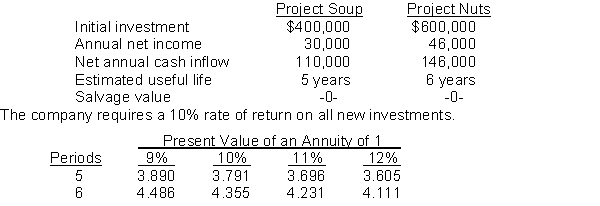 -The cash payback period for Project Nuts is
 (Multiple Choice)
4.9/5 (85)
(85) Use the following table,
Period 8\% 9\% 10\% 1 .926 .917 .909 2 1.783 1.759 1.736 3 2.577 2.531 2.487 A company has a minimum required rate of return of 8%. It is considering investing in a project that costs $379,650 and is expected to generate cash inflows of $150,000 each year for three years. The approximate internal rate of return on this project is
(Multiple Choice)
4.9/5 (88)
(88) Use the following information for questions
Cleaners, Inc. is considering purchasing equipment costing $60,000 with a 6-year useful life. The equipment will provide cost savings of $14,600 and will be depreciated straight-line over its useful life with no salvage value. Cleaners requires a 10% rate of return.
Period 8\% 9\% 10\% 11\% 12\% 15\% 6 4.623 4.486 4.355 4.231 4.111 3.784
-What is the approximate internal rate of return for this investment?
(Multiple Choice)
4.9/5 (75)
(75) When the annual cash flows from an investment are unequal, the appropriate table to use is the
(Multiple Choice)
4.8/5 (79)
(79) The corporate capital budget authorization process consists of how many steps?
(Multiple Choice)
4.9/5 (78)
(78) Use the following information for questions
Cleaners, Inc. is considering purchasing equipment costing $60,000 with a 6-year useful life. The equipment will provide cost savings of $14,600 and will be depreciated straight-line over its useful life with no salvage value. Cleaners requires a 10% rate of return.
Period 8\% 9\% 10\% 11\% 12\% 15\% 6 4.623 4.486 4.355 4.231 4.111 3.784
-What is the approximate net present value of this investment?
(Multiple Choice)
4.8/5 (74)
(74) 
Filters
- Essay(0)
- Multiple Choice(0)
- Short Answer(0)
- True False(0)
- Matching(0)