



 Chat with AI
Exam 16: The Policy Debate: Active or Passive

Exam 1: The Art and Science of Economic Analysis150 Questions
Exam 2: Some Tools of Economic Analysis157 Questions
Exam 3: Economic Decision Makers174 Questions
Exam 4: Demand, Supply, and Markets151 Questions
Exam 5: Introduction to Macroeconomics151 Questions
Exam 6: Tracking the U S Economy149 Questions
Exam 7: Unemployment and Inflation150 Questions
Exam 8: Us Productivity and Growth150 Questions
Exam 9: Aggregate Demand150 Questions
Exam 10: Aggregate Supply150 Questions
Exam 11: Fiscal Policy151 Questions
Exam 12: Federal Budgets and Public Policy153 Questions
Exam 13: Money and the Financial System150 Questions
Exam 14: Banking and the Money Supply150 Questions
Exam 15: Monetary Theory and Policy150 Questions
Exam 16: The Policy Debate: Active or Passive150 Questions
Exam 17: International Trade150 Questions
Exam 18: International Finance150 Questions
Exam 19: Economic Development150 Questions
Select questions type


The figure below shows the relationship between an economy's potential output,price level,and real GDP.According to those who favor a passive approach to policy,the economy will attain equilibrium at potential output when:
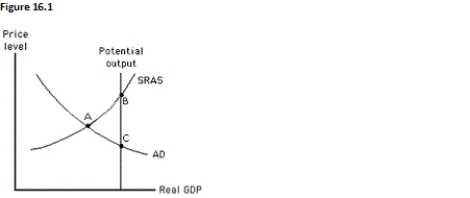
(Multiple Choice)
4.7/5  (85)
(85) According to the rational expectations approach ,if policy makers consistently stimulate aggregate demand when real output falls below the economy's potential output,then people will not be able to anticipate the effects of this policy on the price level,unemployment,and the real output level.
(True/False)
4.8/5 (79)
(79) For those who favor an active approach,public policy changes are necessary to cure a recessionary gap because:
(Multiple Choice)
4.7/5 (89)
(89) Which of the following pairs of lags are typically shorter for monetary policy than for fiscal policy?
(Multiple Choice)
4.8/5 (70)
(70) Long time lags hamper the effectiveness of economic policy because:
(Multiple Choice)
4.8/5 (63)
(63) If an active approach is followed in closing an expansionary gap,_____.
(Multiple Choice)
4.8/5 (86)
(86) Those who prefer a passive approach to the conduct of macroeconomic policy tend to believe that markets are self-correcting.
(True/False)
4.9/5 (74)
(74) The time it takes to identify and examine the nature and seriousness of an economic problem is the _____.
(Multiple Choice)
4.7/5 (74)
(74) Suppose the economy had been operating along a given short-run Phillips curve for several years and then experienced a year of stagflation.The year of stagflation would:
(Multiple Choice)
4.9/5 (84)
(84) The time required _____ is not a time lag associated with using discretionary policy to correct an economic problem.
(Multiple Choice)
4.7/5 (88)
(88) An economy that self-corrects an expansionary gap will experience stagflation.
(True/False)
4.9/5 (70)
(70) The short-run Phillips curve shows that as the unemployment rate goes down,_____.
(Multiple Choice)
4.8/5 (84)
(84) If the time for an economy to self-correct is shorter than the active policy lags,then:
(Multiple Choice)
4.8/5 (78)
(78) Both those who favor an active approach as well as those who favor a passive approach to policy believe that the economy can suffer from extreme and long-lasting swings in real GDP.
(True/False)
4.9/5 (92)
(92) The short-run Phillips curve is based upon labor contracts that reflect a given expected _____.
(Multiple Choice)
4.8/5 (63)
(63) Which of the following is not consistent with a self-correcting economy?
(Multiple Choice)
4.9/5 (91)
(91) 
Filters
- Essay(0)
- Multiple Choice(0)
- Short Answer(0)
- True False(0)
- Matching(0)