



 Chat with AI
Exam 14: Decision Analysis

Exam 1: Introduction to Modeling and Decision Analysis52 Questions
Exam 2: Introduction to Optimization and Linear Programming62 Questions
Exam 3: Modeling and Solving Lp Problems in a Spreadsheet88 Questions
Exam 4: Sensitivity Analysis and the Simplex Method72 Questions
Exam 5: Network Modeling72 Questions
Exam 6: Integer Linear Programming72 Questions
Exam 7: Goal Programming and Multiple Objective Optimization59 Questions
Exam 8: Nonlinear Programming and Evolutionary Optimization68 Questions
Exam 9: Regression Analysis76 Questions
Exam 10: Discriminant Analysis57 Questions
Exam 11: Time Series Forecasting111 Questions
Exam 12: Introduction to Simulation Using Risk Solver Platform65 Questions
Exam 13: Queuing Theory79 Questions
Exam 14: Decision Analysis102 Questions
Exam 15: Project Management Online61 Questions
Select questions type


Based on the radar chart of the weighted scores provided below, which of the following interpretations is incorrect? 
(Multiple Choice)
4.9/5  (90)
(90) A course of action intended to solve a problem is called a(n)
(Multiple Choice)
4.7/5 (76)
(76) A company is planning a plant expansion. They can build a large or small plant. The payoffs for the plant depend on the level of consumer demand for the company's products. The company believes that there is an 69% chance that demand for their products will be high and a 31% chance that it will be low. The company can pay a market research firm to survey consumer attitudes towards the company's products. There is a 63% chance that the customers will like the products and a 37% chance that they won't. The payoff matrix and costs of the two plants are listed below. The company believes that if the survey is favorable there is a 92% chance that demand will be high for the products. If the survey is unfavorable there is only a 30% chance that the demand will be high. The following decision tree has been built for this problem. The company has computed that the expected monetary value of the best decision without sample information is 154.35 million. What is the EVSI for this problem (in $ million)?
Factory Gize High Low Plant Cost ( \million ) Large 200 85 10 Small 100 95 2 
(Multiple Choice)
4.8/5 (79)
(79) Exhibit 14.10
The following questions are based on the information below.
An investor is considering 4 investments, W, X, Y, and Z. The payoff from each investment is a function of the economic climate over the next 2 years. The economy can expand or decline. The following payoff matrix has been developed for the decision problem. The investor has estimated the probability of a declining economy at 80% and an expanding economy at 20%.
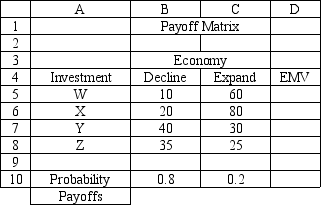 -Refer to Exhibit 14.10. Complete the Regret Table according to the expected regret decision rule.
 (Essay)
4.8/5 (95)
(95) Exhibit 14.9
The following questions are based on the information below.
An investor is considering 4 investments, W, X, Y, and Z. The payoff from each investment is a function of the economic climate over the next 2 years. The economy can expand or decline. The following payoff matrix has been developed for the investment decision problem.
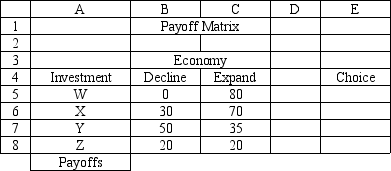 -Refer to Exhibit 14.9. What formula should go in cell D5 and get copied to D6:D8 to implement the maximax decision rule?
 (Short Answer)
4.9/5 (91)
(91) Exhibit 14.7
The following questions use the information below.
A decision maker is faced with two alternatives. The decision maker has determined that she is indifferent between the two alternatives when p = 0.45.
Alternative 1: Receive \ 82,000 with certainty Alternative 2: Receive \ 143,000 with probability and lose \ 15,000 with probability (1 -p)
-Refer to Exhibit 14.7. What is the decision maker's certainty equivalent for this problem?
(Multiple Choice)
4.8/5 (63)
(63) Exhibit 14.1
The following questions are based on the information below.
An investor is considering 4 investments, A, B, C and leaving his money in the bank. The payoff from each investment is a function of the economic climate over the next 2 years. The economy can expand or decline. The following payoff matrix has been developed for the decision problem.
 -Refer to Exhibit 14.1. What formula should go in cell D5 to implement the maximax decision rule?
 (Multiple Choice)
4.9/5 (86)
(86) The ____ correspond to future events that are not under the control of the decision maker.
(Multiple Choice)
4.7/5 (78)
(78) Exhibit 14.7
The following questions use the information below.
A decision maker is faced with two alternatives. The decision maker has determined that she is indifferent between the two alternatives when p = 0.45.
Alternative 1: Receive \ 82,000 with certainty Alternative 2: Receive \ 143,000 with probability and lose \ 15,000 with probability (1 -p)
-Refer to Exhibit 14.7. What is the expected value of Alternative 2 for this decision maker?
(Multiple Choice)
4.8/5 (59)
(59) The decision rule which determines the maximum payoff for each alternative and then selects the alternative associated with the largest payoff is the
(Multiple Choice)
4.8/5 (79)
(79) Exhibit 14.12
The following questions use the information below.
A decision maker is faced with two alternatives.
Altermatrve 1: Recerve $4,000 wrth certannty
Alternative 2: Receive $80,000 with prabability and lose $5,000 with probability (1 -p). The decision maker has determined that she is indifferent between the two alternatives when p = 0.7.
-Refer to Exhibit 14.12. What is the expected value of Alternative 2 for this decision maker?
(Essay)
4.9/5 (80)
(80) The total worth, value or desirability of a decision alternative is called its
(Multiple Choice)
5.0/5 (75)
(75) Exhibit 14.4
The following questions are based on the information below.
 -Refer to Exhibit 14.4. What is the expected value of perfect information for the investor?
 (Multiple Choice)
4.9/5 (72)
(72) Exhibit 14.8
The following questions use the information below.
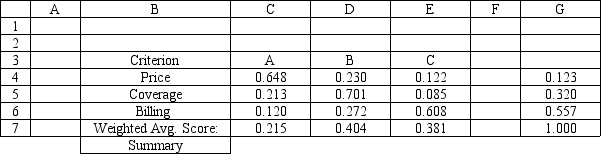
A company needs to buy a new insurance policy. They have three policies to choose from, A, B and C. The policies differ with respect to price, coverage and ease of billing. The company has developed the following AHP tables for price and summary. The other tables are not shown due to space limitations.
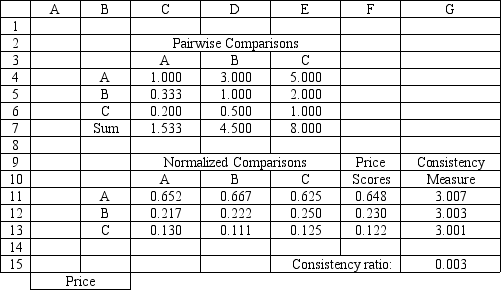
 -Refer to Exhibit 14.8. What formula should go in cell F11 and get copied to F12:F13 of the Price worksheet to compute the Price Score?
 (Multiple Choice)
4.7/5 (87)
(87) Exhibit 14.8
The following questions use the information below.
A company needs to buy a new insurance policy. They have three policies to choose from, A, B and C. The policies differ with respect to price, coverage and ease of billing. The company has developed the following AHP tables for price and summary. The other tables are not shown due to space limitations.
-Refer to Exhibit 14.8. Which policy should the company choose based on the Summary worksheet?
-Refer to Exhibit 14.8. Which policy should the company choose based on the Summary worksheet? (Multiple Choice)
4.8/5 (65)
(65) Exhibit 14.14
The following questions use the Decision Tree model and strategy table information below.
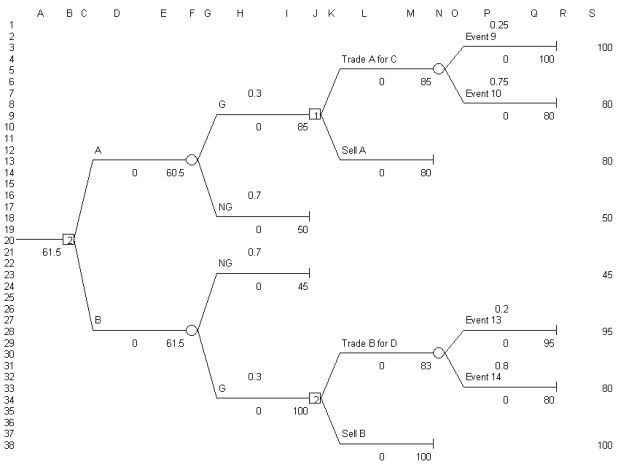
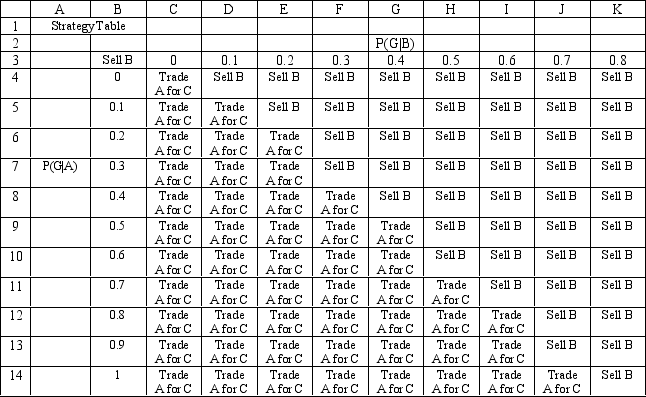 -Refer to Exhibit 14.14. Why does the strategy table, examining the risk associated with P(G|A) and P(G|B) never show "Sell A" or "Trade B for D" as selected options?
 (Essay)
5.0/5 (76)
(76) The amount of opportunity lost in making a decision is called
(Multiple Choice)
4.9/5 (79)
(79) An investor is considering 2 investments, A, B, which can be purchased now for $10. There is a 40% chance that investment A will grow rapidly in value and a 60% chance that it will grow slowly. If A grows rapidly the investor can cash it in for $80 or trade it for investment C which has a 25% chance of growing to $100 and a 75% chance of reaching $80. If A grows slowly it is sold for $50. There is a 70% chance that investment B will grow rapidly in value and a 30% chance that it will grow slowly. If B grows rapidly the investor can cash it in for $100 or trade it for investment D which has a 20% chance of growing to $95 and an 80% chance of reaching $80. If B grows slowly it is sold for $45. Draw the decision tree for this problem.
(Essay)
4.9/5 (69)
(69) Exhibit 14.13
The following questions use the information below.
A student wants to buy a new car. She has three cars to choose from, A, B and C. The cars differ with respect to price, performance and looks. The student has developed the following AHP tables for price and summary. The other tables are not shown due to space limitations.
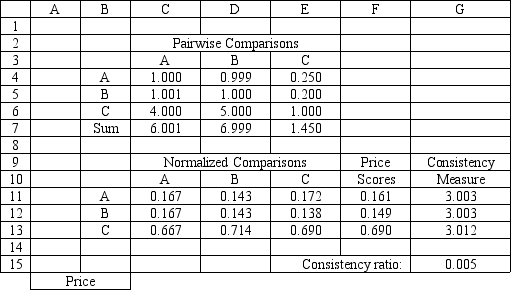
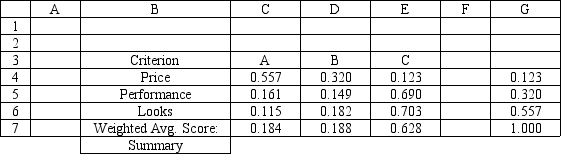 -Refer to Exhibit 14.13. Which car should the student choose based on the Summary worksheet?
 (Short Answer)
4.8/5 (79)
(79) 
Filters
- Essay(0)
- Multiple Choice(0)
- Short Answer(0)
- True False(0)
- Matching(0)