



 Chat with AI
Exam 8: Nonlinear Programming and Evolutionary Optimization

Exam 1: Introduction to Modeling and Decision Analysis52 Questions
Exam 2: Introduction to Optimization and Linear Programming62 Questions
Exam 3: Modeling and Solving Lp Problems in a Spreadsheet88 Questions
Exam 4: Sensitivity Analysis and the Simplex Method72 Questions
Exam 5: Network Modeling72 Questions
Exam 6: Integer Linear Programming72 Questions
Exam 7: Goal Programming and Multiple Objective Optimization59 Questions
Exam 8: Nonlinear Programming and Evolutionary Optimization68 Questions
Exam 9: Regression Analysis76 Questions
Exam 10: Discriminant Analysis57 Questions
Exam 11: Time Series Forecasting111 Questions
Exam 12: Introduction to Simulation Using Risk Solver Platform65 Questions
Exam 13: Queuing Theory79 Questions
Exam 14: Decision Analysis102 Questions
Exam 15: Project Management Online61 Questions
Select questions type


A company makes products A and B from 2 resources, labor and material. The company wants to determine the selling price which will maximize profits. A unit of A costs 30 to make and demand is estimated to be 50 .09 * Price of A. A unit of B costs 20 to make and demand is estimated to be 30 .14 * Price of B. The utilization of labor and materials and the available quantity of resources is shown in the table. A reasonable price for the products is between 90 and 140.
Product A B Available resources Labor (hr/unit) 2 4 150 Material (ounces/unit) 2 8 220 Manufacturing cost( \/ unit) 30 20 Demand (units) 50-0.09* 30-0.14*
Let X1 = demand for As and X2 = demand for Bs.
Let P1 = price for As and P2 = price for Bs.
Formulate the NLP for this company
(Essay)
4.9/5  (98)
(98) An office supply company is attempting to determine the order quantity for laser printer toner cartridges which are sold to local businesses. Annual demand is 20,000 units and each cartridge costs the store $25. It costs $30 to place an order and the inventory carrying cost rate is 25% of the value of the item. The following spreadsheet has been set up to solve the problem. What constraint would you impose on this problem to ensure that at least one order is placed per year? A 1 2 3 Annual Demand: 20,000 4 5 Cost per Unit: \ 25 6 Ordering Cost: \ 30 7 Carrying Cost: 25\% 8 9 Order Quantity: 483.73 10 11 Total Cost: \ 502,738.61
(Multiple Choice)
4.7/5 (79)
(79) A company has collected the following inventory data for an item. What is the total annual cost for this item? Annual demand for the item D=500 Unit purchase cost for the item C=10 Fixed cost of placing an order S=20 Cost of holding one unit in inventory for a year i=30\% Order quantity Q=50
(Multiple Choice)
4.8/5 (87)
(87) Exhibit 8.1
The following questions pertain to the problem and spreadsheet below.
A company makes products A and B from 2 resources, labor and material. The company wants to determine the selling price which will maximize profits. A unit of A costs 25 to make and demand is estimated to be 20 - .10 * Price of A. A unit of B costs 18 to make and demand is estimated to be 30 - .07 * Price of B. The utilization of labor and materials and the available quantity of resources is shown in the table. A reasonable price for the products is between 100 and 200.
Product A B Available resources Labor (hr/unit) 3 2 150 Material (ounces/unit) 1 2 200 Manufacturing cost (\ / unit) 25 18 Demand (units) 20-0.1 30-0.0
Let X1 = demand for As and X2 = demand for Bs.
Let P1 = price for As and P2 = price for Bs
A B C D E 1 2 3 Price 112.50 223.29 4 Marginal Cost 25.00 18.00 5 Profit Margin 87.50 205.29 6 7 Demand 8.75 14.37 8 9 Total Profit 3715.58 10 11 Constraints: Used Available 12 Labor 3.00 2.00 54.99 150.00 13 Material 1.00 2.00 37.49 200.00
-Refer to Exhibit 8.1. What formula is used in cell D12 of the spreadsheet for this problem?
(Multiple Choice)
4.8/5 (76)
(76) Calculate the annual inventory costs for the following data.
Order quantity =400 units Annual demand =12,500 units Unit purchase cost =50 Fixed cost of placing an order =75 Percentage cost of holding one unit in inventory for a year =20\%
(Short Answer)
4.9/5 (63)
(63) A company wants to locate a new warehouse to minimize the longest distance travelled by any of its delivery trucks. It has four stores and their coordinates are listed in the below.
X-Coordinate Y-Coordinate Store 1 70 160 Store 2 60 90 Store 3 180 90 Store 4 150 120
Formulate the NLP for this problem. Let X and Y represent the X, Y coordinates of the new warehouse.
(Essay)
4.9/5 (82)
(82) An investor wants to determine how much interest he must earn to be able to make the payments on a 10-year mortgage which has increasing annual payments. The problem is summarized in the accompanying spreadsheet. The investor has enough money to make an initial investment of $9,000 and hopes he can earn 12%, compounded quarterly, on his investments. He would like to know how low his annual return can be and still allow him to make his payments from interest income. What formula goes in cell C7 of the spreadsheet? 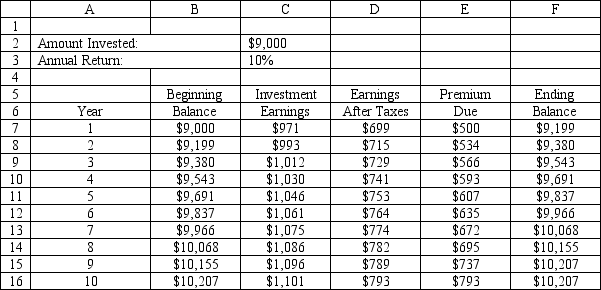
(Multiple Choice)
4.9/5 (86)
(86) How much are additional units of labor worth based on the following sensitivity report?
Final Reduced Cell Name Value Gradient \ B\ 4 Number to make: 4 0 \ \ 4 Number to make: 8.571 0
Final Lagrange Cell Name Value Multiplier \ \ 8 Wood 84 0.714 \ \ 9 Labor 4 3.714 \ \ 10 Hinges 8.571 0
(Short Answer)
4.8/5 (71)
(71) The optimal trade-off between risk and return for a given portfolio problem can be summarized by the
(Multiple Choice)
4.8/5 (101)
(101) The optimal solution to a LP problem is always at I.a cormer point.
II.an interior point
III. the origin
(Multiple Choice)
4.7/5 (82)
(82) What is the search path for the following feasible solution space? The dashed line represents the objective function and the objective is to maximize the value of the objective function. 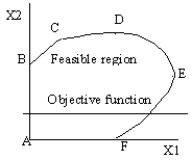
(Multiple Choice)
4.8/5 (68)
(68) Why does the GRG algorithm not provide allowable increase or allowable decrease information with the Reduced Gradient and Lagrange multiplier information?
(Multiple Choice)
4.8/5 (80)
(80) Exhibit 8.2
The following questions pertain to the problem and spreadsheet below.
A construction company just purchased a 300 x 300 foot lot upon which they plan to build an office building. They need at least 60,000 ft2 of office floor space. Zoning regulations require each floor be 10 feet high and the building not exceed 65 ft in height. Further, parking space must equal at least 30% of the total floor space available. The company's cost accountant uses a 60% factor of the building height and a 1% factor of any story's floor area to calculate the total building cost (in millions of dollars).
The following is the NLP formulation for the problem.
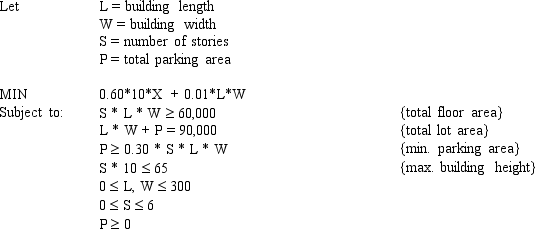 The spreadsheet implementation of this formulation applies to the following questions.
A B C D E 1 Length Width Stories Parking 2 108.39492 92.255243 6 80,000 3 Max Values 300 300 6 4 5 Total Floor Area 60,000 \geq 60,000 6 Total Lot Area 90,000 = 90,000 7 Min. Parking Area 65,000 \geq 0 8 Max. Bld Height 60 \leq 65 9 10 Cost 11 Height Factor 0.6 Total Height 60 12 Area Factor 0.01 Floor Area 10,000 13 Cost \ 136.0 millions \
-Refer to Exhibit 8.2. What formula would you place in cell B6 to calculate Total Lot Area?
The spreadsheet implementation of this formulation applies to the following questions.
A B C D E 1 Length Width Stories Parking 2 108.39492 92.255243 6 80,000 3 Max Values 300 300 6 4 5 Total Floor Area 60,000 \geq 60,000 6 Total Lot Area 90,000 = 90,000 7 Min. Parking Area 65,000 \geq 0 8 Max. Bld Height 60 \leq 65 9 10 Cost 11 Height Factor 0.6 Total Height 60 12 Area Factor 0.01 Floor Area 10,000 13 Cost \ 136.0 millions \
-Refer to Exhibit 8.2. What formula would you place in cell B6 to calculate Total Lot Area? (Short Answer)
4.7/5 (74)
(74) An office supply company is attempting to determine the order quantity for Mt. White fountain pens which are sold to local executives. Annual demand is 5,000 units and each pen costs the store $50. It costs $75 to place an order and the inventory carrying cost rate is 30% of the value of the item.
What values should go in cells B3:B11 of the spreadsheet for this problem if Q = 223.61?
A B 1 2 3 Annual Demand: 4 5 Cost per Unit: 6 Ordering Cost: 7 Carrying Cost: 8 9 Order Quantity: 10 11 Total Cost:
(Essay)
4.9/5 (79)
(79) The Lagrange Multiplier is similar to which of these terms from linear programming?
(Multiple Choice)
4.7/5 (69)
(69) Exhibit 8.2
The following questions pertain to the problem and spreadsheet below.
A construction company just purchased a 300 x 300 foot lot upon which they plan to build an office building. They need at least 60,000 ft2 of office floor space. Zoning regulations require each floor be 10 feet high and the building not exceed 65 ft in height. Further, parking space must equal at least 30% of the total floor space available. The company's cost accountant uses a 60% factor of the building height and a 1% factor of any story's floor area to calculate the total building cost (in millions of dollars).
The following is the NLP formulation for the problem.
The spreadsheet implementation of this formulation applies to the following questions.
A B C D E 1 Length Width Stories Parking 2 108.39492 92.255243 6 80,000 3 Max Values 300 300 6 4 5 Total Floor Area 60,000 \geq 60,000 6 Total Lot Area 90,000 = 90,000 7 Min. Parking Area 65,000 \geq 0 8 Max. Bld Height 60 \leq 65 9 10 Cost 11 Height Factor 0.6 Total Height 60 12 Area Factor 0.01 Floor Area 10,000 13 Cost \ 136.0 millions \
-Refer to Exhibit 8.2. What values would you enter in the Risk Solver Platform (RSP) task pane for the above Excel spreadsheet?
Objective Cell:
Variables Cells:
Constraints Cells:
The spreadsheet implementation of this formulation applies to the following questions.
A B C D E 1 Length Width Stories Parking 2 108.39492 92.255243 6 80,000 3 Max Values 300 300 6 4 5 Total Floor Area 60,000 \geq 60,000 6 Total Lot Area 90,000 = 90,000 7 Min. Parking Area 65,000 \geq 0 8 Max. Bld Height 60 \leq 65 9 10 Cost 11 Height Factor 0.6 Total Height 60 12 Area Factor 0.01 Floor Area 10,000 13 Cost \ 136.0 millions \
-Refer to Exhibit 8.2. What values would you enter in the Risk Solver Platform (RSP) task pane for the above Excel spreadsheet?
Objective Cell:
Variables Cells:
Constraints Cells: (Essay)
4.8/5 (71)
(71) The Risk Solver Platform (RSP) solution strategy for NLP problems is the GRG method. What does GRG stand for?
(Multiple Choice)
5.0/5 (86)
(86) 
Filters
- Essay(0)
- Multiple Choice(0)
- Short Answer(0)
- True False(0)
- Matching(0)