



 Chat with AI
Exam 5: Volcanoes and Volcanic Hazards

Exam 1: An Introduction to Geology42 Questions
Exam 2: Plate Tectonics: a Scientific Revolution Unfolds38 Questions
Exam 3: Matter and Minerals57 Questions
Exam 4: Igneous Rocks and Intrusive Activity45 Questions
Exam 5: Volcanoes and Volcanic Hazards57 Questions
Exam 6: Weathering and Soils41 Questions
Exam 7: Sedimentary Rocks49 Questions
Exam 8: Metamorphism and Metamorphic Rocks39 Questions
Exam 9: Earthquakes and Earths Interior42 Questions
Exam 10: Origin and Evolution of the Ocean Floor33 Questions
Exam 11: Crustal Deformation and Mountain Building32 Questions
Exam 12: Mass Wasting: the Work of Gravity38 Questions
Exam 13: Running Water48 Questions
Exam 14: Groundwater54 Questions
Exam 15: Glaciers and Glaciation59 Questions
Exam 16: Deserts and Wind40 Questions
Exam 17: Shorelines41 Questions
Exam 18: Geologic Time44 Questions
Exam 19: Earths Evolution Through Geologic Time68 Questions
Exam 20: Global Climate Change44 Questions
Select questions type


The Columbia Plateau in Washington and Oregon is __________.
(Multiple Choice)
4.9/5  (75)
(75) Use complete sentences, correct spelling, and the information presented in chapter 5 to answer the questions below.
-What is the name of the chain of volcanoes below that forms at an oceanic to continental plate boundary?
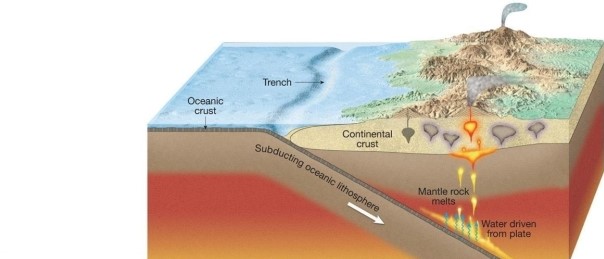
(Essay)
4.8/5 (75)
(75) Use complete sentences, correct spelling, and the information presented in chapter 5 to answer the questions below.
-What type of volcano is shown in the diagram below?
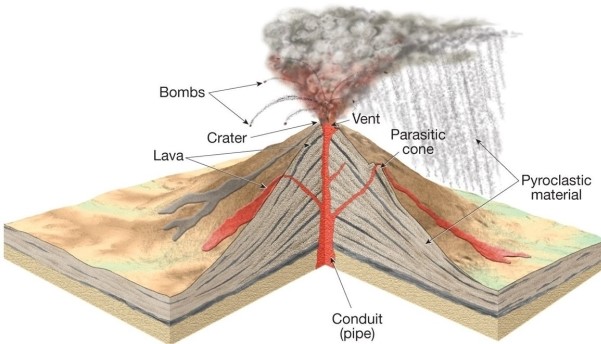
(Essay)
4.9/5 (83)
(83) Which was the most powerful, explosive volcanic eruption of historic time?
(Multiple Choice)
5.0/5 (84)
(84) A _________ volcano is a very large, gently sloping mound composed mainly of basaltic lava flows.
(Multiple Choice)
4.7/5 (69)
(69) ________is the most abundant gaseous component dissolved in most magmas.
(Essay)
4.8/5 (73)
(73) Pockets of magmas can be formed by the melting of deep continental crust heated by the intrusion of other magmas. Which of the following correctly describes this process?
(Multiple Choice)
4.9/5 (78)
(78) ________magma is the most abundant type of erupted at oceanic spreading centers.
(Multiple Choice)
4.7/5 (79)
(79) Which of the following best describes Shiprock, a famous volcanic feature in New Mexico?
(Multiple Choice)
4.8/5 (68)
(68) Use complete sentences, correct spelling, and the information presented in chapter 5 to answer the questions below.
-What type of volcano is shown in the diagram below?
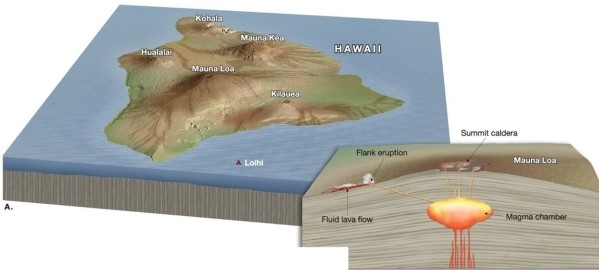
(Essay)
4.7/5 (76)
(76) Which of the following is associated with deep mantle hot spots?
(Multiple Choice)
4.9/5 (83)
(83) ________are usually the most abundant gases emitted during basaltic volcanism.
(Multiple Choice)
4.8/5 (77)
(77) In 1980, ________was the first Cascade Range volcano to erupt since Mt. Lassen, California, in 1915- 16.
(Multiple Choice)
4.8/5 (88)
(88) Which kind of volcanism is typical of mid- oceanic ridge systems?
(Multiple Choice)
4.8/5 (81)
(81) Why would a plume of solid silicate rock rising slowly from deep in the mantle begin melting as it neared the base of the lithosphere?
(Multiple Choice)
4.8/5 (90)
(90) Which region has the greatest concentration of currently active volcanoes?
(Multiple Choice)
4.9/5 (72)
(72) Which kind of eruptive activity is most likely to be highly explosive?
(Multiple Choice)
4.8/5 (80)
(80) Which one of the following statements concerning cinder cones is FALSE?
(Multiple Choice)
4.9/5 (85)
(85) The average composition of rocks comprising a large composite cone or stratovolcano is similar to a(n)________magma.
(Multiple Choice)
4.8/5 (87)
(87) 
Filters
- Essay(0)
- Multiple Choice(0)
- Short Answer(0)
- True False(0)
- Matching(0)