



 Chat with AI
Exam 12: Cognitive Control

Exam 1: A Brief History of Cognitive Neuroscience64 Questions
Exam 2: Structure and Function of the Nervous System98 Questions
Exam 3: Methods of Cognitive Neuroscience65 Questions
Exam 4: Hemispheric Specialization66 Questions
Exam 5: Sensation and Perception65 Questions
Exam 6: Object Recognition65 Questions
Exam 7: Attention64 Questions
Exam 8: Action67 Questions
Exam 9: Memory68 Questions
Exam 10: Emotion64 Questions
Exam 11: Language66 Questions
Exam 12: Cognitive Control66 Questions
Exam 13: Social Cognition64 Questions
Exam 14: Consciousness, Free Will, and the Law65 Questions
Select questions type


Which patient group is most likely to be impaired on a task in which one must decide which of two pictures was seen most recently?
(Multiple Choice)
5.0/5  (81)
(81) Although the prefrontal cortex is not essential for working memory, it is particularly important for the storage of associative knowledge.
(True/False)
4.9/5 (68)
(68) A monkey that has previously received a lesion in the lateral prefrontal cortex is shown two food wells, each of which is covered by a marked stimulus card: 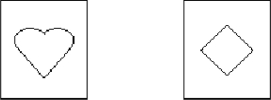 As the monkey watches, a food reward is placed into the left well and then both wells are covered. If the monkey is now allowed to retrieve the food reward immediately, it will
 (Multiple Choice)
4.7/5 (76)
(76) Appropriate goal-oriented behavior is typically described as stimulus-driven.
(True/False)
4.9/5 (89)
(89) In the task-switching experiment between a digit task and a letter task, a digit or letter response was indicated by a word or by a color. Which of these conditions was particularly problematic when switching between digits and letters for frontal lobe patients?
(Multiple Choice)
4.8/5 (80)
(80) Which of the following situations would be most likely to engage the anterior cingulate cortex?
(Multiple Choice)
4.8/5 (60)
(60) Neuroimaging experiments have demonstrated that working memory engages the
(Multiple Choice)
4.8/5 (63)
(63) Is there more than one decision system? Provide evidence to support your view
(Not Answered)
This question doesn't have any answer yet
A person who has difficulty with "recency memory" tasks would have the most difficulty with which of the following?
(Multiple Choice)
4.8/5 (83)
(83) The error-related negativity ERN) has been localized to the anterior cingulate cortex.
(True/False)
4.9/5 (84)
(84) Describe the supervisory attentional system. What brain area is thought to be involved? Describe neuroimaging studies that support your view.
(Essay)
4.9/5 (73)
(73) John is unable to carry on the most rudimentary conversations. Whenever someone changes the subject he persists on the same topic for several minutes. Eventually, people simply leave him alone talking to himself. John has
(Multiple Choice)
4.9/5 (87)
(87) You are driving in a car. Which of the following stops will require the most working memory?
(Multiple Choice)
5.0/5 (69)
(69) Which of the following is NOT a gradient along which the prefrontal cortex is organized?
(Multiple Choice)
4.8/5 (73)
(73) The information that you are currently thinking about, perceiving, or using to guide responding is held in this type of memory store.
(Multiple Choice)
4.8/5 (83)
(83) Prediction error is NOT correlated with which of the following:
(Multiple Choice)
4.9/5 (85)
(85) A monkey is taught that food is associated with a stimulus card that has a star on it. After training, the animal receives a lesion to the lateral prefrontal cortex. The monkey's memory for the food-stimulus card association is then tested by presenting the animal with the two stimulus cards diagrammed here. How will the monkey now respond? 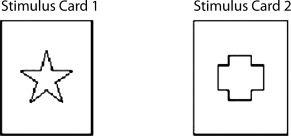
(Multiple Choice)
4.9/5 (79)
(79) Thompson-Schill and colleagues 1997, 1998) conducted an experiment in which participants generated an appropriate verb in response to a presented noun. They found that the processing of nouns such as rope, which have many semantically associated verbs, elicited activity in the inferior frontal cortex than did nouns such as scissors, which do not. This result supports the hypothesis of inferior frontal lobe function.
(Multiple Choice)
5.0/5 (87)
(87) theories describe what people ought to do whereas theories describe what people actually do.
(Multiple Choice)
4.8/5 (77)
(77) In a delayed response task, participants were asked to look at faces or scenes or engage in passive viewing. Which of the following results distinguished older adults from young adults when viewing faces relative to passive viewing?
(Multiple Choice)
4.7/5 (80)
(80) 
Filters
- Essay(0)
- Multiple Choice(0)
- Short Answer(0)
- True False(0)
- Matching(0)