



 Chat with AI
Exam 11: Service Department and Joint Cost Allocation

Exam 1: Cost Accounting: Information for Decision Making145 Questions
Exam 2: Cost Concepts and Behavior153 Questions
Exam 3: Fundamentals of Cost-Volume-Profit Analysis161 Questions
Exam 4: Fundamentals of Cost Analysis for Decision Making150 Questions
Exam 5: Cost Estimation131 Questions
Exam 6: Fundamentals of Product and Service Costing150 Questions
Exam 7: Job Costing159 Questions
Exam 8: Process Costing153 Questions
Exam 9: Activity-Based Costing153 Questions
Exam 10: Fundamentals of Cost Management144 Questions
Exam 11: Service Department and Joint Cost Allocation152 Questions
Exam 12: Fundamentals of Management Control Systems160 Questions
Exam 13: Planning and Budgeting157 Questions
Exam 14: Business Unit Performance Measurement147 Questions
Exam 15: Transfer Pricing147 Questions
Exam 16: Fundamentals of Variance Analysis156 Questions
Exam 17: Additional Topics in Variance Analysis138 Questions
Exam 18: Performance Measurement to Support Business Strategy148 Questions
Select questions type


Advanced Computer Solutions, Inc. has two main services: (1) time on a timeshared computer system and (2) proprietary computer programs. The operation department (Op) provides computer time and the programming department (P) writes programs.
The percentage of each service used by each department for a typical period is:
Supplied User Op P Op --- 40\% P 30\% --- Sold to customers 70\% 60\%
In a typical period, the operation department (Op) spends $4,500 and the programming department (P) spends $2,500.
-
Under the step method (Op first), what is the cost of the computer time and the computer programs for sale?
Time Programs
A. \ 4,500 \ 2,500
B. \ 3,150 \ 3,850
C. \ 1,350 \ 5,650
D. \ 2,700 \ 4,300
(Multiple Choice)
4.8/5  (83)
(83) Dreamland University has 20 departments. Two of its best departments are the (1) College of Innovation (COI) and (2) Testing Services. The College of Innovation (COI) attempts to teach students the difficult, but useful, skill of innovation. Testing Services grades examinations for professors. How would these two departments be classified?
College of Innuvatimn Testing Services
A) Service Service
B) User Service
C) User User
D) Service User
(Multiple Choice)
4.9/5 (93)
(93) In joint product costing and analysis, which one of the following costs is relevant when deciding the point at which a product should be sold in order to maximize profits? (CMA adapted)
(Multiple Choice)
4.8/5 (68)
(68) The estimated net realizable value at the split-off point is calculated by taking the sales value after further processing and deducting the additional processing costs.
(True/False)
4.8/5 (73)
(73) Explain the difference between the net realizable value method for joint cost allocation and the netback (or workback) method.
(Essay)
4.8/5 (87)
(87) In a sell-or-process-further decision, the additional costs incurred after the split-off point are irrelevant.
(True/False)
4.9/5 (85)
(85) The Mallak Company produced three joint products at a joint cost of $100,000. Two of these products were processed further. Production and sales were:
Additional Processing Product Weight Sales Costs P 300,000 \ 245,000 \ 200,000 Q 100,000 30,000 -0- R 100,000 175,000 100,000
-
If the estimated net realizable value method is used and product Q is accounted for as a main product, how much of the joint costs would be allocated to product R?
(Multiple Choice)
4.9/5 (90)
(90) Which of the following is not a reason to justify the allocation of support services?
(Multiple Choice)
4.8/5 (82)
(82) One advantage of the step method is that all reciprocal services are recognized between service departments.
(True/False)
4.8/5 (84)
(84) A management purpose for allocating joint costs of a processing center to the various products produced is to:
(Multiple Choice)
4.8/5 (81)
(81) In a sell-or-process-further decision, the common costs incurred prior to the spilt-off point are irrelevant.
(True/False)
4.8/5 (77)
(77) Product C is one of several joint products that come out of Department M. The joint costs incurred in Department M total $40,000. Product C can be sold at split-off or processed further and sold as a higher quality item. The decision to process further should be based on the:
(Multiple Choice)
4.7/5 (86)
(86) Joint costs are processing costs incurred after the split-off point in a common production process.
(True/False)
4.9/5 (67)
(67) Which of the following statements is(are) false regarding the direct method of allocating service department costs?
(A) The selection of an allocation base in the direct method is easier than the selection of an allocation base in the step method.
(B) Once an allocation is made from a service department using the direct method, no further allocations are made back to that department.
(Multiple Choice)
4.9/5 (78)
(78) Yellville Regional Hospital is a small hospital with two service departments and three revenue areas:
Service Department Direct Costs Square Feet Laundry Pounds Housekeeping (HK) \ 80,000 - 16,000 Laundry \ 132,000 500 Revenue Areas: Surgery \ 400,000 1,500 48,000 Semiprivate Rooms \ 200,000 2,000 24,000 Maternity \ 150,000 1,000 12,000
The hospital wants to allocate the service department costs to the revenue areas. Housekeeping is allocated based on square footage; Laundry is allocated based on pounds of laundry. The normal capacity for Surgery is 200 hours per month; normal capacity for semiprivate rooms is 600 patient days; and normal capacity for maternity is 200 patient days.
Required:
Determine the overhead rate for the three revenue areas. Allocate the service department costs to the revenue areas using the reciprocal method.
(Essay)
4.8/5 (82)
(82) Ridgeline Enterprises produces three products in a joint process. Products A and B are processed further. Additional information is as follows:
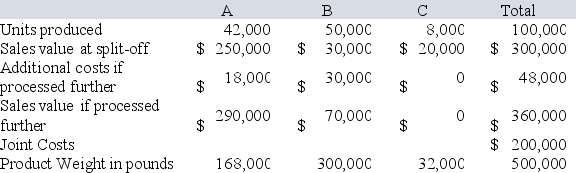 Required:
(a) Allocate the joint costs, assuming that all products are joint products and joint-costs are allocated using the physical quantities method.
(b) Allocate the joint costs using the physical quantities method, assuming that product C is considered a by-product, whose sales value is deducted from the total joint costs.
Required:
(a) Allocate the joint costs, assuming that all products are joint products and joint-costs are allocated using the physical quantities method.
(b) Allocate the joint costs using the physical quantities method, assuming that product C is considered a by-product, whose sales value is deducted from the total joint costs. (Essay)
4.9/5 (68)
(68) The following is a system of simultaneous linear equations to allocate costs using the reciprocal method. Matrix algebra is not required.
The following costs were incurred in three operating departments and three service departments in Westmoreland Company.
DepartMent Direct Costs Label Subassemblies 550,000 P1 Final assembly 775,000 P2 Marketing 285,000 P3 Building occupancy 85,000 S 1 Research \& development 120,000 S 2 Supervision 45,000 S 3
Use of services by other departments is as follows.
 -
The equation for department P1 (subassemblies) is:
-
The equation for department P1 (subassemblies) is: (Multiple Choice)
4.9/5 (73)
(73) The direct method makes no cost allocations between or among service departments.
(True/False)
4.9/5 (87)
(87) Which of the following is not a step needed to maximize the profits from joint products?
(Multiple Choice)
4.8/5 (69)
(69) 
Filters
- Essay(0)
- Multiple Choice(0)
- Short Answer(0)
- True False(0)
- Matching(0)