



 Chat with AI
Exam 13: Planning and Budgeting

Exam 1: Cost Accounting: Information for Decision Making145 Questions
Exam 2: Cost Concepts and Behavior153 Questions
Exam 3: Fundamentals of Cost-Volume-Profit Analysis161 Questions
Exam 4: Fundamentals of Cost Analysis for Decision Making150 Questions
Exam 5: Cost Estimation131 Questions
Exam 6: Fundamentals of Product and Service Costing150 Questions
Exam 7: Job Costing159 Questions
Exam 8: Process Costing153 Questions
Exam 9: Activity-Based Costing153 Questions
Exam 10: Fundamentals of Cost Management144 Questions
Exam 11: Service Department and Joint Cost Allocation152 Questions
Exam 12: Fundamentals of Management Control Systems160 Questions
Exam 13: Planning and Budgeting157 Questions
Exam 14: Business Unit Performance Measurement147 Questions
Exam 15: Transfer Pricing147 Questions
Exam 16: Fundamentals of Variance Analysis156 Questions
Exam 17: Additional Topics in Variance Analysis138 Questions
Exam 18: Performance Measurement to Support Business Strategy148 Questions
Select questions type


Templeton Enterprises expects the following unit sales over the next few months:
Month Urit Sales June 100,000 July 120,000 August 135,000 September 150,000 October 140,000 November 125,000
Templeton's goal is to maintain an inventory equal to a 6-day supply. May 31 inventory is projected to be 18,000 units.
Required:
Prepare a purchases budget (in units) for Templeton for as many months as is possible based on data provided. Assume a 30-day month
(Essay)
4.9/5  (80)
(80) Which of the following terms is not an alternative for a master budget?
(Multiple Choice)
4.8/5 (96)
(96) The following budgeted information is provided:
Month 1 2 3 Sales in units 15,000 20,000 18,000 Production in units 16,000 22,000 15,000
One pound of materials is required for each finished unit. The inventory of materials at the end of each month should equal 20% of the following month's production needs. At the beginning of Month 1, there were 3,200 lbs. of materials on hand. Purchases of raw materials for Month 1 would be (in pounds):
(Multiple Choice)
4.8/5 (82)
(82) A master budget consists of (a) organizational goals, (b) strategic long-range profit plan, and (c) tactical short-range profit plan.
(True/False)
4.7/5 (76)
(76) Jackson Company has developed the following sales projections for the calendar year:
May \ 100,000 June 120,000 July 140,000 August 160,000 September 150,000 October 130,000
Normal cash collection experience has been that 50% of sales is collected during the month of sale and 45% in the month following the sale. The remaining 5% of sales are never collected. Jackson's budgeted cash collections for the third calendar quarter are: (CMA adapted)
(Multiple Choice)
4.9/5 (76)
(76) Kevin Montgomery Retail seeks your assistance to develop cash and other budget information for May, June, and July. At April 30, the company had cash of $5,500, accounts receivable of $437,000, inventories of $446,250, and accounts payable of $133,055. The budget is to be based on the following assumptions:
SALES:
Each month's sales are billed on the last day of the month. Customers are allowed a 3% discount if payment is made within 10 days after the billing date. Receivables are recorded in the accounts at their gross amounts (not net of discounts). 55% of the billings are collected within the discount period; 30% are collected by the end of the month; 9% are collected by the end of the second month; and 6% turn out to be uncollectible.
PURCHASES:
The marketing, general, and administrative expenses and 60% of all purchases of merchandise are paid in the month purchased, with the remainder of merchandise purchases paid in the following month. The number of units in each month's ending inventory is equal to 125% of the next month's units of sales. The cost of each unit of inventory is $30. Marketing, general, and administrative expenses, of which $3,000 is depreciation, are equal to 15% of the current month's sales.
Actual and projected sales are as shown below:
Dollars Units March \ 472,000 11,800 April \ 484,000 12,100 May \ 476,000 11,900 June \ 456,000 11,400 July \ 480,000 12,000 August \ 480,000 12,200
-
What are the budgeted number of inventory units that need to be purchased in July?
(Multiple Choice)
4.9/5 (80)
(80) Rocket Plating Company plans to sell 120,000 units of a certain product line at a price of $6 per unit. There are 10,000 units of the product in inventory at January 1 and the inventory is to be increased 20% during the year.
Two types of materials are used to make the product. Four units of Material A, costing 30 cents each, are required for each unit of product, and two units of Material B, costing 40 cents each, are required for each unit of product. On January 1, there are 10,000 units of Material A in inventory and 5,000 units of Material B. Plans for the year indicate that 12,000 units of Material A and 6,000 units of Material B are to be in the inventory on December 31.
Each unit of product can be produced in 15 minutes of direct labor time. Direct labor is paid at the rate of $8.00 an hour. The variable manufacturing overhead rate is $0.50 per direct labor hour and the fixed manufacturing overhead for the year is estimated at $140,000.
Required:
a. Prepare a production budget for the year.
b. Prepare a direct materials budget for the year.
c. Prepare a direct labor budget for the year.
d. Prepare a budget for manufacturing overhead for the year.
(Essay)
4.8/5 (75)
(75) The following data have been taken from the budget reports of Kenyon Company, a merchandising company.
Purchases Sales January \ 160,000 \ 100,000 February \ 160,000 \ 200,000 March \ 160,000 \ 240,000 April \ 140,000 \ 300,000 May \ 140,000 \ 260,000 June \ 120,000 \ 240,000
Forty percent of purchases are paid for in cash at the time of purchase, and 30% are paid for in each of the next two months. Purchases for the previous November and December were $150,000 per month. Employee wages are 10% of sales for the month in which the sales occur. Marketing and administrative expenses are 20% of the following month's sales. (July sales are budgeted to be $220,000.) Interest payments of $20,000 are paid quarterly in January and April. Kenyon's cash disbursements for the month of April would be: (CMA adapted)
(Multiple Choice)
4.8/5 (82)
(82) Dalley Inc. has the following information for its first year of operations:
Revenues (200,000 units) \2 ,900,000 Manufacturing costs: Materials \ 168,000 Variable cash costs 142,400 Fixed cash costs 327,600 Depreciation (fixed) 999,000 Marketing \& administrative costs: Marketing (variable) 422,400 Marketing depreciation 149,600 Administrative (fixed) 509,200 Administrative depreciation 74,800 Total costs \ 2,793,000 Operating profits \ 107,000
All depreciation charges are fixed and are expected to remain the same for year 2. Sales volume is expected to increase by 15%, but sales prices are expected to fall by 4%. Material costs per unit are expected to decrease by 6%. Other unit variable manufacturing costs are expected to decrease by 2.5% per unit. Fixed manufacturing costs (other than depreciation) are expected to increase by 6%.
Variable marketing costs per unit will remain constant. Administrative costs (other than depreciation) are expected to increase by 10%.
Assume there are no inventories. Dalley operates on a cash basis.
Required:
Prepare a budgeted income statement for year 2.
(Essay)
4.7/5 (77)
(77) Falcon Enterprises expects the following unit sales over the next five months:
Month Unit Sales April 400,000 May 480,000 June 540,000 July 600,000 August 560,000
Falcon's goal is to maintain an inventory equal to 20% of next month's sales requirements. March 31 inventory is projected to be 70,000 units.
Required:
Prepare a purchases budget (in units) for Falcon for as many months as is possible based on data provided. Assume a 30-day month.
(Essay)
4.9/5 (77)
(77) Kevin Montgomery Retail seeks your assistance to develop cash and other budget information for May, June, and July. At April 30, the company had cash of $5,500, accounts receivable of $437,000, inventories of $446,250, and accounts payable of $133,055. The budget is to be based on the following assumptions:
SALES:
Each month's sales are billed on the last day of the month. Customers are allowed a 3% discount if payment is made within 10 days after the billing date. Receivables are recorded in the accounts at their gross amounts (not net of discounts). 55% of the billings are collected within the discount period; 30% are collected by the end of the month; 9% are collected by the end of the second month; and 6% turn out to be uncollectible.
PURCHASES:
The marketing, general, and administrative expenses and 60% of all purchases of merchandise are paid in the month purchased, with the remainder of merchandise purchases paid in the following month. The number of units in each month's ending inventory is equal to 125% of the next month's sales (units). The cost of each unit of inventory is $30. Marketing, general, and administrative expenses, of which $3,000 is depreciation, are equal to 15% of the current month's sales.
Actual and projected sales are as shown below:
Dollars Units March \ 472,000 11,800 April \ 484,000 12,100 May \ 476,000 11,900 June \ 456,000 11,400 July \ 480,000 12,000 August \ 480,000 12,200
-
What are the budgeted merchandise purchases (in dollars) for June?
(Multiple Choice)
4.8/5 (84)
(84) The Delphi technique uses highly sophisticated computerized time series analysis to reduce the subjectivity surrounding the sales forecast.
(True/False)
4.7/5 (94)
(94) Washington Gas Corporation supplies acetylene and other compressed gases to industry. Data regarding the store's operations follow:
? Sales are budgeted at $320,000 for November, $340,000 for December, and $330,000 for January.
? Collections are expected to be 75% in the month of sale, 20% in the month following the sale, and 5% uncollectible.
? The cost of goods sold is 65% of sales.
? The company purchases 80% of its merchandise in the month prior to the month of sale and 20% in the month of sale. Payment for merchandise is made in the month following the purchase.
? Other monthly expenses to be paid in cash are $21,000.
? Monthly depreciation is $16,000.
? Ignore taxes.
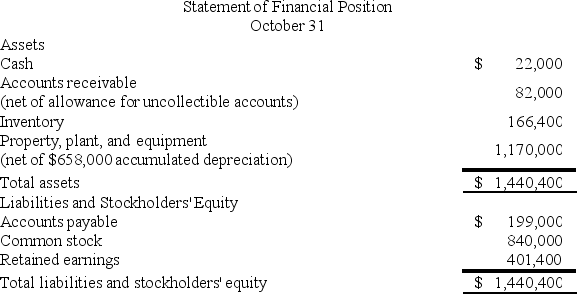 Required:
a. Prepare a Schedule of Expected Cash Collections for November and December.
b. Prepare a Merchandise Purchases Budget for November and December.
c. Prepare Cash Budgets for November and December.
d. Prepare Budgeted Income Statements for November and December.
e. Prepare a Budgeted Balance Sheet for the end of December.
Required:
a. Prepare a Schedule of Expected Cash Collections for November and December.
b. Prepare a Merchandise Purchases Budget for November and December.
c. Prepare Cash Budgets for November and December.
d. Prepare Budgeted Income Statements for November and December.
e. Prepare a Budgeted Balance Sheet for the end of December. (Essay)
4.7/5 (73)
(73) The use of sensitivity analysis techniques allows managers to ask "what-if" questions regarding budget assumptions and estimates.
(True/False)
4.8/5 (78)
(78) Krier Industries has just completed its sales forecasts and its marketing department estimates that the company will sell 36,000 units during the upcoming year. In the past, management has maintained inventories of finished goods at approximately three months' sales. However, the estimated inventory at the start of the year of the budget period is only 6,000 units. Sales occur evenly throughout the year. What is the estimated production level (units) for the first month of the upcoming budget year?
(Multiple Choice)
4.8/5 (73)
(73) The Tori Company had budgeted production for the year as follows:
Quarter 1 2 3 4 Production in units 10,000 12,000 16,000 14,000
Four pounds of raw materials are required for each unit produced. Raw materials on hand at the start of the year total 4,000 lbs. The raw materials inventory at the end of each quarter should equal 10% of the next quarter's production needs in materials. Budgeted purchases of raw materials in the third quarter would be:
(Multiple Choice)
4.7/5 (72)
(72) 
Filters
- Essay(0)
- Multiple Choice(0)
- Short Answer(0)
- True False(0)
- Matching(0)